Why Some Doctors Love to Push FUT Hair Transplants
Introduction
If you’ve been researching hair transplants, you may have noticed that some clinics strongly recommend FUT (Follicular Unit Transplantation)—also known as the strip method—even though modern techniques like FUE and No-Shave FUE are widely available.
This raises an important question for patients:
Why do some doctors continue to push FUT so heavily?
While FUT can still be appropriate in select cases, there are practical reasons—beyond patient outcomes—why some physicians prefer it. Understanding these reasons can help you make a more informed decision.
What Is FUT (Strip Hair Transplant Surgery)?
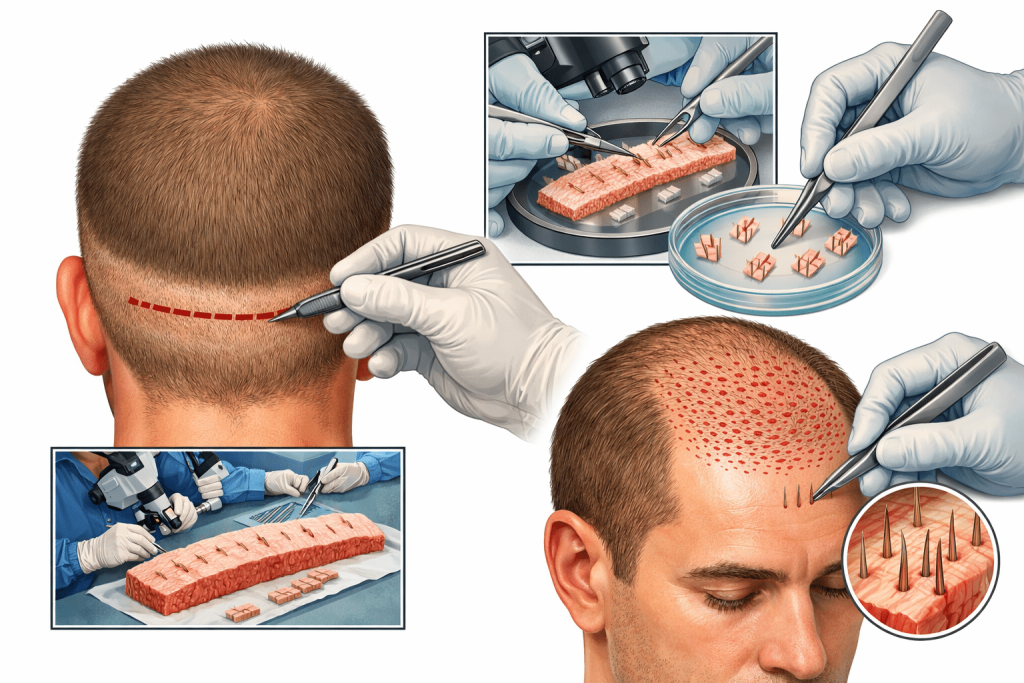
FUT involves surgically removing a strip of scalp from the donor area, usually the back of the head. The strip is then dissected into individual follicular units and transplanted into thinning or balding areas.
This technique predates FUE and was once considered the standard approach to hair restoration.
1. FUT Requires Less Hands-On Work From the Doctor
One of the biggest, yet rarely discussed, reasons some doctors favor FUT is that it often involves less continuous, hands-on work for the physician.
With FUT:
The doctor removes a single strip of scalp
Much of the graft dissection is delegated to technicians
The physician’s active involvement can be shorter and less physically demanding
2. FUT Is Faster and More Predictable for High-Volume Clinics
FUT allows clinics to:
Harvest a large number of grafts quickly
Maintain a predictable workflow
Schedule multiple surgeries efficiently
For clinics operating on a high-volume model, FUT can be easier to manage than FUE, which requires more time, planning, and individualized execution.
3. FUT Demands Less Advanced Technical Skill Than FUE
FUE is technically demanding and requires:
Specialized training
Excellent hand-eye coordination
Experience managing donor areas safely
Not all doctors invest the time or technology needed to master FUE. As a result, some continue to recommend FUT because it aligns with their training and comfort level, not necessarily because it’s the best option for every patient.
This makes FUT a more economical option for clinics, which can influence how strongly it is promoted.
5. Linear Scarring Is Often Downplayed
A major drawback of FUT is the permanent linear scar it leaves behind.
Some doctors minimize this by saying:
“The scar will be very thin”
“It’s easy to hide with hair”
However, patients who prefer short hairstyles, active lifestyles, or flexibility for future procedures should understand that FUT scarring is permanent and cumulative.
6. FUT Can Limit Long-Term Donor Management
Because FUT removes an entire strip of scalp:
Donor elasticity may decrease
Future FUE procedures can become more difficult
Scalp tightness may develop over time
Modern hair restoration emphasizes long-term planning, donor preservation, and flexibility—areas where FUE generally excels.
When FUT May Still Be a Reasonable Option
FUT is not inherently wrong or unsafe. It may be appropriate when:
Who performs the extractions—the doctor or technicians?
What are my long-term options?
Can I see both FUT and FUE results?
A patient-focused practice will explain all suitable options, not steer you toward the one that is easiest for the clinic.
Final Thoughts
Some doctors continue to push FUT because it is faster, less physically demanding, less expensive to perform, and aligns with older training models. While FUT still has a place in select cases, modern hair restoration has evolved.
Patients deserve recommendations based on their goals, lifestyle, and long-term outcomes—not a procedure that requires less work for the clinic.
Interested in learning more?Contact Us or call Hair 4 Life at (480) 525-4547 to schedule an appointment.

https://hairforlifeaz.com/wp-content/uploads/2026/01/FUT.png10241536Ioan A Kelemenhttps://hairforlifeaz.com/wp-content/uploads/2024/02/Hair-for-Life-Medical-Logo-web.pngIoan A Kelemen2026-01-25 11:03:392026-04-26 20:54:15Why Some Doctors Love to Push FUT Hair Transplants
ID used to identify users for 24 hours after last activity
24 hours
_gat
Used to monitor number of Google Analytics server requests when using Google Tag Manager
1 minute
_gac_
Contains information related to marketing campaigns of the user. These are shared with Google AdWords / Google Ads when the Google Ads and Google Analytics accounts are linked together.
90 days
__utma
ID used to identify users and sessions
2 years after last activity
__utmt
Used to monitor number of Google Analytics server requests
10 minutes
__utmb
Used to distinguish new sessions and visits. This cookie is set when the GA.js javascript library is loaded and there is no existing __utmb cookie. The cookie is updated every time data is sent to the Google Analytics server.
30 minutes after last activity
__utmc
Used only with old Urchin versions of Google Analytics and not with GA.js. Was used to distinguish between new sessions and visits at the end of a session.
End of session (browser)
__utmz
Contains information about the traffic source or campaign that directed user to the website. The cookie is set when the GA.js javascript is loaded and updated when data is sent to the Google Anaytics server
6 months after last activity
__utmv
Contains custom information set by the web developer via the _setCustomVar method in Google Analytics. This cookie is updated every time new data is sent to the Google Analytics server.
2 years after last activity
__utmx
Used to determine whether a user is included in an A / B or Multivariate test.
18 months
_ga
ID used to identify users
2 years
_gali
Used by Google Analytics to determine which links on a page are being clicked
30 seconds
_ga_
ID used to identify users
2 years
Clarity is a web analytics service that tracks and reports website traffic.
Registers a unique ID on mobile devices to enable tracking based on geographical GPS location.
1 day
VISITOR_INFO1_LIVE
Tries to estimate the users' bandwidth on pages with integrated YouTube videos. Also used for marketing
179 days
PREF
This cookie stores your preferences and other information, in particular preferred language, how many search results you wish to be shown on your page, and whether or not you wish to have Google’s SafeSearch filter turned on.
10 years from set/ update
YSC
Registers a unique ID to keep statistics of what videos from YouTube the user has seen.
Session
DEVICE_INFO
Used to detect if the visitor has accepted the marketing category in the cookie banner. This cookie is necessary for GDPR-compliance of the website.
179 days
LOGIN_INFO
This cookie is used to play YouTube videos embedded on the website.