
If you have been comparing dhi vs fue transplant options, you have probably already seen confident claims on both sides. One clinic says DHI is more advanced. Another says FUE does the same thing for less. The truth is more precise than either marketing message. These techniques overlap, but they are not identical, and the right choice depends on your hair loss pattern, donor supply, styling goals, and who is actually performing the procedure.
For many patients, the biggest mistake is treating DHI and FUE as if they are competing brands. In practice, FUE usually describes how grafts are harvested from the donor area, while DHI refers more specifically to how grafts are implanted into the recipient area. That distinction matters because it changes how you should evaluate your options.
DHI vs FUE transplant: the real difference
FUE stands for Follicular Unit Extraction. In an FUE procedure, individual follicular units are removed one by one from the donor area, usually the back and sides of the scalp. Those grafts are then prepared and implanted into thinning or balding areas.
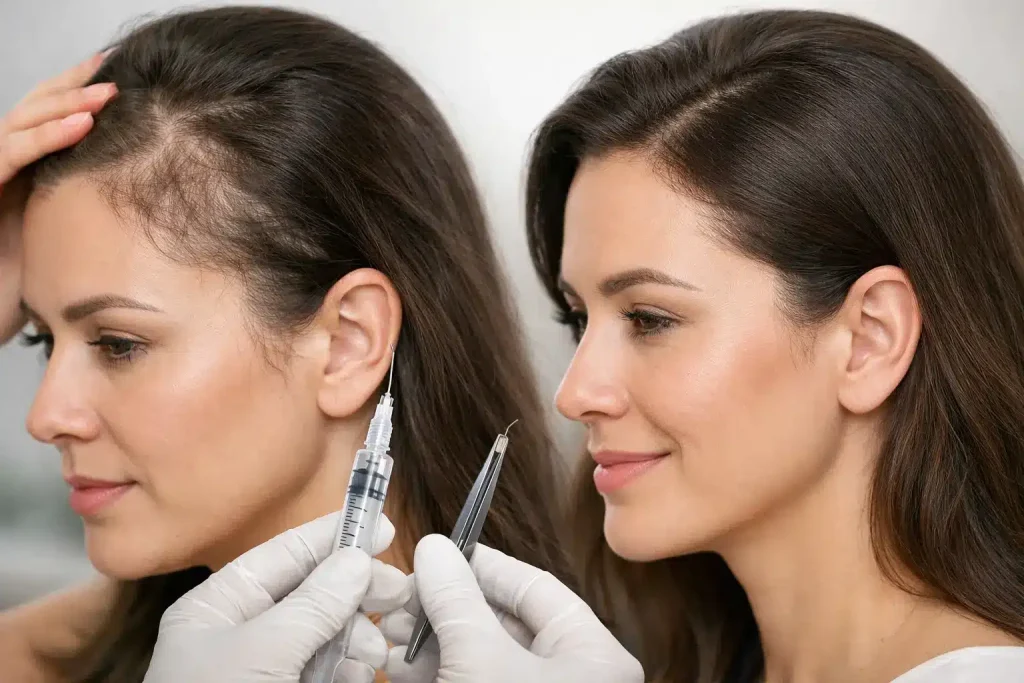
DHI stands for Direct Hair Implantation. In most cases, DHI still uses FUE harvesting. The difference is in the placement phase. Instead of making all recipient sites first and then placing grafts with forceps, the surgeon implants follicles using a specialized implanter pen that creates the site and places the graft in one motion.
So when patients ask about dhi vs fue transplant, the comparison is not perfectly apples to apples. A more accurate question is often standard FUE implantation versus DHI implantation after FUE harvesting. That is why a proper consultation should focus less on labels and more on technique, surgeon control, and expected outcome.
How the procedures differ during surgery
In a conventional FUE case, the surgeon extracts grafts, then creates recipient sites based on the planned hairline, angle, direction, and density. After that, grafts are inserted into those sites. This approach gives the doctor clear control over design and often works very well for large sessions.
In DHI, the graft is loaded into an implanter pen and placed directly into the scalp. This can allow highly controlled placement in select cases, especially when working between existing hairs or refining smaller zones such as the hairline, eyebrows, or beard. It may also reduce the time a graft spends outside the body, depending on how the team is organized.
That said, DHI is not automatically superior because it uses a pen. The final result still depends on graft handling, depth control, angle, spacing, and the experience of the physician. A poorly performed DHI case can look unnatural. A carefully performed FUE case can look exceptionally soft and dense.
Does DHI give better density than FUE?
This is one of the most common assumptions, and it is only partly true. DHI can be helpful when a surgeon wants precise placement in areas that still contain native hair. Because the implanter pen allows controlled insertion, it may lower the risk of unnecessary trauma in certain patients with diffuse thinning or those who want to preserve existing density while adding more coverage.
But density is not created by the tool alone. It depends on donor quality, graft caliber, the number of usable follicular units, scalp characteristics, blood supply, and a realistic plan. If a patient has limited donor hair, no implantation method can create unlimited fullness. If a hairline is designed too aggressively, even a technically good procedure may age poorly.
This is where physician judgment matters more than marketing. High density is only a benefit if it remains natural and sustainable over time.
Healing, shaving, and recovery
Patients often ask whether DHI heals faster. In some cases, DHI can lead to less trauma in the recipient area because implantation is highly controlled. However, recovery differences between DHI and standard FUE are often smaller than people expect. Most patients in either category will have short-term redness, scabbing, and a shedding phase before regrowth begins.
Shaving is another area where the answer depends. Both DHI and FUE can sometimes be adapted for partial-shave, no-shave, or long-hair approaches, but not every patient is a candidate. If discretion matters because of work, social visibility, or personal preference, the discussion should center on your lifestyle and the surgeon’s experience with these modified techniques, not just the DHI label.
For professionals who need a lower-profile recovery, this can be especially important. The best plan is not always the most advertised procedure. It is the one that fits your schedule, your existing hair, and the amount of work being done.
Who may be a better candidate for DHI
DHI can be an excellent option for patients who need focused work in smaller areas and want very controlled implantation. It is often considered for hairline refinement, adding density between existing hairs, eyebrow restoration, beard work, and selected female hair transplant cases where preserving surrounding hair is especially important.
It may also appeal to patients who want a more detail-oriented placement approach and are comfortable with the fact that the procedure can be slower and sometimes more labor-intensive.
Still, candidacy is not based on preference alone. A patient with extensive baldness may need a larger strategic session where standard FUE site creation and placement is more practical. Someone with curly hair, prior surgery, scalp scarring, or limited donor supply may need an even more customized plan.
Who may be a better candidate for standard FUE
Standard FUE is often a strong choice for patients who need larger areas restored, want excellent graft survival, and need flexibility in session size and design. In experienced hands, it can produce natural hairlines, strong density, and efficient coverage.
It is also a very versatile platform. FUE can be used for scalp restoration, beard transplant, eyebrow transplant, scar revision, and corrective surgery. If the physician has deep experience, the technique can be tailored far beyond the simplified version patients often read about online.
The key point is that FUE is not the lesser option. It is the foundation of many of the best modern hair restoration results.
DHI vs FUE transplant cost and value
DHI is often priced higher, partly because it may require different instrumentation, a more time-intensive workflow, or a narrower case selection. But price alone should never decide the procedure.
A less expensive surgery that is poorly planned can cost far more if it needs correction later. On the other hand, paying a premium for DHI does not make sense if your hair loss pattern would do just as well with traditional FUE implantation.
Value comes from accurate diagnosis, a realistic long-term plan, and technical execution. It also comes from asking whether your hair loss is stable enough for surgery and whether non-surgical treatment should be part of the plan. Many patients need both restoration and medical management, especially if thinning is still progressing.
The factor patients miss most often
The biggest variable in dhi vs fue transplant outcomes is not the acronym. It is the surgeon.
Who designs the hairline? Who extracts the grafts? Who makes the recipient sites? Who places the grafts? How much of the surgery is delegated? These questions matter because naturalness depends on artistic judgment and technical consistency from start to finish.
A physician-led practice that evaluates scalp health, donor reserves, pattern evolution, and future loss usually gives safer recommendations than a high-volume sales model built around one procedure. Sometimes the best answer is DHI. Sometimes it is FUE. Sometimes it is FUT, a corrective approach, or a non-surgical treatment plan before surgery is even considered.
That kind of honesty protects the patient.
What to ask at your consultation
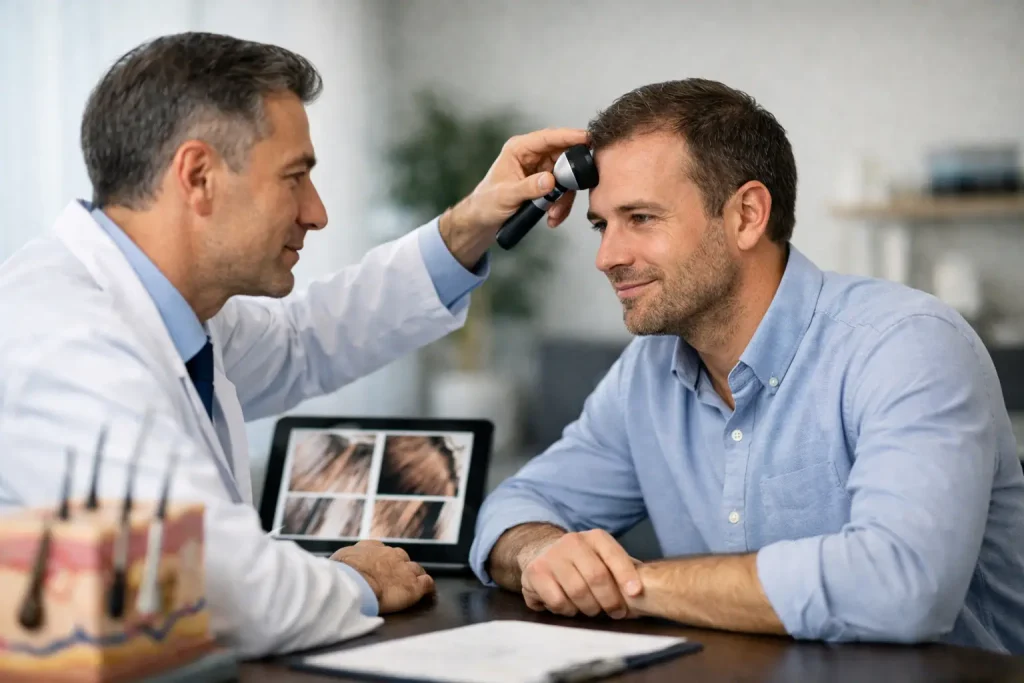
A strong consultation should explain not just which procedure is offered, but why. Ask how your donor area is being measured, whether your hair loss appears stable, how many grafts are realistic, what degree of shaving is required, and what the growth timeline looks like. Ask to see results in patients with hair characteristics similar to yours.
It also helps to ask what happens if your hair loss continues. A good transplant is designed for your future self, not just for the next six months. That is especially important for younger patients and for women with diffuse thinning, where the diagnosis can be more complex.
At Hair For Life Medical, that physician-centered, individualized thinking is central to treatment planning because the goal is not to sell a technique. It is to match the right solution to the right patient and protect the natural look over time.
If you are deciding between DHI and FUE, the best next step is not choosing a buzzword. It is getting a careful medical evaluation from a clinic that can explain the trade-offs clearly, assess the cause of your hair loss, and recommend the approach that truly fits your scalp, your goals, and your life.