When patients ask about fue vs fut differences, they are rarely asking only about technique. What they usually mean is: Which option will look natural, fit my lifestyle, preserve my donor area, and make sense for my pattern of hair loss over time? That is the right question, because FUE and FUT are both valid procedures, but they are not interchangeable.
A good surgical plan is not built around trends. It is built around your donor supply, current thinning pattern, future hair loss, hairstyle preferences, healing characteristics, and the number of grafts you may need now and later. For some patients, FUE is the better fit. For others, FUT is still the more strategic choice.
What are the fue vs fut differences?
The main difference is how the donor hair is harvested from the back and sides of the scalp, where hair is typically more resistant to genetic hair loss.
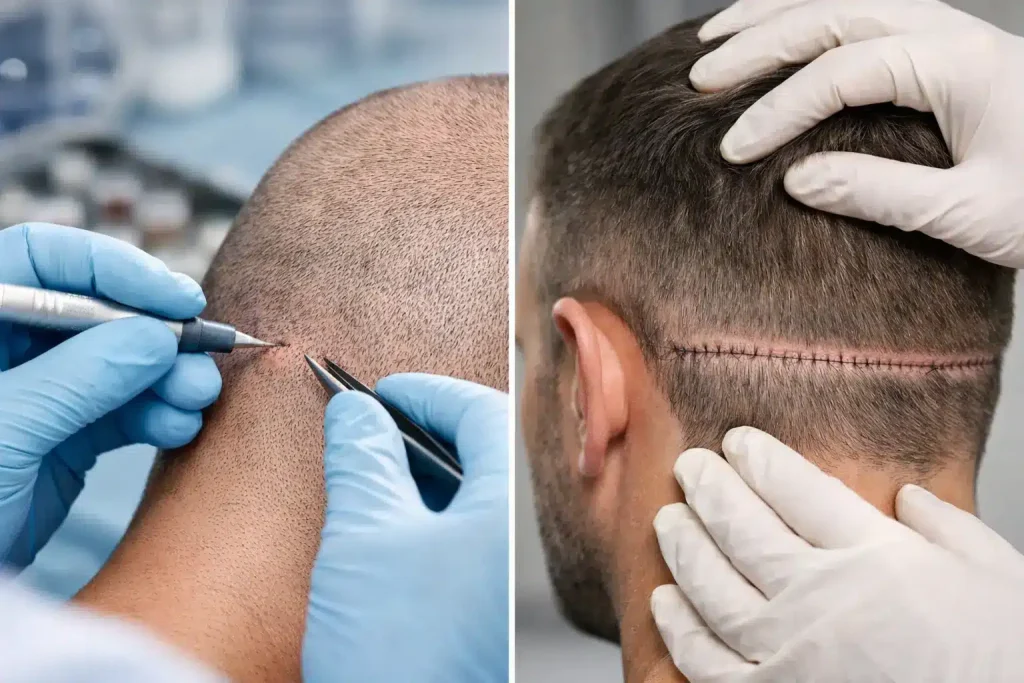
In FUE, or Follicular Unit Extraction, individual follicular units are removed one by one using a very small punch. In FUT, or Follicular Unit Transplantation, a thin strip of donor tissue is removed and then dissected into individual grafts under magnification.
Both methods can produce natural-looking results when designed and performed well. The difference is not whether one can create a natural hairline and the other cannot. Both can. The real differences involve the donor area, the scar pattern, the recovery experience, and how efficiently grafts may be obtained in certain cases.
Donor harvesting changes almost everything
The harvesting method affects more than the first few weeks after surgery. It can influence your styling flexibility, future procedures, and the total long-term use of your donor area.
How FUE works
With FUE, grafts are taken individually from a broader donor zone. This usually results in many tiny circular wounds that heal as small dot scars. These are often difficult to notice, especially if the extraction is well planned and the donor area is not overharvested.
Patients often prefer FUE when they want to wear their hair very short or want to avoid a linear scar. FUE can also be useful in beard, eyebrow, corrective, and certain scar revision cases. It offers versatility, but that does not mean it is always the best first procedure.
How FUT works
With FUT, the surgeon removes a strip from the donor area, then closes the area carefully so it heals as a linear scar. The grafts are prepared from that strip under controlled visualization, which can be very efficient for obtaining a larger number of follicular units while preserving surrounding donor hair outside the strip.
For patients who usually wear their hair longer, the linear scar may be a non-issue. For some, FUT can preserve donor resources more strategically, especially when a higher graft count is needed and future surgeries may still be part of the long-term plan.
Scar pattern is different, not absent
This is one of the most misunderstood fue vs fut differences. Many patients hear that FUE is scarless and FUT leaves a scar. That is not accurate.
FUE leaves multiple tiny scars scattered through the donor area. They are usually less visible, but they still exist. FUT leaves one linear scar, though the appearance depends on surgical technique, scalp laxity, healing, and whether the patient is prone to widening scars.
The practical question is not which method avoids scarring altogether. The question is which scar pattern fits your goals. If you want a very short fade, FUE may be more compatible. If you keep more length in the donor area and need a large session, FUT may still make strong medical sense.
Healing and discomfort are not identical
FUE is often marketed as the easier recovery. Sometimes that is true, but patients should understand the nuance.
Because FUE uses many small extraction sites, the donor area often feels sore or tight for a shorter period. There is usually no suture line, which many patients appreciate. On the other hand, if a large number of grafts are taken, the donor region can still feel quite tender, and visible shaving may be required depending on the technique.
FUT typically involves more tightness in the donor area early on because of the strip excision and closure. Sutures or staples may be involved, and some patients feel the recovery is more noticeable during the first phase of healing. Still, many recover very well, and discomfort is usually manageable when the surgery is properly performed and post-op instructions are followed.
Neither option is defined only by the first week. The better choice depends on what matters more to you: avoiding a linear scar, maximizing graft numbers efficiently, limiting visible shaving, or planning for future surgeries.
Graft yield and donor management matter
If you have significant hair loss, donor management becomes a long-term strategy, not just a procedural detail.
FUT can be advantageous when a patient needs a substantial number of grafts because the strip may allow efficient harvesting of intact follicular units from a concentrated zone. In selected patients, this can help conserve donor hair outside the strip for future use.
FUE can also achieve large sessions, especially in skilled hands, but it requires careful spacing of extractions. If the donor area is overharvested, thinning in the back and sides can become visible, which may limit future options. That risk does not mean FUE is inferior. It means FUE must be planned conservatively and executed with discipline.
This is one reason physician-led evaluation matters. A patient with early hair loss and strong donor density may be a good FUE candidate. A patient with advanced loss, limited donor supply, or a likely need for multiple procedures may need a more strategic conversation.
Who is a better candidate for FUE?
FUE is often a strong option for patients who want to avoid a linear scar, prefer shorter hairstyles, or need more targeted graft placement for smaller areas such as the hairline, beard, eyebrows, or scar correction. It may also suit people with tighter scalps, where strip surgery may be less ideal.
It can be especially attractive to image-conscious professionals who want a modern, flexible option and are comfortable with the trade-off of broader donor harvesting. In some cases, no-shave or long-hair FUE techniques may also help patients seeking more discretion, though candidacy depends on the surgical plan.
Who is a better candidate for FUT?
FUT may be the better choice for patients who need a larger number of grafts, wear their hair long enough to conceal a linear scar, or want to preserve the wider donor area from diffuse FUE extraction. It can also be a smart option for patients with strong scalp laxity and a donor pattern that supports strip harvesting well.
Some patients dismiss FUT too quickly because they assume it is outdated. It is not outdated when it is the right procedure for the patient. In experienced hands, it remains a valuable method with real advantages.
Cost, time, and expectations
Cost varies by clinic, surgeon involvement, complexity, and graft count, so broad comparisons can be misleading. In some markets, FUE costs more because it is labor-intensive and technically demanding. FUT may be more cost-efficient per graft in certain cases.
But price should not be the deciding factor by itself. A cheaper surgery that wastes donor hair or fails to match your long-term pattern of loss becomes expensive very quickly. The better question is whether the plan is medically sound, artistically appropriate, and realistic about maintenance over time.
Patients should also remember that surgery restores hair. It does not stop the biology driving hair loss. If native hair is still thinning, medical treatment and supportive therapies may be part of protecting your result.
The best procedure is the one that fits your long-term plan
The most honest answer to the FUE versus FUT debate is that it depends. It depends on how much hair loss you have now, how much hair loss you may develop, the quality of your donor area, how short you wear your hair, whether you have had prior surgery, and how aggressive or conservative your restoration goals are.
At Hair For Life Medical, this is why treatment planning starts with diagnosis rather than sales. A patient may come in convinced they want FUE, only to learn that FUT would better protect the donor area for the future. Another may assume FUT is necessary, but their goals, scar concerns, and pattern of loss make FUE the better fit.
The right surgeon should be able to explain both options clearly, including where each one shines and where each one has limits. That kind of transparency protects patients from choosing a procedure based on marketing instead of medicine.
If you are weighing these procedures, focus less on which one sounds more advanced and more on which one respects your anatomy, your goals, and your future. That is where good results begin.