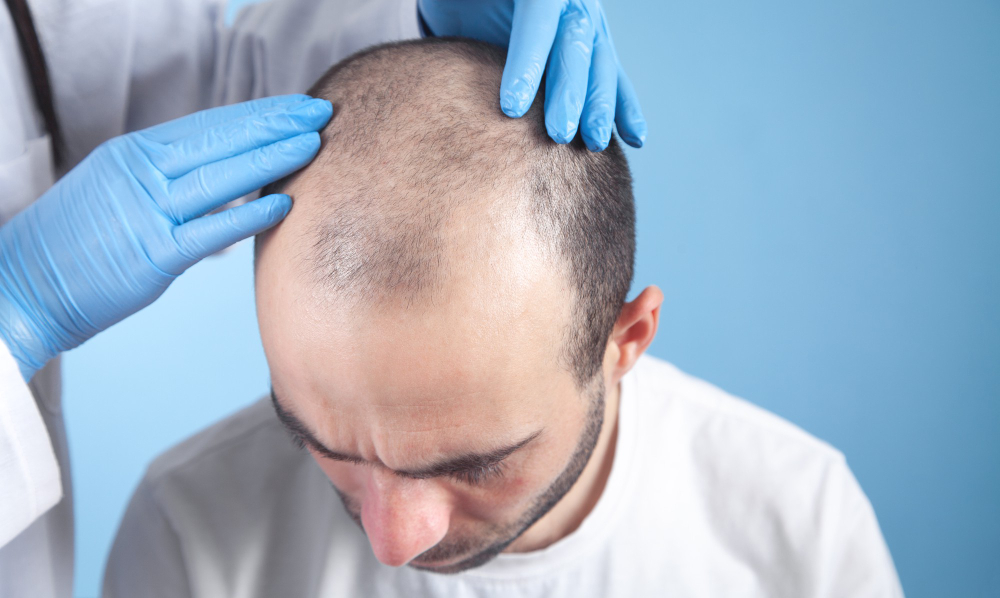
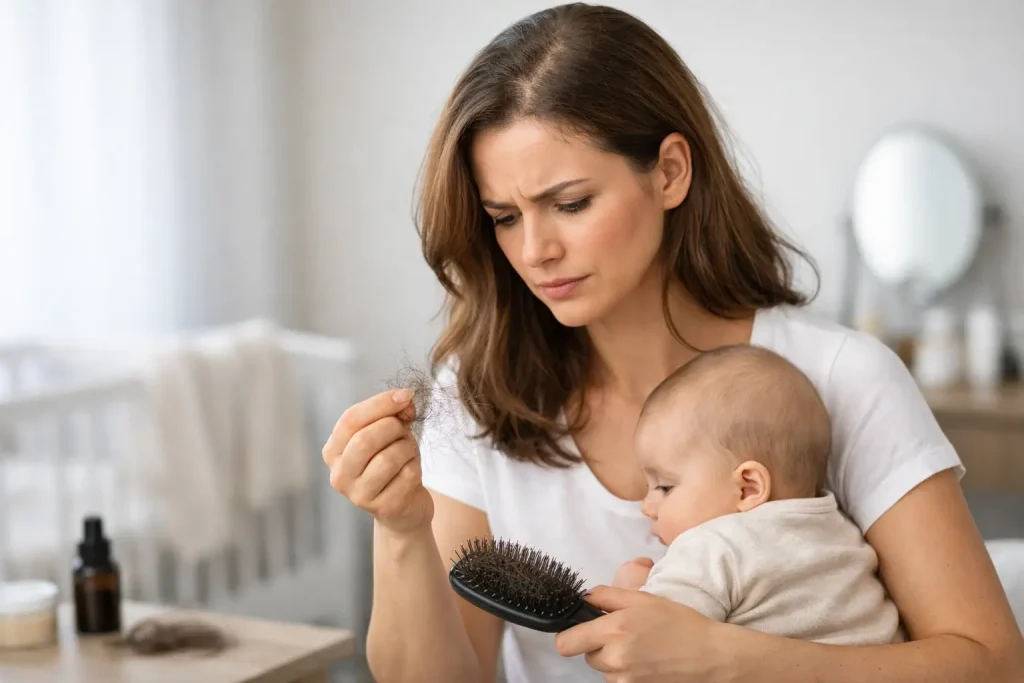
A lot of new mothers notice it the same way – a fuller handful of hair in the shower, loose strands on the pillow, and a ponytail that suddenly feels smaller. Looking up postpartum hair loss solutions can feel urgent when your body has already been through so much, but the first step is knowing this type of shedding is common and, in many cases, temporary.
What matters is not treating every case the same. Some women are dealing with normal postpartum shedding. Others have an underlying issue that pregnancy and delivery simply brought to the surface, such as iron deficiency, thyroid dysfunction, androgen sensitivity, or a preexisting pattern of hair thinning. The right plan depends on which one you are facing.
Why postpartum hair loss happens
During pregnancy, higher estrogen levels keep more hairs in the growth phase for longer. That is why many women feel their hair is thicker while pregnant. After delivery, hormone levels shift quickly. Hairs that were being held in the growth phase move into the shedding phase together, which creates the noticeable hair fall known as postpartum telogen effluvium.
This usually starts around two to four months after childbirth and often peaks a little later. It can be dramatic. Even when the scalp still has good overall coverage, the sudden increase in shedding can be emotionally difficult, especially around the temples and hairline where thinning is easier to see.
The challenge is that postpartum shedding does not always happen in isolation. Blood loss during delivery, poor sleep, stress, nutritional depletion, breastfeeding demands, and thyroid changes can all influence recovery. In some women, postpartum shedding unmasks female pattern hair loss that may have been mild before pregnancy and more obvious afterward.
The best postpartum hair loss solutions start with diagnosis
When hair is shedding after pregnancy, guessing can waste valuable time. Some women only need reassurance and supportive care. Others need medical workup. That distinction matters.
A proper evaluation looks at timing, distribution, family history, medications, recent illness, hormonal symptoms, and scalp health. It may also include blood work to check ferritin, iron studies, thyroid markers, vitamin levels, and other indicators when clinically appropriate. If shedding is diffuse and began a few months after delivery, telogen effluvium is a strong possibility. If thinning is concentrated at the part line, crown, or temples, pattern loss may also be part of the picture.
This is where many online recommendations fall short. They offer one-size-fits-all advice for a condition that has several possible causes. A woman with low iron needs a different plan than a woman with postpartum telogen effluvium alone. A woman with early androgenetic hair loss needs a different strategy than someone whose shedding will likely self-correct.
What actually helps in the early months
Most postpartum hair loss solutions in the first stage are about supporting regrowth while avoiding unnecessary interventions. Patience is part of the process, but passive waiting is not the same as informed care.
Nutrition matters more than people think. Hair is not essential tissue, so when the body is depleted, it diverts resources elsewhere. Low iron stores are especially relevant after childbirth. Protein intake also matters, along with vitamin D, zinc, B12, and folate when deficiencies are present. The key is not taking random supplements forever. The key is identifying what your body actually needs.
Scalp health also deserves attention. Inflammation, flaking, itching, or buildup can interfere with an optimal growing environment. A healthy scalp does not guarantee immediate density, but an unhealthy scalp can absolutely work against recovery.
Stress control is another piece, even though it can sound frustratingly vague to a sleep-deprived new parent. Stress does not cause every postpartum shedding episode, but it can prolong recovery in some patients. That does not mean you need a perfect routine. It means that improving sleep where possible, asking for help, and reducing physiological stress can support the hair cycle as your body recalibrates.
When shedding is normal and when it is not
Normal postpartum shedding usually improves over time. Many women start seeing baby hairs and early regrowth within several months, though full cosmetic recovery can take longer. Hair grows slowly, and the front hairline tends to test your patience.
There are times, however, when a specialist evaluation is worth it. Persistent shedding beyond six to twelve months, widening of the part, visible scalp at the crown, significant recession at the temples, patchy loss, scalp symptoms, or a history of hair thinning before pregnancy all deserve a closer look. The same is true if you feel unwell in other ways, such as fatigue out of proportion to new motherhood, weight changes, palpitations, or signs of thyroid imbalance.
It also depends on your baseline. If you started with very fine or low-density hair, even temporary shedding can create a more noticeable cosmetic change. In that case, supportive treatment may be helpful earlier, even if the process is expected to improve.
Medical postpartum hair loss solutions for slower recovery
If recovery is incomplete or the evaluation suggests more than temporary shedding, treatment can become more targeted. This is where physician-led care becomes especially valuable.
Topical therapies may be considered in select cases, but timing matters, especially if you are breastfeeding or planning another pregnancy. Not every medication is appropriate in the postpartum period. A careful discussion of safety, goals, and timing is essential.
In-office regenerative options may also play a role for some patients with slow regrowth or overlapping pattern hair loss. Depending on the clinical picture, treatments that support scalp circulation, follicle signaling, or tissue quality may be considered. These are not magic fixes, and they are not necessary for every new mother. But for the right candidate, they can be part of a broader plan.
Hormonal assessment can also be important when symptoms suggest a deeper imbalance. Pregnancy can temporarily mask hair issues that later become more visible. If there is underlying androgen-driven thinning, the postpartum phase may be the moment it becomes hard to ignore.
At a specialized hair clinic, the advantage is breadth. You want someone who can tell you when to wait, when to test, when to treat, and when not to over-treat. That kind of restraint is just as important as technical expertise.
What about hair transplantation?
This question comes up more often than many people realize, especially when the postpartum hairline looks dramatically thinner. In most cases, immediate surgical treatment is not the first move.
Postpartum telogen effluvium is often reversible, so transplanting too early can be the wrong decision. If the shedding is temporary, native hair may return on its own. Surgery only makes sense after the pattern is clear, the shedding phase has stabilized, and any underlying contributors have been addressed.
There are exceptions. Some women discover after pregnancy that they were not dealing with simple postpartum shedding at all. They may have a stable pattern of temple recession, traction-related scarring from the past, or established female pattern loss that is not recovering. In those cases, surgical restoration may eventually be part of the conversation, but only after a careful diagnostic process.
The emotional side is real
Hair loss after childbirth is often brushed off because it is common. Common does not mean easy. For many women, this change arrives at the exact moment they feel least like themselves. Your body has changed, your schedule has changed, and now your hair is changing too.
That is why reassurance should never feel dismissive. Yes, postpartum shedding is often temporary. But if it is affecting your confidence, that matters. If it has gone on long enough that you no longer believe it is simply a phase, that matters too.
A good consultation should leave you more informed, not pressured. You should understand whether you are seeing normal postpartum shedding, slower-than-expected recovery, or an underlying hair-loss condition that needs treatment.
How to think about timelines
The hardest part of postpartum hair recovery is that treatment and time move at different speeds than anxiety. Shedding can happen quickly. Regrowth is slow.
Even when the process is improving, most women do not see cosmetic change overnight. New hairs may first appear as short, fine regrowth around the hairline and temples. Density usually returns gradually. If a nutritional deficiency is part of the picture, correction still takes time to translate into visible hair improvement.
That does not mean nothing is working. It means the hair cycle has to catch up. The goal is steady progress and a plan based on evidence, not panic.
For women in Scottsdale, Phoenix, or elsewhere in Arizona who are unsure whether their shedding is normal, a focused hair evaluation can bring real clarity. At Hair For Life Medical, that physician-led approach matters because postpartum hair loss solutions should be matched to the cause, not forced into a generic formula.
If you are seeing more shedding than expected after pregnancy, give yourself room for both patience and answers. Sometimes the right next step is simply time. Sometimes it is testing, treatment, or a more careful diagnosis. Either way, you deserve a plan that respects what your hair is doing and what your body has been through.