Thin brows can change the whole balance of the face. For many patients, the issue is not a makeup problem or a styling problem – it is true hair loss caused by overplucking, genetics, hormonal shifts, trauma, scarring, or simply naturally sparse growth. If you are researching eyebrow transplant Scottsdale options, the real question is not just whether hair can be moved into the brow area. It is whether the result will look believable in everyday life, up close, and for years.
That is where experience matters. Eyebrow restoration is a small procedure in terms of area, but it is one of the most detail-sensitive procedures in hair transplantation. The direction, angle, curl, and placement of each graft affect whether the brow looks soft and natural or too upright, too dense, or poorly designed.
What an eyebrow hair transplant actually does
An eyebrow transplant takes healthy hair follicles from a donor area, usually the scalp, and places them into the brow according to a customized design. The goal is not simply to add hair. The goal is to rebuild shape, improve density, and restore facial framing in a way that fits your features.
This can be a good option for people who have patchy brows, thinning tails, overplucked areas that never came back, scars interrupting the brow, or naturally light density. It can also help patients who want a more defined arch or improved symmetry, though symmetry in the face is always relative. Natural-looking brows are rarely identical side to side.
The best candidates usually have a stable donor supply and realistic expectations about density and maintenance. Because transplanted hairs often come from the scalp, they continue to behave more like scalp hair than native brow hair. That means they may need trimming over time. For many patients, that trade-off is well worth it. For others, especially those with only mild cosmetic concerns, a surgical solution may not be the first recommendation.
Who is a good candidate for eyebrow hair transplant Scottsdale treatment?
A proper evaluation should look beyond the brows themselves. The pattern of hair loss, skin quality, medical history, scarring, hormone status, and even styling goals all matter. Some patients are excellent candidates for an eyebrow hair transplant. Others may do better with non-surgical treatment, medical evaluation, or a combination approach.
You may be a good candidate if your eyebrow loss is due to old overplucking, a healed scar, genetics, or stable thinning that has not responded to other treatment. If you have an active inflammatory condition, uncontrolled hormonal imbalance, or a disorder causing ongoing hair loss, those issues should be addressed first. Transplanting into an unstable environment can compromise growth and long-term satisfaction.
This is one reason physician-led assessment is so valuable. The procedure should match the cause of the problem, not just the appearance of it.
Why eyebrow design is more technical than most people expect
Brows are not just strips of hair above the eyes. They have changing angles, transitions in density, and a distinct flow from the head of the brow through the arch to the tail. Hair at the inner brow tends to sit more upward, then gradually flattens and sweeps laterally. If grafts are placed at the wrong angle, the result can look obvious even if the hairs grow well.
Curl is another factor. Scalp donor hairs vary in caliber and texture. A surgeon has to choose donor hairs carefully and place them with extreme attention to orientation. Single-hair grafts are typically preferred for softness and precision. In many cases, less is more. A brow that is too dense too quickly can look harsh.
There is also the question of facial harmony. A stronger brow is not automatically a better brow. The right design depends on bone structure, forehead shape, eye spacing, sex-based aesthetic goals, and personal preference. Some patients want a fuller but still subtle brow. Others want more structure. The design should reflect the patient, not a trend.
How the procedure works
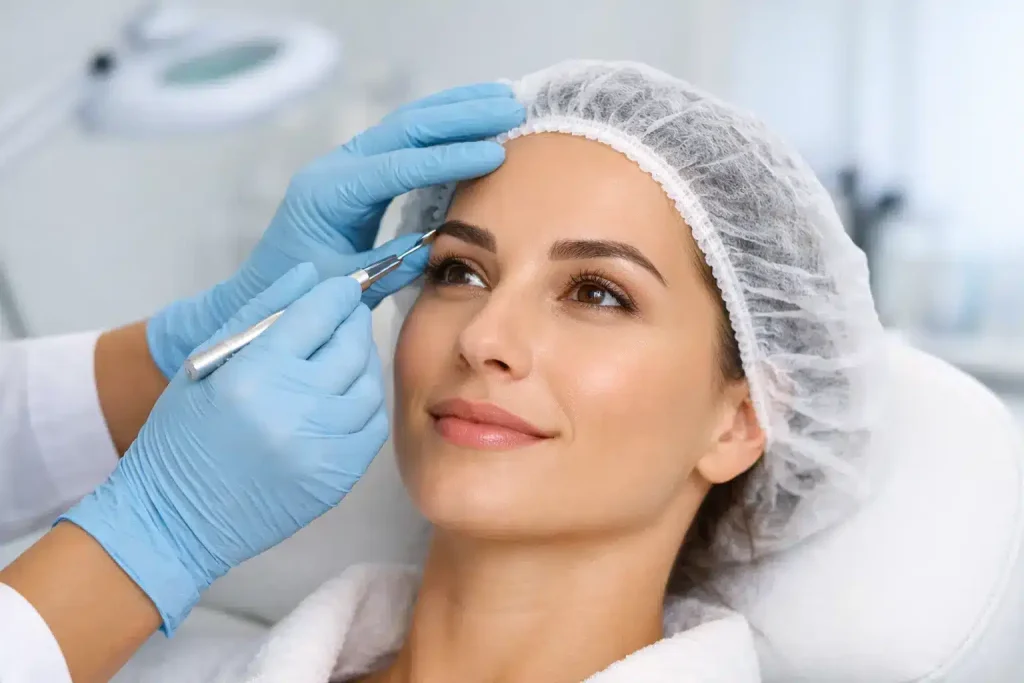
Eyebrow transplantation is usually performed under local anesthesia. The donor area is selected first, often from a part of the scalp where the hair most closely matches the needed softness. Follicular units are then harvested, commonly using refined FUE techniques, and prepared for placement.
Recipient sites are made in the brow with careful control of angle and direction. This step is where artistry and technical judgment come together. The grafts are then placed one by one to create the intended shape and density pattern.
The procedure is generally well tolerated. Patients are awake, and discomfort is usually manageable with local numbing. Because the treatment area is small, the number of grafts is lower than with scalp restoration, but the precision demand is much higher.
Recovery tends to be straightforward. Small crusts form around the implanted hairs and usually shed within days. Mild redness can persist for a short period, depending on skin type. Most patients can return to non-strenuous activities quickly, though they need to follow aftercare instructions carefully to protect graft survival.
The growth timeline and what healing really looks like
One of the most common misunderstandings is expecting immediate cosmetic density. Right after the procedure, you will see the implanted hairs, but many of those shafts shed during the normal post-transplant phase. That does not mean the follicles failed. It is part of the process.
New growth usually begins gradually over the following months. Early hairs may appear fine at first, then mature with time. Final cosmetic improvement can take several months, and sometimes longer depending on the case. Patience matters.
There is also maintenance to consider. Because transplanted eyebrow hairs may keep growing longer than natural brows, trimming is often part of long-term upkeep. Some patients may also need occasional training of the hairs with gel or careful grooming, especially early on. A good consultation should discuss that clearly rather than presenting the procedure as completely maintenance-free.
What makes results look natural
Natural eyebrow restoration depends on restraint, planning, and execution. The surgeon must understand how to create softness at the edges, avoid pluggy density, and preserve the subtle irregularity that makes brows look real. Perfectly uniform placement often looks less natural than a slightly varied pattern.
It also depends on matching the treatment to the patient. Someone with a scar through one brow may need a different strategy than someone with diffuse thinning on both sides. A patient seeking feminization may want a different shape than a patient who wants to restore a flatter or more angular brow. There is no one-size-fits-all template.
At a specialized hair restoration practice such as Hair For Life Medical, that customization is part of the value. Hair restoration is the sole focus, which allows for a deeper diagnostic approach and a more individualized surgical plan.
Questions to ask at a consultation
When comparing eyebrow transplant Scottsdale providers, ask who designs the brow, who makes the recipient sites, and who places the grafts. These details matter. In delicate facial work, physician involvement is not a small point.
You should also ask about donor hair selection, expected graft numbers, likely density after one procedure, and whether a second session is sometimes recommended. Ask to see healed results, not just immediate post-op photos. Immediate photos show placement. Healed photos show judgment.
It is also reasonable to ask whether there are non-surgical factors contributing to your brow loss. A comprehensive clinic should be willing to tell you when surgery is appropriate, when it is not, and when medical workup should come first.
Cost, value, and the premium question
Price is part of the decision, but it should not be the only one. Eyebrow transplantation is a precision procedure performed on one of the most visible parts of the face. Bargain shopping can be expensive if the result requires correction.
Cost varies based on graft count, complexity, physician expertise, and the level of involvement in harvesting, site creation, and placement. A scar revision case or a corrective case may be more complex than straightforward cosmetic thickening. Patients should look at value in terms of planning, naturalness, safety, and long-term satisfaction, not just the upfront number.
This is especially true for patients who have already had a disappointing cosmetic procedure elsewhere. Revision work is often harder than getting it right the first time.
Is an eyebrow hair transplant always the best answer?
Not always. Some patients need diagnosis before surgery. Others may have underlying medical or hormonal issues contributing to eyebrow thinning. If the loss is active, unstable, or caused by a condition that has not been treated, surgery may need to wait.
There are also patients whose goals are better served by a conservative plan. If a person wants a minor enhancement but is not comfortable with trimming transplanted hairs over time, the trade-off may not feel worthwhile. Good medicine means saying that out loud.
The right practice will not push every patient toward surgery. It will explain the options, the limits, and the likely outcome based on your anatomy and your cause of hair loss.
If fuller brows would help you feel more like yourself, the next step is not guessing from photos online. It is getting a careful, physician-led assessment that looks at why your brows changed, what can realistically be restored, and whether a tailored eyebrow transplant is the right fit for your face and your life.
References
EYEBROW & EYELASH HAIR RESTORATION SURGERY – ISHRS
Eyebrow Transplant: Procedure, Cost, Pros & Cons, Precautions