If your hairline has changed, your part looks wider, or shedding has become hard to ignore, a natural hair restoration plan Scottsdale patients choose should start with one thing: a real diagnosis. Not a one-size-fits-all package, not a sales pitch, and not a rushed recommendation based on a few photos. Hair loss has causes, patterns, and stages, and the right plan depends on all three.
For some people, “natural” means supporting regrowth without surgery. For others, it means achieving a result that does not look worked on, overharvested, or artificial. Both are valid. The best treatment plan respects your goals while staying honest about what your hair can realistically do.
What a natural hair restoration plan in Scottsdale should include
A credible plan begins by identifying why hair is thinning in the first place. Male and female pattern hair loss are common, but they are not the whole story. Hormonal shifts, inflammation, nutritional issues, scalp conditions, stress, traction, prior cosmetic work, and even poor graft placement from an earlier transplant can all affect density and long-term outcomes.
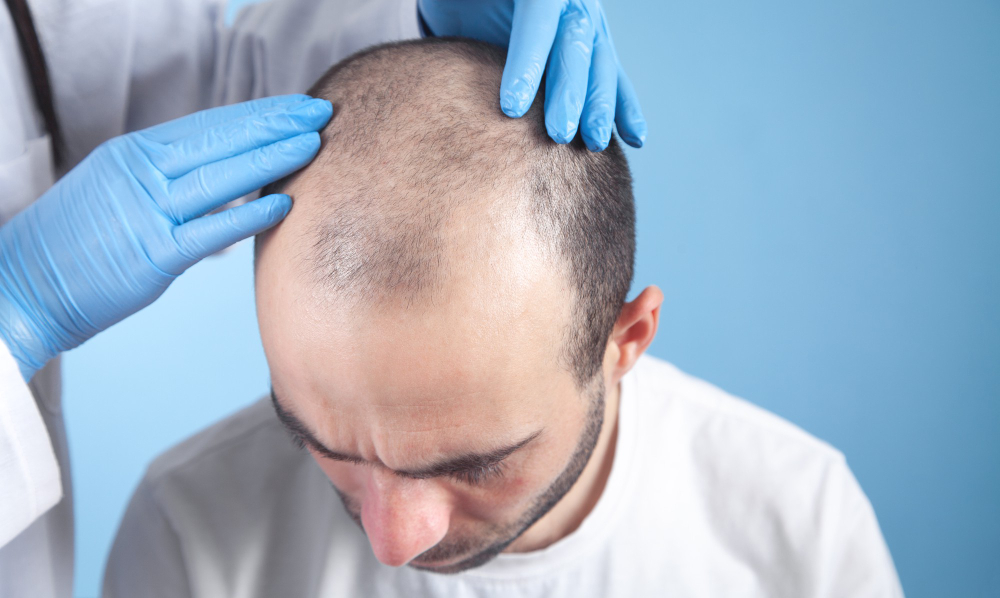
That is why a proper evaluation matters. Scalp analysis, medical history, family history, medication review, and when appropriate, hormone or genetic testing help separate temporary shedding from progressive miniaturization. If the cause is still active, restoring density without addressing it can lead to disappointment later.
A natural plan also looks beyond whether you can grow hair. It considers how you wear your hair, how visible downtime can be in your work and social life, how aggressive you want treatment to be, and whether your priority is preservation, thickening, redesigning a hairline, or correcting previous work.
Natural does not always mean non-surgical
This is where many patients get mixed messages. Non-surgical options can be very effective, especially early in the hair-loss process. But if follicles are no longer viable in a given area, regenerative treatments alone may not recreate meaningful density. In that setting, a surgical approach may actually be the most natural-looking solution because it restores hair using your own follicles.
The goal is not to force one path. The goal is to match the right level of treatment to the biology of your hair loss.
For early thinning, medical therapies and regenerative options may help preserve existing hair and improve caliber. For moderate to advanced loss, surgery may be the anchor of the plan, with supportive medical treatment used to protect surrounding native hair. For patients with scarring, transplant failure, or complex hairline concerns, the plan often needs more nuance and more physician involvement from the start.
Non-surgical options that support natural restoration
When patients ask for a natural hair restoration plan in Scottsdale, they are often asking for treatments that work with the scalp and existing follicles rather than masking the issue. That usually means building a program around preservation, stimulation, and scalp health.
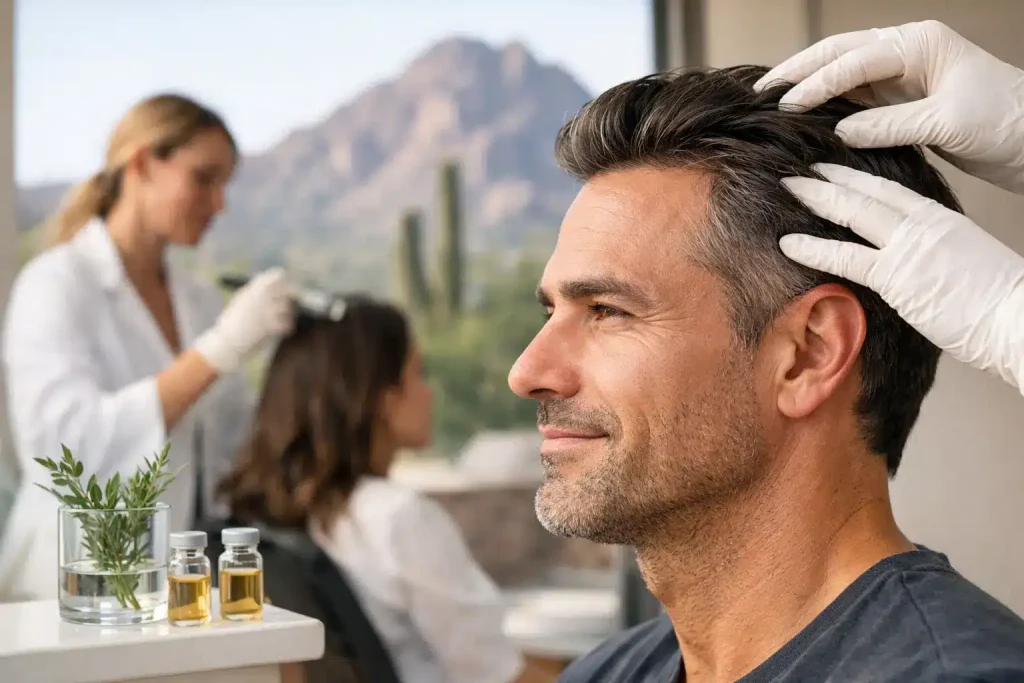
Depending on the diagnosis, this may include physician-guided medications, hormone therapy, laser therapy, injectables, PDO threads for hair loss, Regenera Activa AMT, TricoPat, or other biologic and regenerative approaches. These treatments do not all do the same thing. Some aim to reduce ongoing miniaturization. Others improve the scalp environment or stimulate weakened follicles.
There are trade-offs. Some options require maintenance. Some work better in early-stage loss than in advanced baldness. Some are more attractive to patients who want minimal downtime, while others may involve a series of treatments before results are noticeable. A good doctor will explain not just what can help, but what is unlikely to help enough.
That matters because preserving native hair is often what makes the final result look most natural. Even when surgery is part of the plan, healthy surrounding hair creates better blending, softer transitions, and stronger long-term stability.
When surgery becomes the natural choice
A lot of people hear “transplant” and worry the result will be obvious. That concern is understandable, especially if they have seen pluggy hairlines, poor angles, low density planning, or donor overharvesting. Modern hair restoration should not look like that.
When surgery is recommended carefully and performed with attention to hairline design, direction, graft selection, and donor management, it can produce a very natural result. In fact, for patients with established bald areas, a transplant may be the only way to recreate actual growing hair there.
The method matters. FUE, FUT strip, ARTAS robotic FUE, DHI, no-shave FUE, long-hair FUE, and body hair transplant each have pros and limitations. FUE is popular for its flexibility and small extraction sites, but not every patient is best served by FUE alone. FUT can preserve donor supply efficiently in selected cases. No-shave and long-hair options can be helpful for discretion, but they are not ideal for everyone. Corrective surgery requires even more planning because the challenge is not just adding hair, but improving an existing problem without creating a new one.
A natural result depends less on what sounds trendy and more on whether the chosen method fits your donor characteristics, hair texture, scalp laxity, loss pattern, and future risk of progression.
Why personalized planning matters more than any single treatment
Hair loss treatment often goes wrong when a clinic starts with the procedure it wants to sell. Patients then get pushed toward the same answer whether they have early diffuse thinning, post-menopausal shedding, transplant scarring, temple recession, or eyebrow loss. Those are not the same problem, so they should not have the same plan.
An individualized plan looks at the full picture. A younger man with active pattern loss may need a conservative hairline and a strong maintenance strategy. A woman with diffuse thinning may need a workup before anyone talks about graft numbers. A transgender patient may need facial framing and hairline feminization that requires artistic design as much as technical skill. A patient with a previous poor transplant may need scar revision, redistribution, camouflage, or a staged repair rather than another large session.
This is one reason specialized, physician-led evaluation matters. Hair restoration is a narrow field, but it contains a wide range of medical and surgical variables. Experience changes how those variables are interpreted.
At Hair For Life Medical, that philosophy is central to planning. The practice is built around presenting the full range of options and matching treatment to the patient rather than pushing a single method. For patients, that usually means a more honest conversation and a better chance of getting a result that still feels right years from now.
What Scottsdale patients should ask before starting
If you are comparing clinics, ask how the diagnosis is made, who designs the plan, and whether the recommendation would change if your goals change. Ask what happens if you do nothing for six to twelve months. Ask whether the proposed treatment is meant to regrow hair, preserve hair, improve appearance, or all three. Those are different objectives.
You should also ask about long-term thinking. If your hair loss progresses, will today’s plan still make sense later? Is donor management being protected? Are non-surgical therapies being offered because they fit your case, or because they are easy to package? If surgery is advised, who is doing the critical parts of the procedure?
These questions are not about being skeptical for the sake of it. They help you separate education from pressure.
The most natural result is often a staged one
Some patients want to fix everything at once. Sometimes that is possible, but often the best-looking outcome comes in stages. Stabilizing active loss first can improve the value of later surgery. A conservative first pass can preserve donor hair and allow refinement later if needed. In women and in patients with diffuse thinning, patience can protect native hair that is still worth saving.
That kind of restraint is not a weakness in treatment planning. It is usually a sign that the doctor is thinking beyond the next few months.
Natural hair restoration should look believable in bright light, at close distance, and as your face and hair continue to change over time. That takes more than technical ability. It takes judgment.
If you are considering treatment, the best next step is not choosing a procedure. It is choosing an evaluation thorough enough to tell you whether you need preservation, restoration, correction, or simply more time before deciding.