Why Technician-Driven Hair Transplants Fail
Hair transplantation is often marketed as a simple, routine procedure. It isn’t.
This is microsurgery—performed follicle by follicle, angle by angle, requiring precision that directly determines whether your result looks natural or artificial.
The uncomfortable truth:
Many hair transplants today are not performed by the doctor.
Instead, they are largely done by technicians. And that’s where problems begin.
At Hair 4 Life Medical, every case is approached differently—because when the surgeon is directly involved, the outcome changes.
What Is a Technician-Driven Hair Transplant?
In many clinics:
- The doctor designs the hairline (sometimes)
- The rest of the procedure is delegated to technicians
- Multiple patients are treated in a single day
Technicians may perform:
- graft extraction
- graft dissection
- graft placement
This model is built for volume, not precision.
Why This Model Exists
Simple: speed and profit.
Technician-driven clinics can:
- perform 3–6 surgeries per day
- reduce doctor time per patient
- lower costs and increase margins
But hair transplantation is not a factory process.
Where Technician-Driven Transplants Go Wrong
1. Unnatural Hairlines
Hairline design is not just about placement—it’s about:
- irregularity
- density transitions
- angle and direction
Technicians often follow patterns, not artistry.
Result:
- straight, pluggy, or overly dense hairlines
- “transplant look” that is easy to spot
2. Poor Graft Handling
Each graft is delicate and must be handled properly.
Common issues:
- dehydration
- excessive manipulation
- improper storage
These reduce graft survival.
Result:
- lower growth rates
- patchy density
- need for additional procedures
3. Incorrect Angles and Direction
Hair doesn’t grow straight up—it follows natural angles.
Improper placement leads to:
- hair sticking out unnaturally
- difficulty styling
- obvious surgical appearance
This is one of the most common signs of a technician-driven procedure.
4. Overharvesting the Donor Area
High-volume clinics often prioritize graft numbers over long-term planning.
Without careful control:
- donor area becomes visibly thin
- scarring increases
- future procedures become limited
This damage is permanent.
5. One-Size-Fits-All Approach
Technician-driven clinics often rely on:
- a single technique
- standardized graft counts
- limited customization
But every patient is different.
At Hair 4 Life Medical, treatment is based on:
- donor quality
- hair characteristics
- long-term hair loss progression
The Difference at Hair 4 Life Medical
At Hair 4 Life Medical, the approach is fundamentally different:
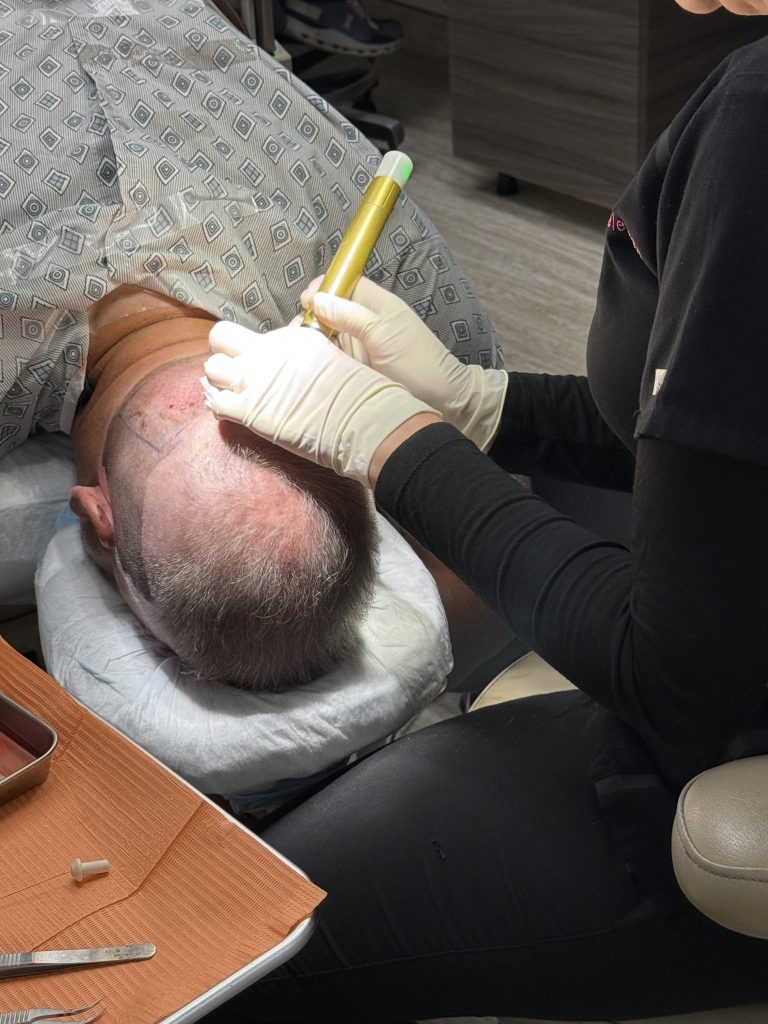
- Dr. Kelemen performs the procedure herself i.e. design, extraction, site making and implantation (implantation is the only step where ONE tech helps out)
- Full control over extraction, incisions, and placement
- One patient at a time
- Multiple techniques available (FUT, manual FUE, motorized, robotic-assisted)
This allows:
- precise hairline design
- optimal graft survival
- long-term donor preservation
Why Doctor-Performed Surgery Matters
Hair transplantation is not just technical—it’s artistic and strategic.
A surgeon:
- evaluates the entire scalp and donor area
- plans for future hair loss
- adjusts in real time during surgery
- ensures every graft is placed correctly
Technician-driven models simply cannot match this level of control.
The Real Cost of a Bad Hair Transplant
Many patients are drawn to lower prices—but the long-term cost is often higher.
Common outcomes of poor procedures:
- unnatural appearance
- visible scarring
- need for repair surgery
- emotional frustration
Repair cases are:
- more complex
- more expensive
- more limited in options
This is why choosing the right clinic the first time matters.
How to Spot a Technician-Driven Clinic
Before committing, ask:
- Who performs the extraction?
- Who makes the incisions?
- Who places the grafts?
- How many surgeries are done per day?
If the answer involves multiple technicians doing most of the work, proceed with caution.
When Technician Assistance Is Appropriate
To be clear, technicians can play a role:
- graft preparation
- assisting during surgery
But they should not be performing the critical surgical steps.
That responsibility belongs to the surgeon.
Why Experience and Control Matter
Hair transplantation is permanent.
You only have a finite donor supply.
Once it’s used—or damaged—it cannot be replaced.
This is why:
- conservative planning
- precise execution
- surgeon involvement
are non-negotiable.
Final Thoughts
Technician-driven hair transplants are built for efficiency—but not for excellence.
At Hair 4 Life Medical, the focus remains on:
- precision over speed
- quality over quantity
- long-term results over short-term volume
That difference is what determines whether a transplant looks natural—or looks like a transplant.
Schedule a Consultation
If you’re considering a hair transplant and want a doctor-performed, personalized approach:
- Receive a full evaluation
- Understand your options
- Get a written treatment plan
Schedule your consultation with Hair 4 Life Medical and make an informed decision before moving forward.
Then Hair 4 Life Medical is not just an option — it’s the standard.
Interested in learning more? Contact Us or call Hair 4 Life at (480) 525-4547 to schedule an appointment.