A transplant does not have to announce itself to your workplace, family, or social calendar. The best discreet hair transplant techniques are designed around a practical goal: restoring hair while keeping donor-area changes, recipient-site evidence, and recovery as private as possible. But discretion means different things for different patients. For one person, it means avoiding a fully shaved scalp. For another, it means returning to client meetings quickly or concealing a prior transplant scar.
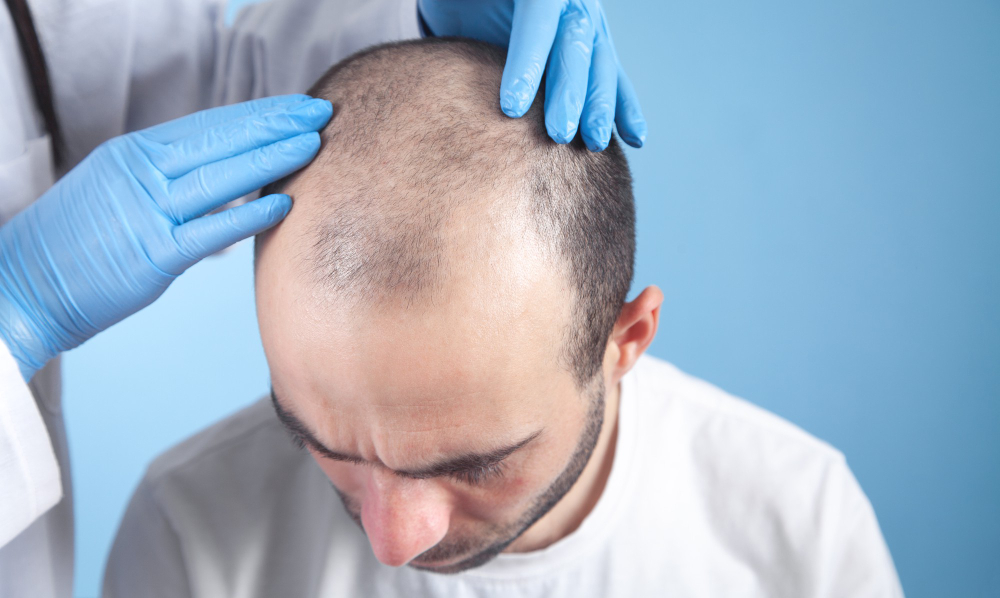
The right approach depends on your hair length, donor supply, degree of hair loss, hair characteristics, work demands, and long-term restoration plan. A physician-led evaluation should look beyond the procedure itself to identify why hair loss is occurring and whether medical treatment can help preserve the hair you still have.
What Makes a Hair Transplant Discreet?
A discreet transplant is not simply the procedure with the shortest recovery period. It is a procedure planned to minimize visible clues at every stage, including preparation, donor harvesting, graft placement, early healing, and the way new growth matures.
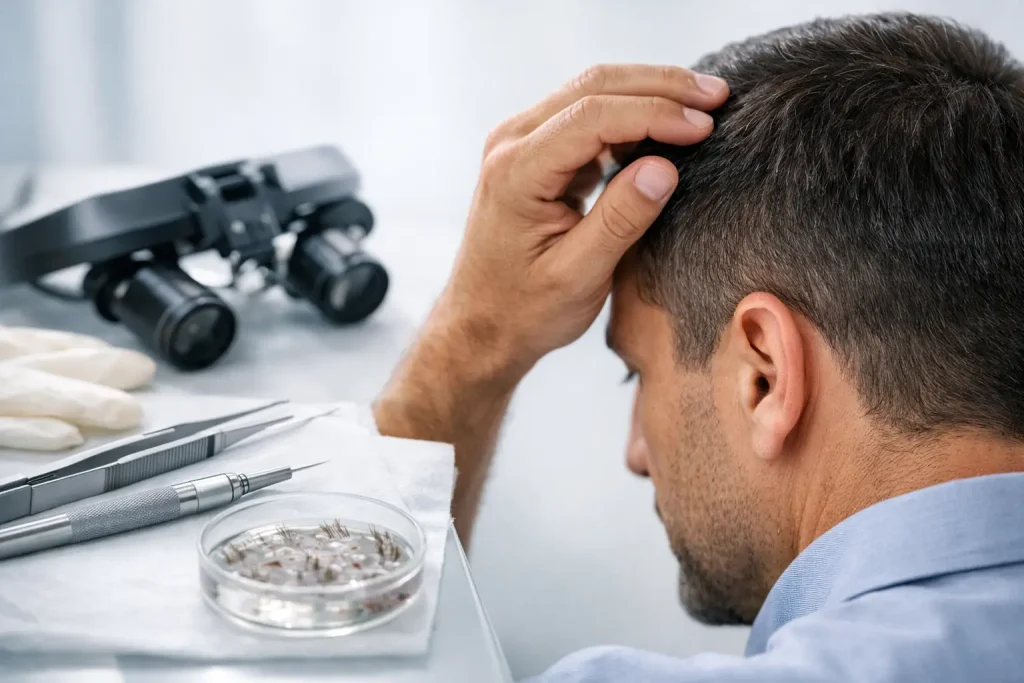
FUE, or follicular unit extraction, is often associated with discreet recovery because grafts are removed individually rather than through a linear strip of scalp. This can leave tiny dot-like extraction sites that are generally difficult to notice once healed. Still, standard FUE often requires shaving at least part of the donor area, and recipient-site redness or small scabs remain possible during the first days after surgery.
For patients who need greater privacy, modified FUE approaches can reduce the visual impact of surgery. These methods require careful case selection and experienced surgical execution. They also involve trade-offs, including procedure time, cost, and the number of grafts that can be safely placed in one session.
No-Shave FUE for Minimal Change Before Surgery
No-shave FUE is one of the best discreet hair transplant techniques for patients who want to maintain their existing appearance before and after the procedure. Rather than broadly shaving the donor region, the physician selectively trims or accesses individual follicular units through the existing hair. The surrounding hair can help conceal the extraction sites.
This option can be especially appealing to professionals, women with longer hair, and patients who are uncomfortable with a noticeable change in appearance. It may also suit patients restoring a smaller area, such as a hairline, temple points, localized thinning, eyebrows, or a scar.
No-shave FUE is technically demanding. Harvesting grafts without broad shaving limits visibility and can make the procedure slower. It is not automatically the right choice for every patient, particularly someone who needs a very large graft count or has a complex donor area. A skilled physician should explain whether the desired density and coverage can be achieved discreetly in one session or whether a staged plan is more appropriate.
What Recovery Usually Looks Like
The donor area may be well camouflaged by surrounding hair, but patients should still expect temporary redness, pinpoint scabbing, and some swelling in the recipient area. Following postoperative instructions is essential. Avoiding friction, sun exposure, strenuous exercise, and picking at healing sites helps protect grafts and reduces the risk of prolonged visible irritation.
Privacy also benefits from realistic scheduling. Even the most discreet technique is not invisible during the earliest healing period. Planning several lower-profile days after surgery can make the experience much more comfortable.
Long-Hair FUE Lets You See Immediate Direction
Long-hair FUE is another advanced option for patients who place a high value on discretion. In this technique, grafts are extracted and implanted while retaining the length of the hair shafts. That allows the surgeon and patient to see the immediate direction, angle, and aesthetic effect of the implanted hair.
This can be particularly useful for refined hairline work, temple restoration, corrective procedures, and patients with longer hairstyles who want to avoid a dramatic preoperative change. Existing hair can provide coverage during healing, while the longer implanted shafts offer an initial preview of the design.
The important distinction is that visible long hair immediately after surgery is not the same as permanent growth. Transplanted shafts commonly shed in the weeks following surgery before new growth begins. Long-hair FUE can make the early period easier to manage aesthetically, but it does not eliminate the normal hair growth cycle.
Because it requires exceptional control of graft handling and placement, long-hair FUE is not a procedure to choose based on marketing alone. The surgeon must protect fragile follicular units while achieving natural orientation and appropriate density. A natural-looking result depends on details that cannot be rushed.
Strategic FUE for Focused Restoration
Sometimes the most discreet option is not a special variation of FUE. It is a conservative, targeted plan. A patient with early recession may not need broad coverage of every thinning area. Strategic placement of limited grafts can soften the hairline, rebuild temple points, add density around a part, or improve the appearance of a small scar with less visible recovery than a large session.
This approach is valuable when preserving the donor supply is as important as the immediate cosmetic change. Donor hair is finite. Using it wisely matters, especially for younger patients or anyone with ongoing pattern hair loss. A physician should assess future loss patterns and avoid creating a low, dense hairline that cannot be supported over time.
For women with diffuse thinning, transplant candidacy requires particular care. If thinning affects the donor region as well as the top of the scalp, surgery may not be the first step. Scalp analysis, laboratory work, hormone evaluation when appropriate, and medical therapies may help determine whether transplantation is suitable and how to protect long-term density.
When FUT May Still Be the Better Choice
FUT, also called strip harvesting, is not usually considered the first choice for a discreet recovery because it creates a linear donor scar. However, it should not be dismissed automatically. For the right candidate, FUT can provide a substantial number of high-quality grafts while preserving more surrounding donor hair.
Patients who consistently wear enough hair length to cover the donor area may find that the scar remains well concealed. FUT can also be useful in certain repair cases or when a patient needs a larger graft yield. The trade-off is clear: the donor scar requires thoughtful planning, and some patients prefer FUE specifically to avoid a linear scar.
A comprehensive consultation should compare both methods honestly. The best technique is not the newest option or the one with the simplest label. It is the one that protects your donor resources and fits your recovery needs without compromising the result.
Discretion Depends on Hairline Design, Too
A transplant can heal beautifully and still look conspicuous if the design is too aggressive, too dense, or too uniform. Natural hairlines have irregularity, variation in caliber, and age-appropriate placement. Fine single-hair grafts typically belong at the leading edge, while naturally occurring groups of hairs can create fullness behind it.
This is why surgical artistry matters as much as extraction method. The angle at which a graft is placed affects how hair lies against the scalp. Direction determines whether it blends with existing growth. Density must be balanced with blood supply and the available donor reserve.
Patients seeking corrective surgery after an unnatural prior transplant often need a carefully staged plan. This may involve removing or redistributing poorly placed grafts, softening the hairline, adding density, treating scars, or using scalp micropigmentation as an adjunct in selected cases. Discretion in these situations comes from restraint and planning, not from attempting to fix everything in one day.
How to Choose a Discreet Transplant Plan
Ask direct questions during a consultation: Will any area need trimming? How many grafts are recommended, and why? What will be visible during the first 10 to 14 days? When can you return to work, exercise, and public-facing commitments? How will the plan account for future hair loss?
You should also know who performs the critical surgical steps. At Hair For Life Medical, treatment planning is centered on physician expertise, diagnostic evaluation, and a realistic discussion of every appropriate option. There is no single discreet procedure that fits every scalp or every lifestyle.
The most private transplant is often the one that looks thoughtfully planned rather than dramatically changed. With an appropriately conservative design, skilled graft handling, and a recovery plan built around your life, hair restoration can remain personal while the result simply looks like you.