Tag Archive for: Body to scalp hair transplant

One of the most common questions patients ask is: Can I do a hair transplant without shaving my head?
The answer is yes — in many cases, a hair transplant can be performed without shaving, depending on the technique, hair characteristics, and the experience of the surgeon.

At Hair 4 Life Medical, Dr. Ramona Kelemen offers advanced no-shave and long hair FUE techniques designed for patients who want a discreet procedure with minimal visible signs.

This guide explains how hair transplant without shaving works, who is a candidate, and what results you can expect.


What Is a No-Shave Hair Transplant?

A no-shave hair transplant is a Follicular Unit Extraction (FUE) procedure performed without shaving the entire head. Instead, grafts are extracted carefully between existing hairs while keeping the surrounding hair long.

This technique is also called:

  • No shave FUE

  • Unshaven hair transplant

  • Long hair FUE

  • Partial shave hair transplant

The goal is simple: restore hair without anyone noticing you had surgery.


Benefits of Hair Transplant Without Shaving

Patients choose a no-shave hair transplant for several reasons:

Discreet Recovery

Longer hair hides redness and small extraction sites, making the procedure far less noticeable.

No Drastic Change in Appearance

Patients can return to work quickly without the obvious “shaved head” look.

Immediate Cosmetic Coverage

Existing hair covers the recipient area during healing.

Ideal for Professionals

This option is popular among executives, public figures, and patients who cannot take extended time off.


Who Is a Candidate for No-Shave Hair Transplant?

Not everyone is an ideal candidate, but many patients qualify. Good candidates include:

  • Patients needing smaller to moderate graft sessions

  • Hairline restoration patients

  • Eyebrow transplant patients

  • Female hair transplant patients

  • Patients with longer hair

  • Patients requiring discreet procedures

Larger sessions may still require partial trimming to maintain surgical precision.


Is No-Shave Hair Transplant More Difficult?

Yes — significantly.

Performing FUE without shaving requires:

  • Advanced surgical skill

  • Slower, more meticulous extraction

  • Careful graft handling

  • Precise site creation

Because the surgeon must work between long hairs, visibility is reduced, making the procedure more technically demanding.

This is why many clinics do not offer true no-shave procedures.


Long Hair FUE vs Traditional FUE

Traditional FUE

  • Head shaved

  • Easier extraction

  • Faster procedure

  • Visible healing phase

No-Shave / Long Hair FUE

  • Hair left long

  • Discreet recovery

  • More technically demanding

  • Slower, more precise procedure

Both methods can produce excellent results when performed properly.


Does No-Shave Hair Transplant Affect Results?

No. When performed correctly, no-shave hair transplants produce the same growth as shaved procedures.

The key difference is technique and surgeon experience, not the final outcome.

The grafts themselves are identical — only the surrounding hair length changes.


Partial Shave Hair Transplant Option

Some patients choose a partial shave instead of completely unshaven surgery.

This involves:

  • Shaving small hidden donor sections

  • Leaving surrounding hair long

  • Maintaining a natural appearance

This allows larger sessions while still keeping the procedure discreet.


No-Shave Hairline Transplant

Hairline restoration is one of the most popular uses for no-shave FUE.

Benefits include:

  • Immediate coverage

  • Minimal downtime

  • Natural transition with existing hair

  • Discreet healing

This is especially beneficial for patients who want subtle improvement without dramatic changes.


No-Shave Eyebrow Transplant

Eyebrow transplants are naturally performed without shaving the scalp in many cases. The surrounding hair remains long, allowing:

  • Minimal visible healing

  • Fast return to normal appearance

  • Natural placement and growth

This is a common request at Hair 4 Life Medical.


Why Surgeon Experience Matters

No-shave FUE is more technically demanding than traditional shaved procedures. It requires:

  • Precise extraction between long hairs

  • Careful graft orientation

  • Controlled site placement

  • Donor preservation

Without experience, this technique can lead to:

  • Transection of grafts

  • Uneven extraction

  • Poor growth

  • Donor thinning

That is why no-shave hair transplant should only be performed by experienced surgeons.


What to Expect During Recovery

Recovery after a no-shave hair transplant is similar to standard FUE, but more discreet.

Typical timeline:

Day 1–3: mild redness
Day 4–7: small scabs hidden by hair
Week 2: shedding phase
Month 3–4: early growth
Month 6–9: visible improvement
Month 12: final results

Because hair is not shaved, most patients return to work quickly.


Can Large Sessions Be Done Without Shaving?

Yes — but it depends on:

  • Donor density

  • Hair length

  • Hair characteristics

  • Surgeon experience

Large sessions may require strategic trimming rather than full shaving.

Each case is customized.


Hair Transplant Without Shaving at Hair 4 Life Medical

Hair 4 Life Medical offers advanced no-shave and long hair FUE options for patients seeking discreet hair restoration.

The procedure is carefully planned to:

  • Preserve donor density

  • Maintain natural appearance

  • Minimize downtime

  • Deliver natural growth

Each patient receives a customized approach based on hair type and goals.


Final Answer: Can You Do a Hair Transplant Without Shaving?

Yes — many patients can undergo a hair transplant without shaving, especially for hairline restoration, smaller sessions, and discreet procedures.

However, the technique requires experience and careful planning to ensure optimal results.

A consultation is the best way to determine whether a no-shave hair transplant is right for you.


Considering FUE Hair Transplant in Scottsdale or Hair Transplant in Phoenix?

Start with a consultation led by a hair transplant physician, not a salesperson. Technology can assist—but medical judgment still matters most.

Then Hair 4 Life Medical is not just an option — it’s the standard.

Interested in learning more? Contact Us or call Hair 4 Life at (480) 525-4547 to schedule an appointment.
References

FUE Hair Transplant: What to Expect, Cost, Pictures, and More FUE Hair Transplant: Benefits, Process & Recovery Follicular Unit Extraction Hair Transplant – PMC Shaven and Un-Shaven Hair Transplant Terminology Non Shaven FUE Hair Transplant | Hairsmith Clinic No-Shave FUE Hair Transplant: What is it? How is it performed? – Hair Loss Restoration Replacement Raleigh North Carolina      

Why This Question Matters More Than Technique, Price, or Graft Count

When researching a hair transplant, most patients focus on the wrong things—FUE vs DHI, cost per graft, or clinic popularity. Those details matter, but they are not what ultimately determines your result. The single most important question is:
Who is actually performing your hair transplant surgery from beginning to end?
In today’s market, the answer is often not what patients expect—and that’s where problems begin.

The Truth About Modern Hair Transplant Clinics

In 2026, many clinics operate on a high-volume, technician-driven model. It’s efficient for business, but it comes at the expense of quality. Here’s what typically happens behind the scenes:
  • The doctor may briefly draw the hairline
  • Technicians perform the graft extractions
  • Technicians create recipient sites
  • Technicians place the grafts
  • The doctor is minimally involved—or not present at all
This is not a minor detail. It fundamentally changes the outcome of your surgery. Hair transplantation is not a repetitive task. It is a precise surgical procedure that requires judgment, artistry, and consistency from start to finish.

Why It Matters Who Performs Each Step

Every phase of a hair transplant builds on the one before it. When multiple people handle different steps, the final result often lacks cohesion.

Hairline Design

A natural hairline requires:
  • Irregularity (not straight or artificial)
  • Proper transition zones
  • Age-appropriate planning
This cannot be standardized or rushed.

Graft Extraction (FUE)

Poor extraction leads to:
  • Permanent donor damage
  • Patchy or overharvested areas
  • Limited options for future procedures
This step demands surgical precision—not delegation.

Recipient Site Creation

This is the foundation of the final result. It determines: Even slight errors here can result in an unnatural look.

Graft Placement

Improper placement can:
  • Reduce graft survival
  • Cause unnatural growth patterns
  • Waste valuable donor hair
Every graft counts—especially for patients with limited donor supply.

The Hair 4 Life Medical Approach: Surgeon-Led From Start to Finish

At Hair 4 Life Medical, the philosophy is simple and uncompromising:
The surgeon performs the surgery. Every step. No exceptions.
Dr. Ramona Kelemen personally performs 100% of the hair transplant procedure from beginning to end. This includes:
  • Consultation and surgical planning
  • Hairline design
  • Donor area management
  • FUE graft extraction
  • Recipient site creation
  • Graft placement
There is no outsourcing of critical steps. No assembly-line process. No uncertainty about who is handling your grafts.

A Rare Standard in the United States

Very few clinics in the U.S. operate this way. Most rely heavily on technicians due to:
  • Time constraints
  • High patient volume
  • Business scalability
Dr. Ramona Kelemen has chosen a different path—one that prioritizes quality, precision, and accountability over volume. This is especially important for:
  • Repair cases
  • Patients with limited donor hair
  • Individuals seeking natural, undetectable results

The Importance of a Consistent Surgical Team

While Dr. Ramona Kelemen performs every step herself, she is supported during graft implantation by one highly experienced technician: Jessica, who has worked alongside her for over 20 years. This is not a rotating staff or a group of assistants. It is a longstanding surgical partnership built on consistency and trust. Why this matters:
  • Seamless coordination during implantation
  • Consistent handling of grafts
  • Refined technique developed over decades
  • No variability from case to case
In an industry where teams often change daily, this level of continuity is exceptionally rare.

Why This Produces Superior Hair Transplant Results

When one surgeon controls the entire procedure:
  • The original vision is preserved from start to finish
  • Grafts are handled with maximum care and precision
  • The donor area is protected for long-term use
  • Hairlines appear natural, soft, and undetectable
And when that surgeon works with the same trusted assistant for decades, the process becomes even more refined. This is how consistent, high-quality results are achieved—not through marketing terms or trendy techniques.

One Size Does Not Fit All: Customized FUE Techniques

Another advantage at Hair 4 Life Medical is the ability to tailor the procedure to the patient. Dr. Ramona Kelemen utilizes multiple advanced approaches, including: This flexibility ensures that each patient receives the right method—not just the only method available at a clinic.

Questions You Should Ask Before Choosing a Hair Transplant Clinic

If you are considering a hair transplant in Arizona or anywhere in the U.S., ask these questions directly:
  • Who will be extracting my grafts?
  • Who will be creating the recipient sites?
  • Who will be placing the grafts?
  • Will the same person perform the entire procedure?
If the answers are unclear or involve multiple technicians, you are not getting a true surgeon-led procedure.

Hair Transplant in Scottsdale, AZ: Choosing the Right Clinic

Patients searching for: should understand that location and price are secondary to surgical involvement. A well-performed transplant should:
  • Look natural in all lighting
  • Age appropriately over time
  • Preserve donor hair for future needs
Those outcomes depend on who performs the procedure—not the marketing.

The Bottom Line

Hair transplantation is permanent. There is no room for shortcuts. At Hair 4 Life Medical, Dr. Ramona Kelemen performs your surgery from the first step to the final graft placement, maintaining full control over every detail. She is assisted only during implantation by Jessica, her trusted technician of over 20 years—ensuring consistency, precision, and continuity throughout the procedure.
This is not the industry standard—but it should be.

Schedule Your Consultation

If you are considering a hair transplant—or correcting a previous one—the first step is a professional, in-person evaluation. Meeting directly with Dr. Ramona Kelemen allows you to:
  • Receive an honest assessment
  • Understand your options
  • Get a personalized surgical plan
Because in the end, the most important decision you will make is not the technique—It’s who is holding the instruments.


References

FUE Hair Transplant: What to Expect, Cost, Pictures, and More FUE INSTRUMENTS AND THEIR USE – ISHRS The Role of Technicians in Hair Transplant Surgery: Importance and Skills Required – Hair Transplant Surgery Hair Transplant Network | Where you can find pre-screened physicians as chosen by real patients Who’s Behind Your Hair Transplant? The Vital Importance of Qualified Professionals – DiStefano Hair Restoration Center Understanding Hair Transplants – American Hair Loss Association SpexHair Exposing The Truth: The Reality Behind Hair Loss & Hair Transplants • Spex Hair

Hair transplant technology has evolved dramatically over the past two decades. One of the most heavily marketed innovations is the robotic hair transplant system known as ARTAS Robotic Hair Transplant System. Clinics often promote robotic surgery as the most advanced option available, implying that a robot automatically delivers better results.

The reality is very different.

While robotics may sound impressive in marketing brochures, experienced hair transplant surgeons understand that the success of a hair transplant depends on surgical judgment, artistic design, and meticulous graft placement—things a robot cannot truly replicate.

If you are researching hair restoration, it is important to understand why robotic systems like ARTAS are often not the best choice for achieving the most natural results.


Understanding What ARTAS Actually Does

The ARTAS Robotic Hair Transplant System is a robotic device designed to assist with FUE (Follicular Unit Extraction). It uses cameras and algorithms to identify hair follicles and harvest them from the donor area.

The system can:

  • Scan the donor scalp

  • Select follicular units

  • Punch around follicles using a robotic arm

However, the robot does not perform the entire transplant. A physician or technician still needs to:

  • Design the hairline

  • Extract grafts that the robot misses

  • Create recipient sites

  • Implant the grafts

The robot simply assists with part of the extraction process, and even then it has limitations.


Hair Transplants Are Artistic Surgery, Not Automation

Hair restoration is not like assembling a machine. It is closer to microsurgical artistry.

A successful transplant requires careful decisions such as:

A robot cannot judge facial symmetry or long-term hair loss patterns the way an experienced surgeon can.

That is why the most respected hair transplant doctors rely on manual FUE techniques, where they personally control every step of the surgery.


The Punch Size Problem

One of the major limitations of robotic extraction is punch size.

Robotic systems often use larger punches than highly refined manual techniques. Larger punches can:

  • Remove more surrounding tissue

  • Increase the risk of visible donor scarring

  • Limit donor area preservation

Manual systems like:

allow surgeons to work with smaller punches and more control, which can produce cleaner extractions and better donor preservation.


Robots Cannot Adapt to Different Hair Types

Hair characteristics vary dramatically between patients.

Examples include:

  • Curly hair

  • Coarse hair

  • Fine hair

  • Angled follicle growth

  • Tight scalp skin

Human surgeons can adjust their technique instantly. A robotic algorithm, however, relies on pre-programmed scanning patterns that may not adapt well to these variations.

This can lead to:

  • Increased graft transection (damaged follicles)

  • Missed grafts

  • Inconsistent extraction quality

For patients with curly or African hair, robotic systems are especially limited.


Hairline Creation Cannot Be Automated

The most important part of any hair transplant is the hairline.

Natural hairlines require:

  • Micro-irregularities

  • Precise graft distribution

  • Fine single hairs in the front

  • Angles that mimic natural growth

These subtle details cannot be programmed into a robot.

If grafts are placed too far apart or at incorrect angles, the result can look artificial. This is one reason robotic systems struggle to consistently produce the ultra-natural hairlines achieved by experienced surgeons.


Robots Do Not Perform the Implantation

Another major misconception is that robotic systems perform the entire transplant. They do not.

Implantation—the process of placing grafts into the scalp—is the most critical stage of the surgery.

Proper implantation determines:

In many robotic clinics, this step is often performed by technicians rather than the surgeon. This approach can reduce surgical control and consistency.


Marketing vs. Reality

The popularity of robotic systems is largely driven by marketing.

Robots attract attention because they sound futuristic and advanced. Many clinics promote robotics because it helps differentiate them in a competitive market.

But experienced hair transplant surgeons know that:

Technology does not replace surgical skill.

A robot cannot substitute for:

  • Surgical experience

  • Artistic hairline design

  • Advanced manual extraction techniques

  • Precision implantation


The Importance of Surgeon-Performed Hair Transplants

When evaluating hair transplant clinics, patients should ask an important question:

Who is actually performing the surgery?

The best results typically come from clinics where:

  • The doctor performs the extraction

  • The doctor designs the hairline

  • The doctor controls the graft placement

This level of surgical involvement is critical for achieving consistent and natural outcomes.


Advanced Alternatives to Robotic Hair Transplants

Modern hair restoration offers far more advanced options than robotic extraction alone.

Examples include:

These approaches allow surgeons to customize the procedure for each patient rather than relying on automated systems.


The Bottom Line

Robotic hair transplant systems like the ARTAS Robotic Hair Transplant System may appear impressive, but they are not the gold standard in hair restoration.

Hair transplantation remains a surgeon-dependent procedure where experience, technique, and artistic judgment matter far more than automation.

Patients seeking the most natural results should focus on finding a highly skilled surgeon who performs the procedure personally and uses advanced manual techniques tailored to each individual case.


Final Advice for Patients

Before choosing a hair transplant clinic, make sure to ask:

  • Who performs the extraction?

  • Who creates the hairline?

  • Who implants the grafts?

  • What punch size is used?

  • How many procedures has the surgeon performed?

The answers to these questions will reveal far more about the quality of the clinic than whether or not a robot is involved.

Because in hair restoration, the best technology is still the experienced human hand.


References

FUE Hair Transplant: What to Expect, Cost, Pictures, and More ARTAS® Robotic Hair Transplant | Venus Treatments USA Improve FUE: Mechanically and Electronically-Assisted Help Improve transection rates of FUE. Improvements in instrument technology and technique have made FUE a procedure competitive with strip harvesting for obtaining donor hair for hair transplantation: Benefits For Both Patient and Surgeon. FUE INSTRUMENTS AND THEIR USE – ISHRS      

No Shave FUE Hair Transplant

Dr Kelemen using implanters

Hair transplantation has advanced dramatically over the past several decades. Modern procedures can restore hairlines, improve density, and deliver natural results when performed correctly.

However, patients researching hair restoration often encounter confusing terminology. Two of the most commonly discussed techniques are DHI (Direct Hair Implantation) and FUE (Follicular Unit Excision).

Many clinics advertise DHI as a revolutionary new procedure that is superior to traditional FUE. This marketing can make patients believe the two techniques are completely different surgeries.

In reality, DHI is not a separate hair transplant method. It is simply a variation of the implantation technique used after follicles are harvested through Follicular Unit Excision.

Understanding how these procedures actually work is essential for anyone considering hair restoration.

At Hair 4 Life Medical, Dr. Ramona Kelemen focuses on surgical precision, natural hairline design, and long-term donor area management rather than marketing buzzwords.

This article explains the real differences between DHI and traditional FUE, how implantation tools affect results, and what patients should know before choosing a hair transplant clinic.


Understanding Modern Hair Transplant Surgery

Hair transplantation works by relocating healthy hair follicles from a permanent donor area to areas affected by hair loss.

The donor hair is typically located in the back and sides of the scalp, where follicles are genetically resistant to male pattern baldness.

These transplanted follicles retain their resistance to hair loss even after being moved to a new location.

Modern hair transplant procedures transplant follicular units, which are natural groupings of:

  • 1 hair

  • 2 hairs

  • 3 hairs

  • occasionally 4 hairs

By transplanting these natural groupings, surgeons can recreate natural hair patterns and density.

The key elements that determine success include:

  • Proper graft harvesting

  • Careful graft handling

  • Strategic hairline design

  • Correct implantation angle and direction

  • Long-term planning for future hair loss

Regardless of whether DHI or traditional implantation techniques are used, these factors ultimately determine the quality of the final result.


What Is FUE (Follicular Unit Excision)?

FUE stands for Follicular Unit Excision, which is one of the most widely used hair transplant techniques in modern hair restoration.

During an FUE procedure, individual follicular units are excised one by one from the donor area using specialized micro-surgical instruments.

These grafts are then transplanted into thinning or balding areas.

The typical steps of an FUE procedure include:

  1. Donor area preparation

  2. Extraction of individual follicular units

  3. Creation of recipient sites

  4. Placement of grafts into those sites

Because grafts are removed individually, the procedure avoids the large linear scar associated with older strip surgery techniques.

Instead, FUE leaves behind tiny circular extraction sites that heal quickly and are often difficult to detect once healed.


Advantages of Follicular Unit Excision

Follicular Unit Excision has become the dominant hair transplant method worldwide because of several important advantages.

Minimal Scarring

FUE avoids the long linear scar created by strip surgery. The tiny extraction sites typically heal as small dots that are difficult to detect.

Faster Recovery

Most patients return to normal activities within a few days.

Natural Results

When performed by an experienced surgeon, FUE can produce extremely natural hairlines and density.

Flexibility With Hairstyles

Because there is no linear scar, patients often have greater flexibility with shorter hairstyles.

For these reasons, FUE has become the preferred technique for modern hair transplantation.


What Is DHI (Direct Hair Implantation)?

DHI stands for Direct Hair Implantation.

Despite being promoted as a unique procedure, the follicles used in DHI procedures are still harvested using Follicular Unit Excision.

The difference lies in how the grafts are placed into the scalp.

In a DHI procedure:

  1. Hair follicles are harvested using FUE.

  2. The grafts are loaded into a specialized implantation pen.

  3. The pen is used to create a site and insert the graft simultaneously.

This device is often referred to as an implanter pen.

It combines the creation of the recipient site and graft placement into a single step.


Implantation Tools: Implanter Pens vs Custom Site Blades

One of the most important differences between traditional FUE implantation and DHI involves the size and design of the tools used to create recipient sites.

In traditional FUE procedures, many experienced surgeons create recipient sites using custom-made blades or micro needles.

These blades are designed specifically to match the size of the graft being implanted.

Because they are custom made, they can be extremely small and precise.

This precision allows surgeons to:

  • Create dense recipient site patterns

  • Control hair direction and angle

  • Recreate natural hair growth patterns

  • Minimize trauma to surrounding tissue

With DHI implantation pens, the graft must fit inside the needle tip of the implanter.

Because the follicle must be loaded into the device, the needle opening typically needs to be larger than the custom blades used for traditional site creation.

This size difference can limit how tightly grafts can be placed in certain areas.

For surgeons focused on maximum density and natural hairline design, custom site blades often provide greater flexibility and precision.


Why Marketing Around DHI Can Be Misleading

The hair transplant industry is highly competitive.

Some clinics promote DHI as if it were a revolutionary new technique that produces superior results.

In reality, the extraction method remains exactly the same: Follicular Unit Excision.

The difference is simply the implantation tool used.

Both DHI and traditional FUE implantation can produce excellent outcomes in skilled hands.

Patients should be cautious of marketing claims suggesting that one method is dramatically superior.

What matters far more than the instrument used is the experience and skill of the surgeon performing the procedure.


Why Surgeon Skill Matters More Than Technique

Hair transplantation is both a medical procedure and an artistic discipline.

The surgeon must design a hairline that looks natural not only today, but also years into the future as hair loss progresses.

Key elements that determine a successful hair transplant include:

Hairline Design

The hairline must match the patient’s facial structure, age, and natural growth patterns.

Graft Survival

Proper handling of follicles during surgery is critical for long-term growth.

Angle and Direction

Hair grows at very specific angles depending on location on the scalp.

Improper angles can make transplanted hair look unnatural.

Donor Area Management

Removing too many grafts from the donor area can permanently damage the donor supply.

These factors depend on the surgeon’s experience—not the name of the technique used.


When DHI May Be Useful

Although DHI is not fundamentally different from FUE, it can be useful in certain situations.

Examples include:

Small Procedures

DHI can work well for smaller graft counts.

Facial Hair Transplants

Some surgeons prefer implanter pens for procedures involving eyebrows or beards.

Hairline Refinement

The pen can allow precise placement of individual grafts.

However, these benefits do not necessarily mean that DHI is the best option for every patient.


When Traditional FUE Implantation Is Preferred

Traditional FUE implantation using custom site blades is often preferred for larger hair transplant sessions.

Benefits can include:

  • Greater control over graft density

  • More precise hairline creation

  • Ability to create extremely small recipient sites

  • Efficient workflow for large graft numbers

Many experienced hair transplant surgeons continue to rely heavily on this approach because it offers maximum control over hairline artistry and graft placement.


Hair Transplant Recovery

Recovery following both DHI and traditional FUE procedures is very similar.

Patients typically experience:

  • Mild redness for several days

  • Small scabs around transplanted follicles

  • Temporary shedding of transplanted hairs

The shedding phase is completely normal.

New hair growth usually begins around three to four months after surgery.

Significant improvement occurs by six months, with full results typically visible between 10 and 12 months.


Choosing the Right Hair Transplant Clinic in Arizona

Patients considering hair restoration should focus on choosing a surgeon with:

  • Extensive hair transplant experience

  • Natural-looking results

  • Strong donor area management

  • A personalized treatment approach

At Hair 4 Life Medical, Dr. Ramona Kelemen performs hair transplant procedures with a focus on surgical precision and individualized treatment planning.

Dr. Kelemen is known for performing hair transplant procedures personally, ensuring that patients receive care directly from an experienced physician rather than relying heavily on technicians.

This physician-driven approach helps ensure:

  • careful graft handling

  • natural hairline design

  • long-term donor preservation


DHI vs FUE: Final Thoughts

Patients researching hair restoration are often overwhelmed by technical terms and marketing claims.

The most important thing to understand is that DHI and traditional FUE are closely related techniques.

Both rely on Follicular Unit Excision to harvest hair grafts.

The primary difference lies in the implantation method used to place those grafts.

When performed by an experienced hair transplant surgeon, both approaches can produce excellent results.

However, natural hair restoration ultimately depends on:

  • surgical expertise

  • artistic hairline design

  • careful graft placement

  • responsible donor area management

For patients considering hair transplantation in Arizona, choosing the right surgeon is far more important than choosing between DHI and traditional FUE.


Considering FUE Hair Transplant in Scottsdale or Hair Transplant in Phoenix?

Start with a consultation led by a hair transplant physician, not a salesperson. Technology can assist—but medical judgment still matters most.

Then Hair 4 Life Medical is not just an option — it’s the standard.

Interested in learning more? Contact Us or call Hair 4 Life at (480) 525-4547 to schedule an appointment.
References

FUE Hair Transplant: What to Expect, Cost, Pictures, and More FUE Hair Transplant: Benefits, Process & Recovery Follicular Unit Extraction Hair Transplant – PMC            

When searching for “FUT vs FUE scarring Arizona,” it’s easy to get lost in marketing buzzwords like “scarless hair transplant.” Here’s the truth: every hair transplant leaves some scarring. The real difference is how the scar appears, how it heals, and how it affects your long-term hair options.

At Hair 4 Life Medical, we focus on physician-performed FUE with meticulous planning for natural, long-lasting results — so Arizona patients can feel confident in their hair restoration.


Does Every Hair Transplant Leave a Scar?

Yes. Any time tissue is removed from the scalp, it heals with scar formation.

  • FUT (Strip Method) creates a single linear scar.

  • FUE (Follicular Unit Extraction) leaves tiny dot scars scattered in the donor area.

The goal is minimal visibility rather than zero scarring.


FUT Scarring – Linear and Permanent

FUT involves removing a strip of scalp from the donor area.

Key Points:

  • Linear scar across the back of the scalp

  • Width depends on surgical technique and healing

  • Typically hidden by longer hair

  • Can widen if tension is high during closure

Best for: Patients who do not plan to shave the back of their head and wear longer hairstyles.


FUE Scarring – Micro-Dot, Less Visible

FUE extracts individual follicular units with a small punch tool.

Key Points:

  • Tiny circular scars (<1mm)

  • Scattered throughout the donor region

  • Often undetectable when performed correctly

  • Allows short hairstyles

Best for: Patients who want flexibility in hair length and short cuts in Arizona’s hot climate.


FUT vs FUE Scarring – Side by Side Comparison

Feature FUT FUE
Scar Pattern Linear Micro-dot
Hair Length Flexibility Limited High
Healing Sutured Open micro-healing
Visibility Can widen Diffused, minimal
Donor Density Risk Low if sutured properly Risk if overharvested

Visual Comparison Layout

Suggested Graphic for WordPress:

  • Left panel: Illustration of a back-of-head FUT linear scar

  • Right panel: Illustration of FUE dot scars

  • Bottom caption: “FUE: Minimal, Diffused, Natural. FUT: Linear, Less Flexible.”

  • Include your clinic logo and “Physician-Performed FUE in Arizona” tagline for authority.

You can generate this graphic using stock head images or diagrams of scar patterns and overlay text for clarity.


Why Surgeon Skill Matters in Arizona

Scarring is not just about technique — it’s about who is performing the surgery.

At Hair 4 Life Medical, Dr. Ramona Kelemen:

  • Performs 100% of FUE procedures personally

  • Designs hairlines for natural aging

  • Uses advanced extraction tools to minimize scarring

  • Focuses on lifetime donor management

Other clinics may delegate key surgical steps to technicians. That can increase risk of visible scarring or inconsistent results. Arizona patients deserve verified physician-performed outcomes, not marketing promises.


Can Hair Transplant Scars Be Invisible?

No, but FUE done properly can make scarring virtually undetectable.

Important factors:

  • Punch size and spacing

  • Donor density preservation

  • Post-op care

  • Surgeon expertise

Marketing terms like “scarless hair transplant” are misleading. Transparency and surgical skill are the only guarantees.


Final Thoughts – FUT vs FUE Scarring in Arizona

  • FUT = Linear scar, limited flexibility, hidden by long hair

  • FUE = Micro-dot scars, highly flexible, minimal visibility

  • Surgeon skill and physician involvement = critical

At Hair 4 Life Medical, we focus on natural, long-term results with minimal scarring for every Arizona patient. Our goal isn’t to promise “no scar” — it’s to deliver real, verifiable outcomes you can trust.


Considering FUE Hair Transplant in Scottsdale or Hair Transplant in Phoenix?

Start with a consultation led by a hair transplant physician, not a salesperson. Technology can assist—but medical judgment still matters most.

Then Hair 4 Life Medical is not just an option — it’s the standard.

Interested in learning more? Contact Us or call Hair 4 Life at (480) 525-4547 to schedule an appointment.
References

FUE Hair Transplant: What to Expect, Cost, Pictures, and More FUE Hair Transplant: Benefits, Process & Recovery Follicular Unit Extraction Hair Transplant – PMC NeoGraft FUE Hair Transplant, No Scar, No Downtime A no-scar FUT hair transplant is an advanced strip method designed to … | hairline transplant | TikTok      

The Truth About “Scarless” FUE or NO Scar Hair Transplant 


If you’ve searched for “no scar hair transplant Arizona”, you’ve probably seen bold claims promising scarless procedures.

It sounds reassuring. Modern. Advanced.

But here’s the honest truth:

There is no such thing as a completely scar-free hair transplant.

Not in Arizona. Not anywhere.


Does FUE Leave Scars?

Yes.

Every surgical procedure that removes tissue creates scar tissue. That is basic human biology.

In FUE (Follicular Unit Extraction), individual grafts are removed from the donor area using a small circular punch tool. Each extraction leaves a tiny wound that heals as a small dot scar.

These scars are:

  • Microscopic

  • Scattered throughout the donor region

  • Often difficult to detect when properly performed

  • Typically under 1mm in size

But they are still scars.

Marketing FUE as “scarless” or “no scar” is medically inaccurate.


FUT vs FUE – Understanding the Scar Difference

When patients search for scarless hair transplant in Arizona, what they are often comparing is FUT vs FUE.

FUT (Strip Method)

  • A strip of scalp is removed

  • Leaves a linear scar

  • Usually hidden by longer hair

FUE

  • Individual grafts are extracted

  • Leaves small circular scars

  • Allows for shorter hairstyles when done correctly

The difference is scar pattern, not the absence of scarring.


Why Do Clinics Advertise “No Scar Hair Transplant”?

Because fear drives marketing.

Patients worry about visible scarring, so “no scar” sounds safer and more advanced.

In most cases, what clinics mean is:

“No linear strip scar.”

That is not the same as scar-free.

Clear language matters — especially when surgery is involved.


What Matters More Than “No Scar” in Arizona Hair Transplants

If you are researching hair transplant scars in Arizona, ask better questions:

  1. What punch size is used during FUE?

  2. Who performs the extractions — the doctor or technicians?

  3. How is donor density protected long-term?

  4. Can I see healed donor photos at 12 months?

  5. How do you prevent overharvesting?

Those answers determine whether scars are minimal and undetectable — not marketing slogans.


The Real Goal – Invisible Scarring, Not “No Scarring”

A properly performed FUE hair transplant in Arizona should aim for:

  • Conservative donor harvesting

  • Strategic graft spacing

  • Minimal punch size

  • Clean healing

  • Long-term donor preservation

When executed properly, scarring becomes virtually invisible in normal grooming conditions.

But it is never zero.


Red Flags When You See “Scarless Hair Transplant Arizona”

Be cautious if you see:

  • “Guaranteed no scar”

  • “Completely scar-free surgery”

  • “New technology eliminates scarring”

  • Heavy marketing language without healed donor photos

Hair transplantation is permanent surgery. Precision matters more than buzzwords.


Final Word on “No Scar Hair Transplant Arizona”

There is no magic device. There is no scar-free extraction. There is no shortcut around biology.

There is only skilled surgical technique and responsible donor management.

If you are considering a hair transplant in Arizona, focus on:

  • Surgeon involvement

  • Conservative planning

  • Long-term strategy

  • Documented healed results

That’s how you protect your donor supply for life.

Not with marketing — but with medicine. So if any doctor or office offers/markets No Scar hair transplant know that it is misleading, unethical and you should run as fast as you can from there!


Considering FUE Hair Transplant in Scottsdale or Hair Transplant in Phoenix?

Start with a consultation led by a hair transplant physician, not a salesperson. Technology can assist—but medical judgment still matters most.

Then Hair 4 Life Medical is not just an option — it’s the standard.

Interested in learning more? Contact Us or call Hair 4 Life at (480) 525-4547 to schedule an appointment.

References

FUE Hair Transplant: What to Expect, Cost, Pictures, and More FUE Hair Transplant: Benefits, Process & Recovery Follicular Unit Extraction Hair Transplant – PMC NeoGraft FUE Hair Transplant, No Scar, No Downtime A no-scar FUT hair transplant is an advanced strip method designed to … | hairline transplant | TikTok      

 
Hair transplant consultation

Hair transplant consultation in person vs zoom


If you are considering an FUE hair transplant in Scottsdale or researching a hair transplant in Phoenix, it’s natural to ask whether a virtual consultation can truly provide reliable guidance.

The honest answer:
Yes—when used correctly. But Zoom is a starting point, not the final decision.


Why Zoom Hair Consultations Are Common for FUE Hair Transplant in Scottsdale

Scottsdale has become a destination for advanced FUE hair transplant procedures, attracting patients from Phoenix, Paradise Valley, Fountain Hills, and across the U.S.

A physician-led Zoom consultation allows patients to:

Used ethically, virtual consults improve patient outcomes.


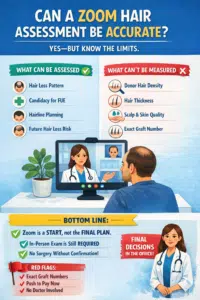
What Can Be Accurately Assessed During a Zoom Consultation

Hair Loss Pattern and Progression

An experienced Scottsdale hair transplant doctor can evaluate:

  • Male pattern hair loss (Norwood scale)

  • Female pattern hair loss (Ludwig / Sinclair)

  • Frontal recession vs crown loss

  • Diffuse thinning patterns

This helps determine suitability for hair transplant Phoenix patients and those seeking FUE in Scottsdale.


Candidacy for FUE Hair Transplant

During a Zoom consult, a doctor can identify:

  • Patients who should not yet undergo surgery

  • Those who need medical stabilization

  • Unrealistic expectations

  • High-risk donor situations

This step protects patients from unnecessary or premature procedures.


Hairline Design and Long-Term Planning

Proper hairline planning for FUE hair transplant Scottsdale includes:

  • Age-appropriate hairline placement

  • Future hair loss prediction

  • Conservative graft distribution

  • Donor preservation strategy

A good hair transplant in Phoenix is planned for decades—not months.


What Zoom Cannot Accurately Measure

Regardless of location, certain elements require an in-person exam.

Donor Hair Density

Accurate donor evaluation for FUE hair transplant Scottsdale requires:

  • Direct visualization

  • Magnification

  • Identification of safe extraction zones

This cannot be finalized virtually.


Hair Thickness and Miniaturization

Hair caliber significantly affects:

These details must be assessed in person for any hair transplant Phoenix procedure.


Scalp and Skin Characteristics

Scalp thickness, elasticity, and healing tendencies cannot be evaluated accurately via video.


Exact Graft Numbers

Ethical clinics provide ranges, not exact numbers, during Zoom consults.

Any clinic offering a precise graft count before an in-person exam is guessing—or selling.


How Ethical Scottsdale & Phoenix Hair Transplant Clinics Use Zoom

Reputable practices offering FUE hair transplant Scottsdale or hair transplant Phoenix will:

  • Use Zoom for education and screening

  • Clearly explain limitations

  • Provide conservative estimates

  • Confirm all findings in person before surgery

  • Finalize the plan only after donor evaluation

This approach reflects traditional surgical standards—supported by modern tools.


Red Flags During Virtual Hair Transplant Consultations 🚩

Avoid clinics that:

  • Lock you into a graft count online

  • Push immediate payment

  • Use sales consultants instead of doctors

  • Claim Zoom is as accurate as an in-office exam

  • Promise unrealistic density

These are signs of volume-based clinics, not surgical practices.


Bottom Line: FUE Hair Transplant Scottsdale & Hair Transplant Phoenix

A Zoom consultation is an excellent first step for patients considering:

But final surgical decisions must always be made in person.

Hair transplant surgery is permanent.
It should be planned carefully, ethically, and with long-term vision.


Considering FUE Hair Transplant in Scottsdale or Hair Transplant in Phoenix?

Start with a consultation led by a hair transplant physician, not a salesperson. Technology can assist—but medical judgment still matters most.

Then Hair 4 Life Medical is not just an option — it’s the standard.

Interested in learning more? Contact Us or call Hair 4 Life at (480) 525-4547 to schedule an appointment.

References

FUE Hair Transplant: What to Expect, Cost, Pictures, and More FUE Hair Transplant: Benefits, Process & Recovery Follicular Unit Extraction Hair Transplant – PMC            

 
Dr Ramona Kelemen

Dr Kelemen the founder of Hair 4 Life Medical

 
Scottsdale is known for luxury—but when it comes to hair transplantation, affordability has very little to do with discounts and everything to do with long-term value. Patients often ask whether a hair transplant in Scottsdale is “affordable.” The honest answer is this: it depends on who performs the surgery, how it’s done, and whether it’s done right the first time. This guide breaks down hair transplant costs in Scottsdale, what influences pricing, and why choosing the cheapest option often becomes the most expensive mistake.

What Does a Hair Transplant Cost in Scottsdale AZ?

In Scottsdale, hair transplant pricing typically ranges from $6,000 to $20,000+, depending on several factors. Clinics advertising prices far below this range usually rely on technician-driven models, high-volume scheduling, or shortcuts that compromise results. Cost alone tells you nothing unless you understand what you’re paying for.

Why Hair Transplant Prices Vary So Widely

Several variables influence the cost of a hair transplant in Scottsdale:
  • Who performs the surgery (physician vs. technicians)
  • Extent of hair loss and graft count required
  • Technique used (manual FUE, motorized FUE, FUT, or hybrid approaches)
  • Time and precision involved
  • Long-term planning and donor management
Clinics that quote prices without examining your donor area or hairline design are selling procedures—not medical care.

Affordable vs. Cheap: A Critical Difference

An affordable hair transplant is one that: A cheap hair transplant often results in:
  • Pluggy or unnatural hairlines
  • Overharvested donor areas
  • Poor growth or incorrect graft angles
  • The need for costly revision surgery
Repair cases routinely cost more than doing it correctly the first time.

The Hidden Costs Patients Don’t Consider

Many Scottsdale patients focus only on upfront price. What they overlook:
  • Lost donor hair cannot be replaced
  • Revision surgery is more complex and expensive
  • Emotional stress and downtime from poor outcomes
  • Ongoing camouflage treatments
True affordability means minimizing risk—not minimizing price.

Why Scottsdale Has Both High-End Clinics and High-Risk Ones

Scottsdale’s reputation attracts both elite surgical practices and aggressive marketing operations. Some clinics invest more in branding than medicine. Others quietly focus on results. Red flags include:
  • Sales consultants instead of physicians
  • Same-day discounts
  • One-size-fits-all pricing packages
  • Emphasis on speed over precision
Hair transplantation has always been about craftsmanship, not volume.

How to Judge Value Instead of Price

When evaluating affordability, ask:
  • Will the physician personally perform my procedure?
  • Is the clinic dedicated exclusively to hair restoration?
  • Does the surgeon have experience with repair cases?
  • Is my long-term hair loss being considered?
If those questions are answered clearly, cost usually makes sense.

Is a Hair Transplant in Scottsdale Worth the Investment?

For the right patient, performed by the right surgeon, a hair transplant is a one-time investment that delivers permanent, natural results. When done poorly, it becomes an ongoing expense. The most affordable hair transplant is the one that never needs to be fixed.

Final Thoughts: Affordability Is About Outcomes

Scottsdale offers a wide range of hair transplant pricing—but very few clinics deliver consistent, long-term results. Choose experience over deals. Precision over speed. Medicine over marketing. Because when it comes to hair transplant surgery, affordability is measured in decades—not dollars.

Considering a hair transplant in Scottsdale AZ? A proper consultation with a physician—not a salesperson—is the first step toward understanding true cost and real value.

The Bottom Line: Who Performs Your Hair Transplant Matters

If you’re looking for:

  • A physician-performed hair transplant in Phoenix or Scottsdale

  • Advanced FUE with refined tools like the WAW Slim

  • Natural, age-appropriate hairlines

  • A clinic that values craftsmanship over volume

Then Hair 4 Life Medical is not just an option — it’s the standard.

Because when it comes to permanent results, there is no substitute for a skilled doctor’s hands.

Interested in learning more? Contact Us or call Hair 4 Life at (480) 525-4547 to schedule an appointment.

References

FUE Hair Transplant: What to Expect, Cost, Pictures, and More FUE Hair Transplant: Benefits, Process & Recovery Follicular Unit Extraction Hair Transplant – PMC            

 
Dr Ramona Kelemen

Dr Kelemen the founder of Hair 4 Life Medical


Choosing a hair transplant clinic in Phoenix isn’t hard. Choosing the right one is. Phoenix is crowded with ads, med spas, consultants, and clinics that offer hair transplants as a side service. Hair restoration, when done properly, is surgery—meticulous, permanent, and unforgiving of shortcuts. This guide tells it like it is. If you want real results that stand the test of time, here’s how to separate true hair transplant clinics from marketing-driven operations.

Choose a Physician-Led Hair Transplant Clinic in Phoenix AZ

Why the Doctor Matters More Than the Brand

Traditionally, medicine has always been physician-led. Hair transplantation should be no different. When evaluating a Phoenix hair transplant clinic, ask one simple question: Who actually performs the surgery? If the answer is technicians, assistants, or the doctor only supervises, walk away. A legitimate hair transplant clinic should have:
  • A physician who personally designs the hairline
  • The same physician extracting grafts
  • The same physician placing grafts
Hair transplantation is not assembly-line work. It requires judgment, artistry, and surgical precision—skills earned over decades, not weekend certifications. If a clinic avoids answering who does the work, that tells you everything you need to know.

Avoid Med Spas Offering Hair Transplants in Phoenix

Hair Transplant Clinics vs. Med Spas

Phoenix has no shortage of med spas offering “hair restoration.” This is where many patients make their first mistake. A true hair transplant clinic:
  • Focuses only on hair restoration
  • Does not rotate between Botox, fillers, lasers, and weight loss injections
  • Is structured around surgery, not cosmetic add-ons
Hair transplantation is a specialty. Doctors who divide their attention between multiple procedures rarely master any of them. Depth beats variety—every time.

Hair Transplant Experience Matters More Than Technology

Why Skill Beats Robots and Gadgets

Technology is a tool. Skill is the difference-maker. In Phoenix, many clinics market robotic FUE systems or the “latest device.” What they don’t tell you is this:
  • No machine replaces surgical judgment
  • Poor technique with advanced tools still produces poor results
  • One-size-fits-all technology leads to cookie-cutter outcomes
A reputable clinic should be fluent in multiple extraction methods, including: The right clinic chooses the tool for the patient, not the patient for the tool.

Understanding FUE vs. FUT Hair Transplants in Phoenix AZ

Long-Term Donor Planning Is Critical

If a clinic pushes only one procedure, be cautious. In Phoenix, many clinics aggressively promote FUE while quietly avoiding discussions about donor management, scarring, or long-term planning. Ethical clinics explain:
  • When FUE is appropriate
  • When FUT may be beneficial
  • The long-term impact on the donor area
Hair loss is progressive. A proper clinic plans for your next 10–20 years, not just your next Instagram post.

Hair Transplant Consultations in Phoenix Should Be Doctor-Led

Red Flags During a Hair Transplant Consultation

A legitimate hair transplant consultation is:
  • Performed by a physician
  • Unhurried
  • Focused on medical history, donor quality, and expectations
Red flags include:
  • Non-medical “consultants” leading the discussion
  • Pressure to book the same day
  • Discounts that expire “today only”
Traditional medicine values evaluation before intervention. Any clinic rushing you into surgery is prioritizing volume over outcomes.

How to Evaluate Hair Transplant Before-and-After Photos

What Real Phoenix Hair Transplant Results Look Like

Phoenix clinics love dramatic photos—but look closer. Strong evidence includes:
  • Consistent lighting and angles
  • Multiple stages of growth (not just peak results)
  • Close-ups of the hairline and donor area
Be wary of:
  • Stock photos
  • Heavily styled hair
  • Results with no donor area shown
A confident clinic shows everything, not just the flattering angles.

Long-Term Care After a Hair Transplant in Phoenix AZ

Why Follow-Up Matters

Hair transplantation doesn’t end on surgery day. A serious Phoenix hair transplant clinic provides:
  • Direct access to the physician post-op
  • Long-term follow-up
  • Honest guidance on future hair loss
Clinics that disappear after the procedure are not clinics—they are transaction centers.

Ethical Hair Transplant Clinics in Phoenix AZ

Safety, Regulation, and Proven Medicine

Some clinics chase trends: unproven biologics, off-label treatments, or vague “regenerative” add-ons. Ethical clinics:
  • Follow U.S. medical regulations
  • Use evidence-based treatments
  • Put patient safety above marketing
Tradition in medicine exists for a reason—it protects patients.

Final Advice for Choosing the Best Hair Transplant Clinic in Phoenix AZ

Permanent Surgery Deserves Permanent Standards

Phoenix offers many options, but very few true hair transplant clinics. Choose the clinic that:
  • Is physician-led
  • Focuses exclusively on hair restoration
  • Has decades—not months—of experience
  • Prioritizes long-term planning over short-term hype
Hair transplantation is permanent. Marketing is temporary. If you choose wisely, your results will still look natural long after trends fade.
Looking for a physician-only hair transplant clinic in Phoenix, Arizona? A proper consultation with an experienced hair restoration doctor—not a salesperson—is the traditional and proven way to start.

The Bottom Line: Who Performs Your Hair Transplant Matters

If you’re looking for:

Then Hair 4 Life Medical is not just an option — it’s the standard.

Because when it comes to permanent results, there is no substitute for a skilled doctor’s hands.

Interested in learning more? Contact Us or call Hair 4 Life at (480) 525-4547 to schedule an appointment.

References

FUE Hair Transplant: What to Expect, Cost, Pictures, and More FUE Hair Transplant: Benefits, Process & Recovery Follicular Unit Extraction Hair Transplant – PMC Choosing the Right Hair Transplant Clinic: Key Factors The Definitive Guide to the Best Hair Transplant Clinics in the USA (2025 Edition) – Sport A Real          

 
Dr Ramona Kelemen

Dr Kelemen the founder of Hair 4 Life Medical


In modern medicine, technology should support the physician — not replace them. Hair transplant surgery is no exception.

Robotic systems like ARTAS have been marketed heavily over the past decade, often presented as a shortcut to better results. The truth is more nuanced. While robotics can play a limited role in hair transplantation, no robot can replace surgical judgment, experience, and artistry.

At Hair 4 Life Medical, we believe patients deserve transparency. That’s why we do not rely on robots alone to perform hair transplant surgery.

Hair Transplant Surgery Is Not an Assembly Line

Every scalp is different.

Hair angle, curl, caliber, density, skin elasticity, donor limitations, and future hair loss patterns vary from patient to patient. These variables must be assessed and adjusted in real time during surgery.

Robots follow algorithms.
Surgeons read tissue, adapt instantly, and protect long-term outcomes.

That difference matters.

Why Robotic Hair Transplants Have Been Controversial

Organizations such as the International Society of Hair Restoration Surgery (ISHRS) have raised concerns over the years regarding how robotic systems have been used — not because technology is bad, but because of how it has been misapplied.

Common concerns include:

  • Larger punch sizes used in earlier robotic systems, increasing donor scarring risk

  • Higher transection rates when hair characteristics are complex

  • Clinics using robots as a replacement for the physician, rather than a surgical tool

  • Uniform extraction patterns that fail to respect donor preservation

The biggest issue has never been the robot itself — it’s been doctors stepping away from the surgery.

A Robot Cannot Design a Natural Hairline

Hairline design is where experience shows.

Creating a natural, age-appropriate hairline requires:

  • Facial analysis

  • Understanding of gender differences

  • Knowledge of future hair loss progression

  • Artistic judgment developed over years of surgical practice

No robotic system can make those decisions. A robot cannot see a patient’s future — a trained hair transplant surgeon can plan for it.

Technology Should Assist, Not Replace, the Surgeon

Used responsibly, robotic tools can assist with:

  • Improving consistency in select extraction cases

  • Reducing surgeon fatigue during long procedures

  • Supporting manual techniques when carefully supervised

Used irresponsibly, they become a shortcut — and shortcuts in surgery usually show up later as poor density, donor damage, or unnatural results.

At Hair 4 Life Medical:

  • The doctor performs the critical steps

  • Technology is adjusted, overridden, or abandoned when the patient requires it

  • Manual and hybrid FUE techniques are used when they offer better outcomes

  • Patient selection comes before marketing claims

Why Surgeon-Performed FUE Still Matters

Hair transplantation is permanent. Mistakes cannot be undone easily.

Surgeon-performed FUE allows for:

  • Individual graft selection

  • Customized punch sizing

  • Real-time response to bleeding, scarring, or hair angle changes

  • Better donor area preservation

  • More natural, dense, long-term results

This is why many of the most respected hair transplant surgeons worldwide continue to rely primarily on manual or hybrid techniques, even as technology evolves.

The Bottom Line

Robots don’t replace doctors.
They never should.

The future of hair restoration isn’t about choosing between tradition and technology — it’s about combining time-tested surgical principles with modern tools, under the hands of an experienced physician.

If a clinic markets the robot more than the surgeon, that tells you everything you need to know.

Looking for a surgeon, not a machine?

A one-on-one consultation with a physician — not a consultant — is the best way to determine which technique is right for you.

Then Hair 4 Life Medical is not just an option — it’s the standard.

Because when it comes to permanent results, there is no substitute for a skilled doctor’s hands.

Interested in learning more? Contact Us or call Hair 4 Life at (480) 525-4547 to schedule an appointment.

References

FUE Hair Transplant: What to Expect, Cost, Pictures, and More News: The Rise and Fall of ARTAS: Robotic Hair Transplant Surgery ARTAS® Robotic Hair Transplant | Venus Treatments USA What Is ARTAS Robotic Hair Transplant and Is It Really Better? ARTAS System – EverybodyWiki Bios & Wiki ARTAS Hair Transplant: Cost, Before and After and Reviews