Introduction: Finding the Right Balance Between Technology and Artistry
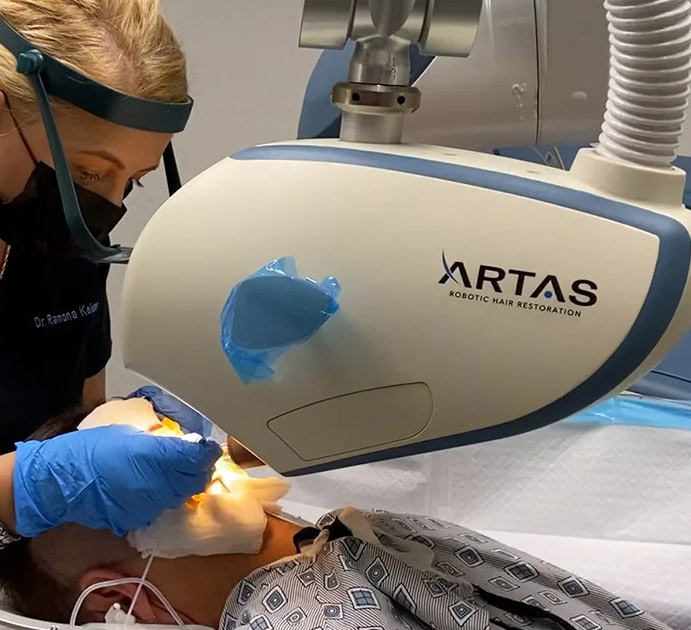
In the world of hair restoration, ARTAS has become a buzzword—robotics, AI mapping, no-hand fatigue. It’s marketed as the pinnacle of precision. But here’s the truth: calling ARTAS “the best FUE” frequently reflects deeper gaps—in the robot or in the doctor’s skills. In contrast, the top practices blend art, judgment, and tool mastery. This extended blog unpacks:- What ARTAS does well — and where it fundamentally falls short
- How reliance on the system may hint at missing surgical finesse
- The enduring strengths of handheld FUE techniques
- How Hair 4 Life Medical (Dr. Kelemen) harmonizes both to deliver exceptional, patient-centered results
1. What ARTAS Excels At—and Where It Fails
Key Advantages of ARTAS
- Consistent Precision & Efficiency ARTAS leverages AI and robotics for consistent, fatigue-resistant graft extraction—often achieving 300–600 grafts per hour.
- Reduced Fatigue for Practitioners A robotic arm doesn’t tire—maintaining accuracy where manual extraction might wane.
- Ideal for High-Volume Cases The ability to maintain steady pace and extraction patterns can facilitate large sessions.
- Randomized Extraction Minimizes Thinning Spots The algorithm avoids overharvesting from one donor area.
- Virtually Invisible Scarring Like manual FUE, ARTAS leaves dot-like scars—no linear scarring typical of strip surgery. But due to anchoring the dot scars are much larger.
Significant Limitations of ARTAS
- Lacks Surgical Judgment & Artistic Design ARTAS can’t adjust to hairline curvature, twirls, density, or symmetry—it’s precision without artistry.
- Poor Performance on Curly or Fine Hair Its imaging software struggles to detect subtle follicles, limiting effectiveness with non-straight hair types.
- Limited Donor Harvest Scope ARTAS can only extract from the mid-back and sides of the scalp—not body hair or expansive donor zones.
- Larger Punch Size Means Higher Scarring Risk ARTAS typically uses ~1mm punches, versus 0.75–0.95mm in skilled manual FUE for finer healing.
- Higher Graft Transection Rate for Certain Cases Although efficient, graft survival may be lower—particularly when hair type or scalp anatomy complicate extraction.
- Expensive & Rarely Accessible With a $200k–$250k price tag, ARTAS is only offered in 5% of clinics worldwide, driving up patient cost.
2. When Doctors Lean Too Much on ARTAS, It Can Signal Deeper Issues
Why Heavy Reliance on ARTAS Can Indicate Lack of Skill
- Automated Crutch for Less-Skilled Practitioners Some doctors use robotics to compensate for weaker manual technique—relying on a machine rather than honing their craft.
- Misuse in Complex Cases ARTAS cannot navigate curls, irregular crowns, or tight donor skin—yet is still used in such cases by clinics over-promoting its abilities.
- Inferior Aesthetic Outcomes in Some Instances Patients report “moth-eaten” donor zones, mis angled grafts, and unnatural hairlines—a result of robot-plus-inexperienced execution, not technique.
- Patient Critiques Emphasize Human Touch
“A robot just can’t perform such a nuanced task… I prefer a doctor’s hand.” See broader user sentiments across forums.
3. Why Handheld FUE Remains a Gold Standard
Raw Control, Real Tactility
- Surgeons feel resistance, gauge tissue depth, adjust angle in real time—factors a robot can’t replicate.
- Handheld punches allow for customizable design—ideal for matching growth direction, curl, and density nuances.
Precision Scarring and Graft Picking
- Hand tools allow smaller punch sizes, less scarring, and targeted donor harvesting.()
- Skilled surgeons can harvest denser areas with care, preserving donor sites for future use.
Better for Complex Cases
- Curly, ethnic, or <1mm thick hair types—manual techniques better accommodate variance.
- Surgeons adjust techniques dynamically mid-procedure—robots cannot.
High Survival Rates and Artistry
- Graft survival in skilled manual FUE can approach ~99%, with natural aesthetics and density.()
- Manual artistry ensures tailored design, matching individual face shape, age, and gender cues.
4. The Balanced Approach of Hair 4 Life Medical
Dr. Ramona Kelemen: Master of Both Art and Tools
- Offers full spectrum—ARTAS, WAW, uGraft, SAFE, long-hair, No Shave, manual FUE—choosing what fits each case best.
- Every procedure is fully physician-led, with zero delegation to techs—preserving artistry and oversight.
- Hybrid methodology: uses ARTAS when appropriate but defaults to handheld finesse for intricate zones.
- Integrates healing modalities—e.g., HBOT, trichology, Regenera Activa—for elevated recovery and outcome quality.
Why Patients Trust Hair 4 Life Medical
- Customized, not canned: each treatment path is patient-aligned, not equipment-driven.
- Transparent about tools vs artistry—ARTAS is a tool, not the artist.
- Exemplifies alta fidelity: skilled hands with tech enhancement, not tech dependence.
5. Voices from Patients: Lessons Learned
“Seen terrible results… I would rather a doctor’s hand than a robot.” “ARTAS transected 20% of my grafts—city had to fix it manually.” “Robots can’t match artistry. Manual surgeon gave me natural hairline.”These quotes underscore the value of artistry, control, and tailored execution over automated precision.
6. Full Comparison: ARTAS vs. Handheld FUE in Practice
| Factor | ARTAS (Robotic) | Handheld Manual FUE | Hybrid Approach (e.g., Hair 4 Life Medical) |
|---|---|---|---|
| Precision | High consistency per pattern | High, with surgeon adaptability | High precision + artistic flexibility |
| Transection/Graft Viability | Moderate risk, depends on patient anatomy | Lower risk in skilled hands | Max viability through tool selection |
| Adaptability to Hair Type | Poor with curly/fine hair | Excellent, versatile | Adapts method to hair type |
| Artistic Control | None—robot extracts only | Full creative control | Art meets tool—best of both |
| Recovery & Scarring | Minimal scarring but larger punch size | Minimal scarring, optimized healing | Healing supported with holistic care |
| Surgeon Involvement | Limited to pre/post steps | Complete supervision | Doctor-led throughout |
| Cost & Access | High equipment cost, limited availability | Lower cost, broadly available | Balanced pricing, selective tool deployment |
7. Why “Best FUE” Isn’t About the Tool—it’s About the Team
- If ARTAS is pitched as a replacement rather than an adjunct, that’s a lane-marking red flag.
- What matters most: surgeon skill, patient-specific tactics, flexibility, and empathetic care.
- At Hair 4 Life Medical, ARTAS isn’t the centerpiece—it’s one of many instruments chosen thoughtfully.
8. FAQs: ARTAS vs Manual FUE—Real Questions, Real Answers
Q: Who benefits most from an ARTAS transplant? A: Patients with straight, dark hair and a flat donor zone—requiring large graft counts and seeking minimal scarring. Q: What about curly or fine hair? A: ARTAS often mismaps or misses grafts—manual FUE is usually the superior choice. Q: Does ARTAS improve graft survival? A: It matches or slightly improves survival in ideal cases, but in complex cases manual FUE can surpass ARTAS. Q: Is the robot cheaper or faster for clinics? A: No—it’s expensive to own and maintain, so patient pricing often increases. Manual FUE is sustainably cost-effective. Q: Can the robot handle hairline or crown design? A: No. The robot only assists extraction. Design and implantation remain manual artistry verifiably critical.9. Real-World Comparisons and Data
- Graft survival: Manual FUE ~97–99%, ARTAS ~90–95%. Public forum data and surgical studies.
- Adoption rate: ARTAS used in less than 5% of clinics worldwide.
- Cost premium: 20–40% higher per graft for ARTAS vs. manual methods in similar markets.
- Real patient outcomes: Repair requests after ARTAS are common; manual clinics like Hair 4 Life report far fewer corrective cases.
10. Conclusion: Art, Technology, and Integrity
Robots, including ARTAS, are powerful tools—but not replacements. Declaring them “the best FUE” may signal that fundamental surgical skill and artistry are being bypassed. In authentic hair restoration, success comes from:- A doctor’s judgement, nuance, and design sense
- Adapting technology to the person—not the person to the tech
- Holistic patient care beyond the graft
👉 Ready to restore your hair? Schedule a consultation with Dr. Kelemen today!
Interested in learning more? Contact Us or call Hair 4 Life at (480) 525-4547 to schedule an appointment.References
What Is ARTAS Robotic Hair Transplant and Is It Really Better? FUE Hair Transplant: What to Expect, Cost, Pictures, and More ARTAS® Robotic Hair Transplant | Venus Treatments USA ARTAS Hair Transplant Benefits, Cost | RealSelfThe ARTAS Robotic System
- Wimpole Clinic,
- Chaffoo, Richard (californiahairmd.com)
- The Clifford Clinic
- Dr Serkan Aygin Clinic
- Bernstein Medical Center
- hairrestorationpittsburgh.com
- Medihair
- DR. Emrah CINIK
- hairrestorationpittsburgh.com
- The Clifford Clinic
- californiahairmd.com
- Jae Pak MD
- Mane Advanced Hair
- Coastal Dermatology Institute
- Dr. Yates Hair Science