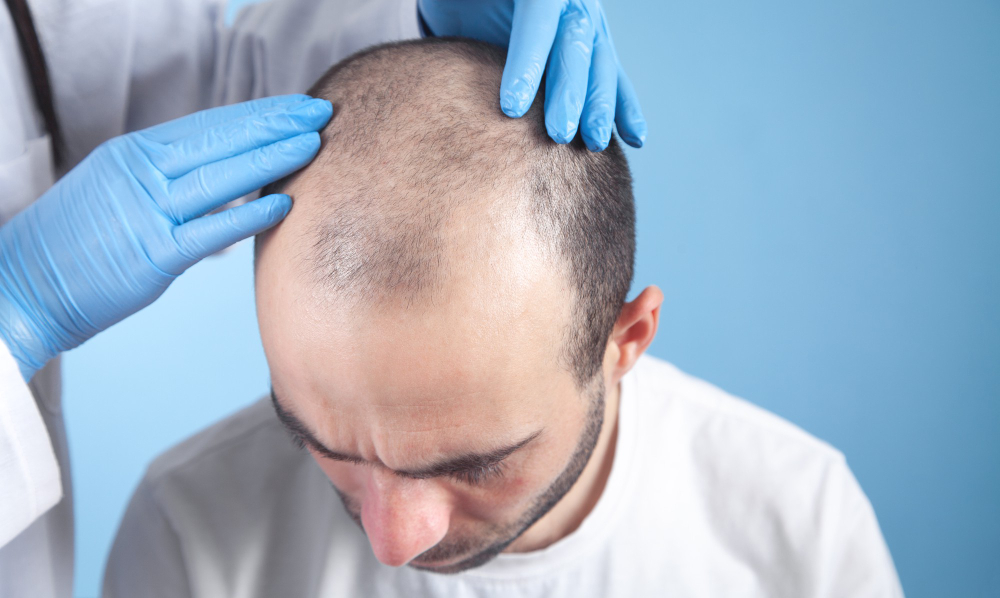
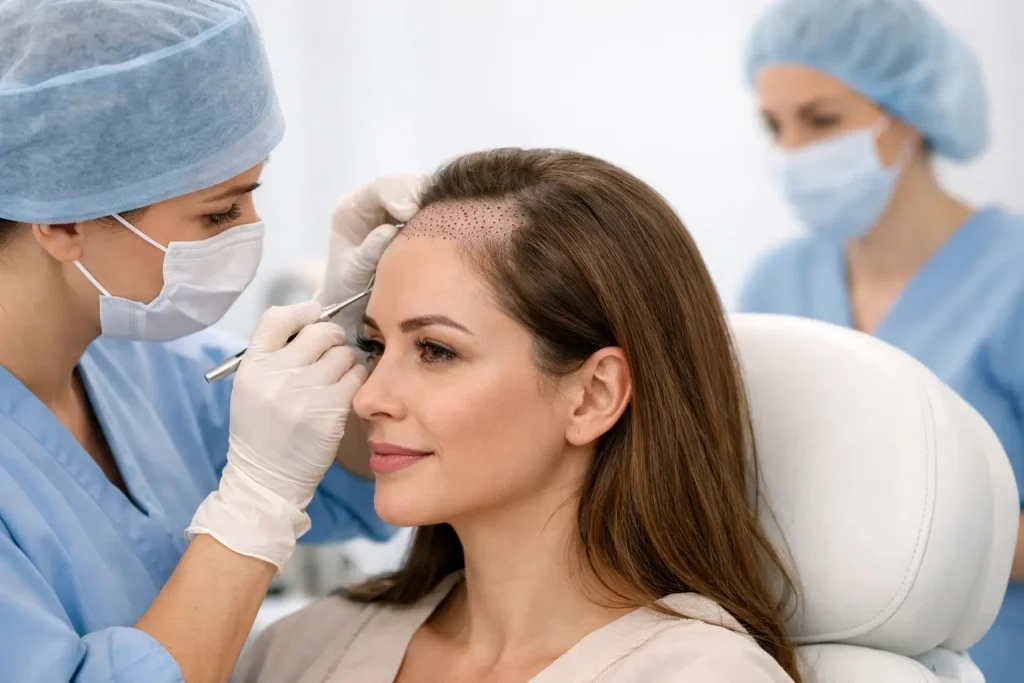
A widening part can feel very different from a receding hairline, but the question is often the same: can women get FUE transplants? Yes, many women can. The more accurate answer is that some women are excellent candidates for FUE, some are better served by another procedure, and some need medical treatment first because surgery alone would not address the real cause of shedding.
That distinction matters. Female hair loss is often more medically complex than male pattern baldness, and a careful diagnosis is what separates a good plan from a disappointing one.
Can women get FUE transplants for all types of hair loss?
Not for all types. FUE, or follicular unit extraction, works by removing individual follicular units from a stable donor area and placing them into areas with thinning or visible scalp. For the procedure to succeed, the donor hair must be strong and resistant to the same loss process affecting the recipient area.
In women, that is not always straightforward. Some have a stable donor zone and localized thinning, which makes FUE a very good option. Others have diffuse thinning that affects the entire scalp, including the donor region. In those cases, extracting grafts may weaken the back and sides without delivering durable density where it is needed.
This is why a proper workup comes first. A physician-led evaluation should look at the pattern of loss, miniaturization, scalp health, medical history, hormonal influences, family history, and whether the shedding is ongoing or stable.
When FUE can work very well in women
Female patients often do well with FUE when the issue is limited and clearly defined. That can include temple recession, traction-related thinning after the damaging tension has stopped, brow restoration, scar camouflage, or restoring density in an area where the surrounding donor hair remains strong.
Women with high foreheads or naturally sparse hairlines may also be good candidates if the goal is hairline softening rather than trying to cover a very large area. In these cases, FUE can create a refined, natural-looking result because graft placement can be highly controlled.
Some women are also candidates for no-shave FUE or long-hair FUE, depending on hair characteristics and surgical goals. These approaches can make the process more discreet, which is often important for professionals and anyone who does not want an obvious sign of surgery during recovery.
When FUE may not be the best first choice
The biggest limitation is diffuse, unstable hair loss. If thinning is active across the top, sides, and back of the scalp, the surgeon has less reliable donor hair to work with. In that setting, surgery can become an attempt to redistribute already limited density.
Women with telogen effluvium, active inflammatory scalp disease, or untreated hormonal imbalances may also need treatment before surgery is even considered. If the underlying condition continues, transplanted hair may survive while surrounding native hair keeps thinning, leaving an uneven overall result.
There are also cases where FUT, DHI, medical therapy, scalp micropigmentation, regenerative treatment, or a combined plan may make more sense than FUE alone. A trustworthy clinic does not force every patient into the same solution. It matches the treatment to the diagnosis.
What makes a woman a good candidate for FUE?
A strong candidate usually has a defined area of concern, enough donor density, and a loss pattern that appears stable or predictable. The scalp should be healthy enough for healing, and expectations should be realistic. FUE can improve density and shape, but it does not create unlimited volume.
Hair caliber matters too. Coarser hair often creates better visual coverage than finer hair, so the number of grafts needed can vary widely from one patient to another. Curl pattern, contrast between hair and scalp, and styling habits also affect planning.
In women, candidacy is especially dependent on diagnosis. Female pattern hair loss can present as diffuse central thinning with preservation of the frontal hairline, but not every case follows the textbook pattern. Some patients have patchy loss, some have frontal accentuation, and some have mixed causes. That is why magnified scalp analysis and a detailed history are more than formalities. They guide whether surgery is appropriate at all.
Why diagnosis comes before graft count
Many patients start by asking how many grafts they need. For women, the better first question is why the hair is thinning. A graft count only becomes meaningful once the cause and pattern are understood.
For example, a woman with traction alopecia at the temples may need a relatively modest number of grafts and enjoy a very satisfying cosmetic change. A woman with widespread miniaturization may technically be able to undergo FUE, but the long-term value could be poor if the donor area is not truly stable.
This is also where medical expertise matters. Hair loss in women can be tied to androgen sensitivity, thyroid changes, iron deficiency, stress-related shedding, autoimmune disease, menopause, medications, or scalp inflammation. If those issues are missed, surgery may be offered too early or for the wrong reason.
What the FUE procedure looks like for women
FUE is a minimally invasive harvesting method. Individual follicular units are extracted one by one, then sorted and implanted into the target area according to angle, direction, and density goals. The artistry is not optional. In female hair restoration, especially around the hairline or temples, small mistakes in design are easy to see.
The procedure is typically done under local anesthesia. Recovery is usually measured in days rather than weeks, though the full cosmetic result takes much longer because transplanted follicles enter a temporary resting phase before regrowth begins.
Most women can expect shedding of the implanted hairs early on, then gradual regrowth over several months. Meaningful improvement often starts to become visible around the four- to six-month mark, with continued maturation after that.
Are results natural in women?
They can be extremely natural when the case selection and design are correct. The challenge is that female restoration often requires subtlety rather than dramatic reconstruction. The goal may be softening a hairline, reducing scalp show-through, or restoring a delicate transition zone. That calls for careful control of graft type, placement, and density.
Natural results also depend on respecting the existing hair. In women with retained native strands in the treatment area, implantation must be done thoughtfully to reduce unnecessary trauma to those hairs. This is one reason physician experience matters so much.
At Hair For Life Medical, that physician-led approach is central to planning because women are rarely best served by a one-size-fits-all transplant formula. The most successful outcomes usually come from aligning surgery with the patient’s biology, goals, lifestyle, and long-term hair loss risk.
Can FUE be combined with non-surgical treatment?
Often, yes, and that is frequently the smartest plan. Many female patients benefit from combining FUE with medical management or regenerative therapies that support native hair. Surgery can restore density where it has already been lost, while non-surgical treatment can help stabilize ongoing thinning.
That balance is especially helpful in women who have both a transplantable area and a broader tendency toward miniaturization. Treating only one side of the problem can limit the final result.
Questions women should ask at a consultation
A good consultation should not feel like a sales pitch. It should clarify the diagnosis, explain whether the donor area is stable, discuss alternatives, and set realistic expectations about density and timeline.
Ask what type of female hair loss you have, whether the donor zone shows miniaturization, whether medical treatment is recommended before surgery, and whether FUE or another approach is actually the best fit. Also ask who performs the key parts of the procedure. In hair restoration, technique and consistency matter.
The bottom line on whether women can get FUE transplants
Yes, women can get FUE transplants, and for the right candidate the procedure can be transformative. But female hair restoration is not simply the male model applied to a different patient. It requires diagnosis first, surgical judgment second, and a treatment plan built around long-term hair health rather than a quick cosmetic fix.
If you are considering FUE, the most valuable next step is not chasing a number of grafts. It is getting a careful evaluation from a clinic that understands the many reasons women lose hair and is willing to tell you when surgery is right, when it is not, and when another path may serve you better.