A higher or thinning hairline can change far more than a photograph. It may make styling feel limiting, expose a scar, or create a facial frame that no longer feels like your own. Female hairline restoration results can be remarkably natural, but the best outcomes begin long before a graft is placed. They depend on correctly identifying why the hairline changed, designing for the individual face, and protecting the hair that remains.
For some women, the concern is a naturally high hairline that has been present for years. For others, the change is related to traction, hormonal shifts, genetic thinning, menopause, inflammatory scalp conditions, or a previous procedure that did not heal or grow as expected. These are not interchangeable situations. A hairline transplant may be an excellent option in one case and the wrong first step in another.
What Female Hairline Restoration Results Should Look Like
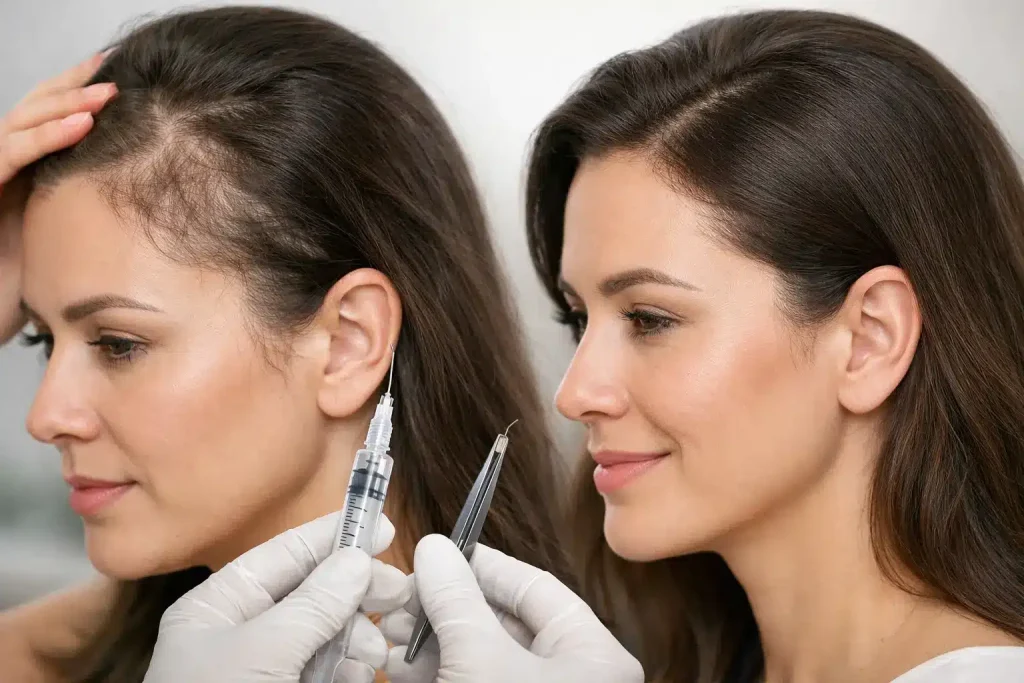
Natural results do not announce themselves as a procedure. The goal is a softer, age-appropriate hairline with irregularity that mirrors how native hair grows. A convincing female hairline is rarely a straight line. It has gentle variation, subtle points, and single-hair grafts placed at thoughtful angles so the transition into existing density appears gradual rather than abrupt.
Hairline lowering can create a meaningful change with a relatively modest number of grafts when the primary concern is facial framing. Density restoration is different. If thinning extends behind the hairline or across the top of the scalp, concentrating every available graft at the very front may create a stronger initial frame while leaving inadequate coverage behind it. This is why results must be designed around both the current appearance and the likely future pattern of loss.
The most satisfying outcome is not necessarily the lowest possible hairline. It is the hairline that fits the patient’s facial proportions, age, donor supply, and long-term goals. Lowering too aggressively can use grafts that may be needed later and can produce a look that becomes less natural over time.
The Diagnosis Behind a Successful Result
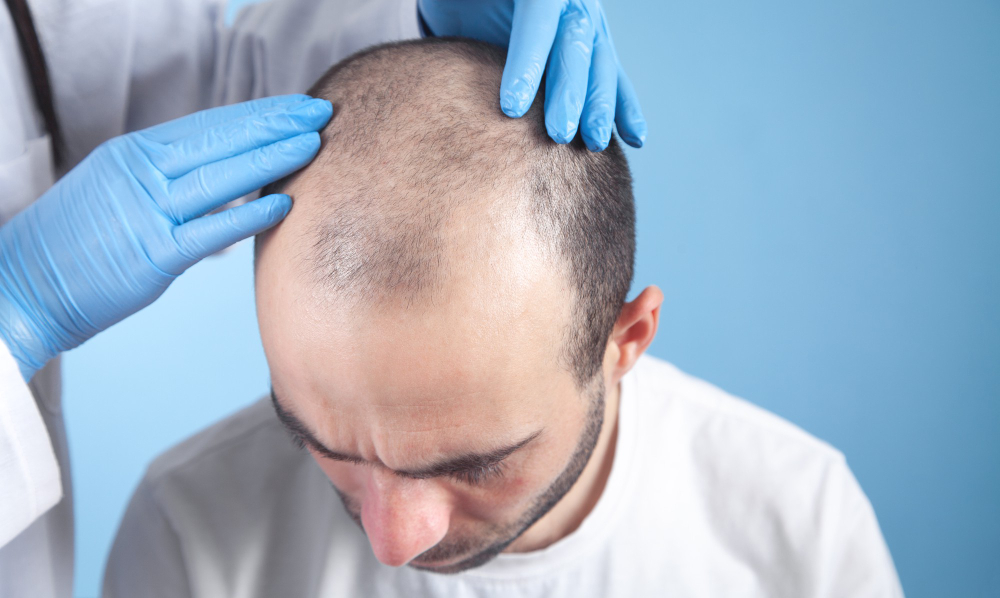
Women often experience hair loss differently from men, and a visible recession at the temples is only one possible pattern. Diffuse thinning can reduce density throughout the scalp while keeping the front edge relatively intact. Other patients develop widening at the part, loss around the temples, or a receding frontal hairline. A doctor-led evaluation should distinguish stable hairline shape from active hair loss before surgical planning begins.
This may involve a detailed health history, scalp examination, microscopic assessment, laboratory or hormone evaluation when appropriate, and discussion of medications, nutritional factors, and family history. Inflammatory conditions and certain forms of scarring hair loss require particular caution. Transplanting into an actively inflamed scalp may compromise growth and can worsen the overall situation.
When active thinning is present, medical treatment or regenerative support may be recommended before or alongside surgery. Options can include physician-guided medications, hormone evaluation, laser therapy, injectable approaches, platelet-based treatments, or regenerative therapies, depending on the diagnosis. These treatments do not replace every transplant, and a transplant does not replace the need to manage progressive loss. The right plan often uses both.
How Surgical Technique Shapes the Hairline
FUE and FUT are donor-hair harvesting methods, not different styles of hairline. Either may be appropriate when performed with precise graft selection and implantation. FUE removes individual follicular units from the donor area, while FUT obtains donor follicles through a carefully planned strip. The better option depends on hair characteristics, donor density, scalp flexibility, previous procedures, desired hairstyle flexibility, and the number of grafts needed.
For a refined front edge, the surgeon typically selects naturally occurring single-hair follicular units. These are placed in the leading zone of the hairline, while grafts containing more hairs may be used behind them for density. Direction matters as much as graft count. Hair that exits the scalp at the wrong angle or points away from its natural flow can look noticeable even when it grows well.
Female patients may also prioritize discretion during recovery. No-shave FUE or long-hair FUE can be considered for selected candidates who want to minimize visible evidence of the procedure. These approaches can be valuable, but they are not automatically the best choice for every scalp or every graft goal. They require careful planning and may involve practical trade-offs in procedure time, cost, or the number of grafts that can be placed efficiently.
A Realistic Timeline for Growth
Patience is part of every honest conversation about hairline restoration. The transplanted hairs commonly shed within the first few weeks after surgery. This is expected. The follicles remain beneath the scalp and enter a resting phase before new growth begins.
Early new hairs may appear around three to four months, often fine and uneven at first. By six months, many patients begin to see clearer cosmetic change, though growth rates vary. The hairline usually looks more developed between nine and 12 months, with continued refinement in texture, caliber, and density up to 12 to 18 months.
Temporary redness, small scabs, and mild swelling can occur during the first phase of healing. Following aftercare instructions matters, especially around washing, exercise, sun exposure, and avoiding friction on newly placed grafts. The donor area also needs to be treated as a long-term resource, not an unlimited supply.
Factors That Can Affect Female Hairline Restoration Results
No ethical physician should promise an identical result for every patient. Hair growth is biological, and several variables influence the final appearance. Donor quality, graft survival, scalp health, hair texture, contrast between hair and skin, and the presence of ongoing hair loss all matter. Curly or wavy hair often creates visual fullness with fewer grafts than very straight, fine hair. Dark hair against lighter scalp skin may require more density to achieve the same cosmetic coverage.
Prior procedures can add complexity. Patients seeking correction after pluggy grafts, visible scars, or an unnaturally placed hairline may need a staged approach. Scar tissue has a different blood supply from healthy scalp, and the repair may involve grafting, scar revision, scalp micropigmentation, or a combination of treatments. The first priority is to create a believable direction and softer transition, not to chase maximum density in a single session.
Transgender hairline restoration also deserves individualized design. The objective may be to reduce temple recession, round the frontal corners, or create a more traditionally feminine frame while respecting donor limitations and hormone-related changes. Careful facial analysis is especially valuable in these cases.
Questions Worth Asking Before You Decide
A productive consultation should leave you clearer, not pressured. Ask what diagnosis is driving the hairline concern, whether loss appears stable, and whether non-surgical treatment should come first. Ask how many grafts are proposed, where they will be placed, how the donor area will be protected, and what the plan would be if thinning progresses.
It is also reasonable to ask who performs each part of the procedure. Hairline work is detail-sensitive. The physician’s role in design, graft handling, and implantation can influence the refinement of the final result. At Hair For Life Medical, this physician-centered planning is paired with a full review of surgical and non-surgical options, so patients can make decisions based on their own diagnosis and priorities.
Bring photographs that show the hairline you had in earlier years, if available, but remain open to a design that accounts for your current anatomy and future hair needs. A good result should feel like a return to balance, not like someone else’s hairline placed on your face.
The most helpful next step is a thorough evaluation that treats your concern with the same care as the result you hope to see. When the cause is understood and the plan respects both your goals and your long-term donor supply, hairline restoration can provide a quiet, lasting change in confidence.