Hair shedding in the shower is one thing. Seeing your part widen, your ponytail shrink, or your scalp show through under bright Arizona sun is different. If you are searching for a Phoenix female hair loss specialist, you are likely past generic advice and ready for real answers about why your hair is changing and what can actually be done.
Female hair loss is often misunderstood because it does not always follow a simple pattern. Many women do not develop a sharply receding hairline or obvious bald spot. Instead, they notice diffuse thinning, loss of density at the crown, increased shedding, or a texture change that makes the hair feel weaker and less forgiving. That difference matters because the right diagnosis shapes everything that comes next.
Why a female hair loss specialist matters
Women with hair loss are frequently told to wait, reduce stress, or try a product for a few months. Sometimes that advice is harmless. Sometimes it delays treatment while the condition progresses. A specialist who regularly evaluates female hair loss looks beyond the surface and asks the more useful question: what is driving it?
The answer may be hormonal change, genetics, menopause, thyroid issues, nutritional deficiency, inflammatory scalp disease, traction, autoimmune activity, or a combination of factors. In many women, the problem is not one cause but several acting at once. That is why a specialist approach is different from a one-size-fits-all recommendation.
An experienced physician-led practice also understands that female patients often need a broader treatment plan than men do. Some women are strong candidates for medical therapy alone. Others need regenerative support, hormonal evaluation, scalp treatment, or surgery planned with exceptional conservatism and artistry. The goal is not simply to add hair. It is to restore density in a way that looks natural, age-appropriate, and sustainable.
What a Phoenix female hair loss specialist should evaluate
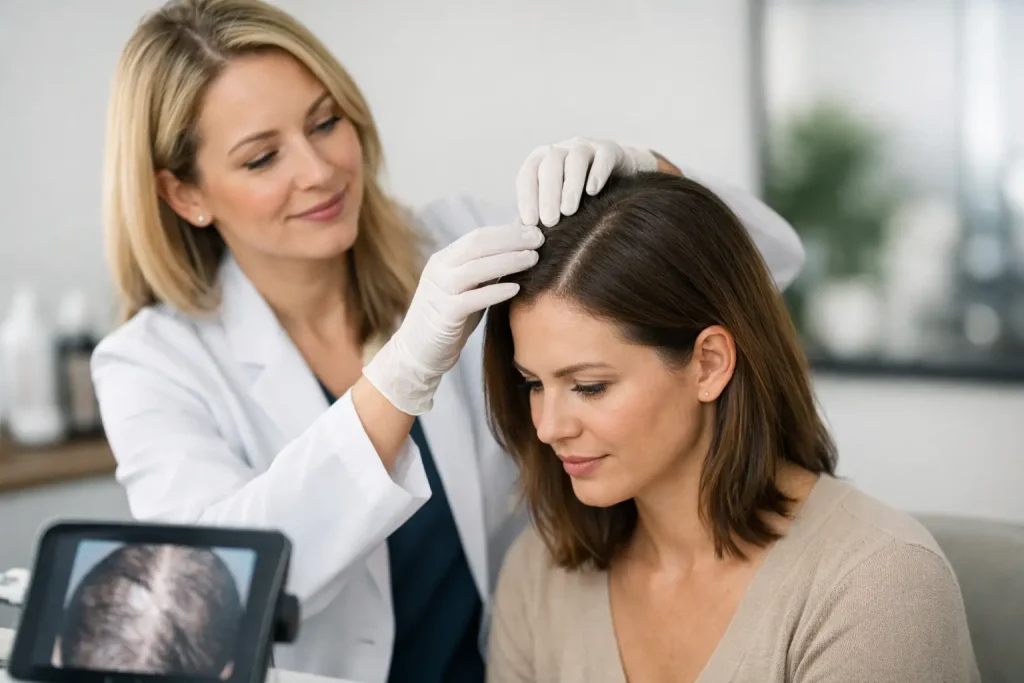
A proper consultation should feel diagnostic, not sales-driven. That means your visit should focus on pattern recognition, medical history, scalp condition, family history, shedding timeline, and lifestyle factors that may influence the treatment plan.
Hair loss pattern and progression
Not all thinning is the same. Female pattern hair loss usually presents as widening through the central part or reduced density across the top of the scalp while preserving the frontal hairline. Telogen effluvium often causes diffuse shedding after illness, stress, medication changes, childbirth, or weight loss. Scarring forms of alopecia can look subtle early on but require prompt treatment to protect follicles before loss becomes permanent.
A specialist should be able to distinguish among these possibilities and explain what they are seeing in plain language.
Scalp health and follicle status
Healthy growth depends on more than the visible hair shaft. Inflammation, miniaturization, scarring, poor scalp condition, and reduced follicular activity all affect what kind of improvement is realistic. Scalp analysis can help clarify whether follicles are dormant, shrinking, or no longer viable.
That distinction matters because some treatments are designed to preserve and strengthen existing hair, while others are more appropriate when restoration requires transplantation.
Hormonal and medical contributors
Many women first notice hair changes around pregnancy, perimenopause, menopause, or after a shift in medications. Others have underlying metabolic or endocrine factors. A serious evaluation may include discussion of hormones, thyroid function, nutrient status, genetics, and overall health.
This is one of the clearest signs you are with the right specialist. If your hair loss is being treated without asking why it started, the plan may be incomplete.
Treatment options should match the cause
The best specialist is not the one who offers the most aggressive procedure first. It is the one who can present the full range of options and explain which approach makes sense for your stage of loss, hair characteristics, goals, and comfort level.
For many women, non-surgical care is the right starting point. Depending on the diagnosis, that may include medication, hormone-based treatment, injectables, laser therapy, regenerative approaches such as Regenera Activa AMT, TricoPat, PDO threads for hair loss, or other therapies meant to support follicle health and slow progression. Some patients benefit from combining several modalities because preserving miniaturizing hair often requires more than one tool.
Surgery can also be an excellent option, but only when planned correctly. Female hair transplantation is highly technical. The surgeon must consider donor density, existing native hair, styling patterns, long-term progression, and whether the patient wants a no-shave or long-hair approach for privacy. In women, the challenge is often not creating a new hairline from scratch. It is adding density between existing hairs without damaging what is already there.
That is why physician skill matters so much. Technique, graft handling, angle placement, and recipient-site design can make the difference between a result that disappears into your natural hair and one that looks thin, obvious, or poorly matched.
When surgery makes sense for women
Not every woman with thinning is a transplant candidate. That is worth saying clearly, because honest care includes knowing when not to recommend surgery.
A transplant may make sense when hair loss has become stable enough to plan around, donor hair is adequate, and the main issue is loss of density in a defined area such as the frontal scalp, temples, eyebrows, or along a scar. It can also be appropriate for women with traction-related loss or for those who need corrective work after a poor prior procedure.
It may not be the right first step if the shedding is active and diffuse, if the diagnosis is uncertain, or if the donor area is also weakening. In those cases, medical stabilization usually comes first. A good specialist will tell you when patience is the smarter move.
What sets a high-level specialist apart
If you are comparing clinics, the difference is not just the list of services. It is the quality of decision-making behind them.
A true specialist in female hair restoration should have deep experience with both diagnosis and treatment selection. That includes understanding when to use FUE, FUT strip, DHI, robotic options, regenerative medicine, hormone-based support, scalp micropigmentation, or corrective surgery, and when not to use them. Breadth matters because women do not all need the same solution.
Doctor involvement matters too. Female cases often require careful graft placement around existing hair, nuanced hairline and density planning, and close attention to concealment and recovery preferences. A physician-centered approach gives patients more confidence that the plan is being shaped by medical judgment rather than by a preset sales script.
In Scottsdale and the greater Phoenix area, Hair For Life Medical stands out for exactly that reason. Dr. Ramona Kelemen brings more than two decades of hair restoration experience, a rare level of procedural skill, and a treatment philosophy centered on individualized care rather than pushing one procedure. For women who want both answers and options, that kind of specialization is meaningful.
Questions worth asking at your consultation
The best consultations are two-way conversations. You should leave with more clarity than you had when you arrived.
Ask what type of hair loss the physician believes you have and how confident they are in that diagnosis. Ask whether the plan is meant to preserve existing hair, regrow miniaturized hair, restore missing density, or all three. Ask what kind of timeline is realistic, because many treatments require months before visible change appears.
It is also smart to ask about trade-offs. Will a treatment require ongoing maintenance? Is there downtime? Could the hair loss continue around transplanted areas? Are you being offered a staged plan because it is medically appropriate, or because the clinic cannot provide a broader range of care? Those questions often reveal the depth of the practice.
Natural results come from restraint
For women, the most successful restoration rarely announces itself. It simply looks like your hair came back.
That usually means conservative planning, respect for existing hair, and a strategy built around long-term harmony rather than short-term drama. More grafts are not always better. Lower is not always better. Faster is not always better. The right plan is the one that fits your biology and protects your options over time.
Hair loss can feel intensely personal, but the evaluation should be grounded, specific, and calm. A skilled specialist will not dismiss your concerns, and they should not rush you into a decision either. They should help you understand what is happening, what can improve, and what path makes sense for you now.
If you are looking for a Phoenix female hair loss specialist, look for one thing above all: someone who sees more than the symptom. When the diagnosis is thoughtful and the treatment plan is truly individualized, confidence tends to follow.