If you are searching for a hair loss doctor Scottsdale patients trust, you are probably past the point of wanting vague advice. You want to know what is causing the shedding, whether it can be stabilized, and what options make sense for your stage of loss, budget, and goals. That is a medical question first and a cosmetic question second.
Hair loss is not one condition. Male pattern baldness, female pattern thinning, traction-related damage, hormonal shifts, autoimmune causes, scarring alopecia, failed transplants, and eyebrow or beard loss all behave differently. A good evaluation should never start with a one-size-fits-all procedure. It should start with diagnosis.
What a hair loss doctor in Scottsdale should actually do
The right physician does more than confirm that you are thinning. A true hair restoration specialist studies the pattern, speed, and likely cause of loss, then matches treatment to what your scalp and donor area can realistically support. That distinction matters because some patients need surgery, some need medical therapy, and many need a combination.
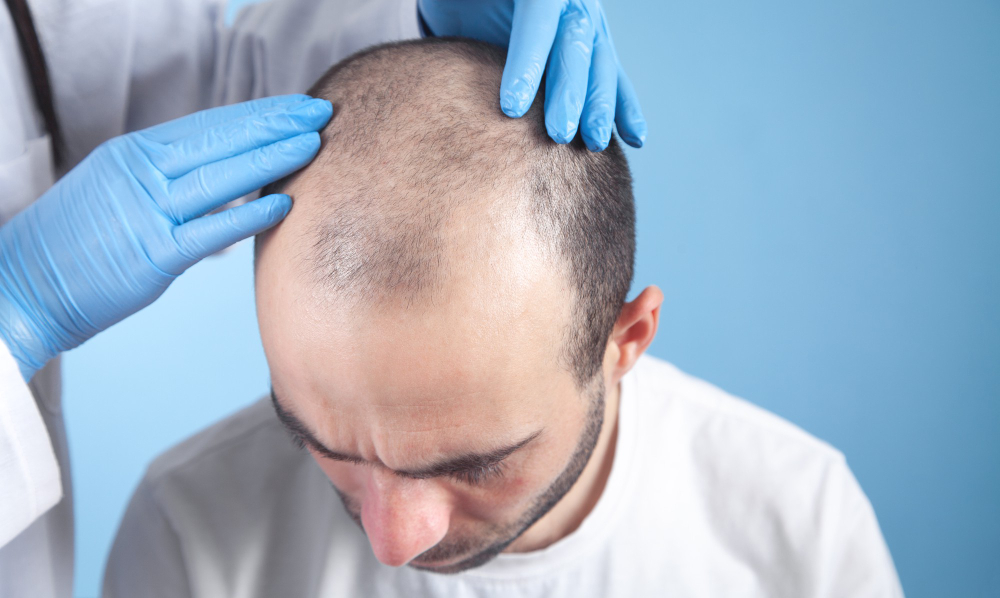
A proper consultation should look closely at scalp health, miniaturization, donor density, family history, hormones, medications, and prior procedures if you have had them. If someone recommends graft numbers before understanding why your hair is falling out, that is a warning sign. You do not want to rush into a transplant if the underlying condition is still active.
This is especially important for women, younger patients, and anyone with sudden or diffuse shedding. In those cases, the cause may be more complex than pattern hair loss alone. Medical assessment, scalp analysis, and sometimes lab or hormone evaluation can prevent the wrong treatment plan.
Not every hair loss clinic offers the same level of care
Many patients assume all clinics provide similar results because the marketing sounds similar. It does not. Hair restoration is one of the few fields where the difference between physician-led care and sales-led care can dramatically change the outcome.
Some practices are built around one procedure and steer every patient toward it. That may work for a narrow group of candidates, but it is not the same as personalized medicine. A better clinic can explain the trade-offs between FUE and FUT strip, when robotic FUE may help, when no-shave or long-hair FUE makes sense for discretion, and when surgery should be delayed while medical treatment stabilizes the loss.
That broader view matters because hair loss is progressive. A transplant can improve density in one area, but it does not stop future thinning around it. If your plan addresses only the visible gap and not the long-term pattern, you may be dissatisfied later even if the surgery itself was technically competent.
The best treatment is not always surgery
This is where many patients feel relieved once they meet a true specialist. They realize the goal is not to be sold a transplant. The goal is to preserve, improve, and restore hair in the most appropriate way.
Non-surgical options can play a major role, especially in early-stage loss or as support before and after surgery. Depending on the cause, treatment may include medication, hormone therapy, regenerative therapies such as Regenera Activa, injectables, laser therapy, scalp micropigmentation, or supportive diagnostics like genetic testing and detailed scalp analysis. For some patients, these options buy time. For others, they meaningfully improve density without surgery.
Surgery becomes the right answer when the pattern is established, the donor area is strong, and expectations are realistic. Even then, technique selection matters. FUE is popular for minimal linear scarring and flexibility. FUT strip can still be the better choice when a patient needs a large graft count and wants to preserve donor resources. DHI, body hair transplant, scar revision, beard transplant, eyebrow transplant, and corrective procedures all require very different planning.
A serious doctor should be able to explain not just what can be done, but why one approach fits you better than another.
Questions to ask a hair loss doctor Scottsdale patients are considering
Patients often focus on before-and-after photos, and those are useful, but they should not be your only filter. The better questions get into judgment, experience, and consistency.
Ask who performs the critical parts of the procedure. Ask how donor management is handled. Ask whether the doctor treats both men and women, performs corrective work, and evaluates underlying causes before recommending surgery. Ask what happens if you are not a transplant candidate right now. A physician who is comfortable saying, “not yet,” is often the one taking your long-term result seriously.
You should also ask how natural hairline design is approached. Hair restoration is not just about filling space. Hairline position, angle, direction, density transitions, and age-appropriate planning all affect whether the result looks believable years from now. An aggressive low hairline may sound appealing in a consultation, but it can become a problem if future loss continues or donor supply is limited.
For patients with prior poor work, these questions become even more important. Repair cases often involve scar tissue, depleted donor areas, unnatural graft placement, or pluggy hairlines. They require patience, technical restraint, and honest discussion about what can and cannot be improved.
Why physician experience matters more than marketing
Hair restoration is detail work. Tiny decisions during diagnosis, graft harvesting, hairline design, and placement can change the final result. Experience is not just about years in practice. It is about depth of specialization.
A doctor who focuses exclusively on hair restoration sees the edge cases others may miss. That includes diffuse unpatterned alopecia, scarring disorders, transgender hairline planning, body hair use in selected repairs, eyebrow reconstruction, and strategies for patients who want minimal visibility during recovery. These are not side services. They require focused training and repetition.
This is one reason many Arizona patients choose consultation-led practices such as Hair 4 Life Medical. The appeal is not hype. It is the combination of surgical depth, medical diagnostics, and transparent planning around all available options rather than a single favored treatment.
What to expect at a high-quality consultation
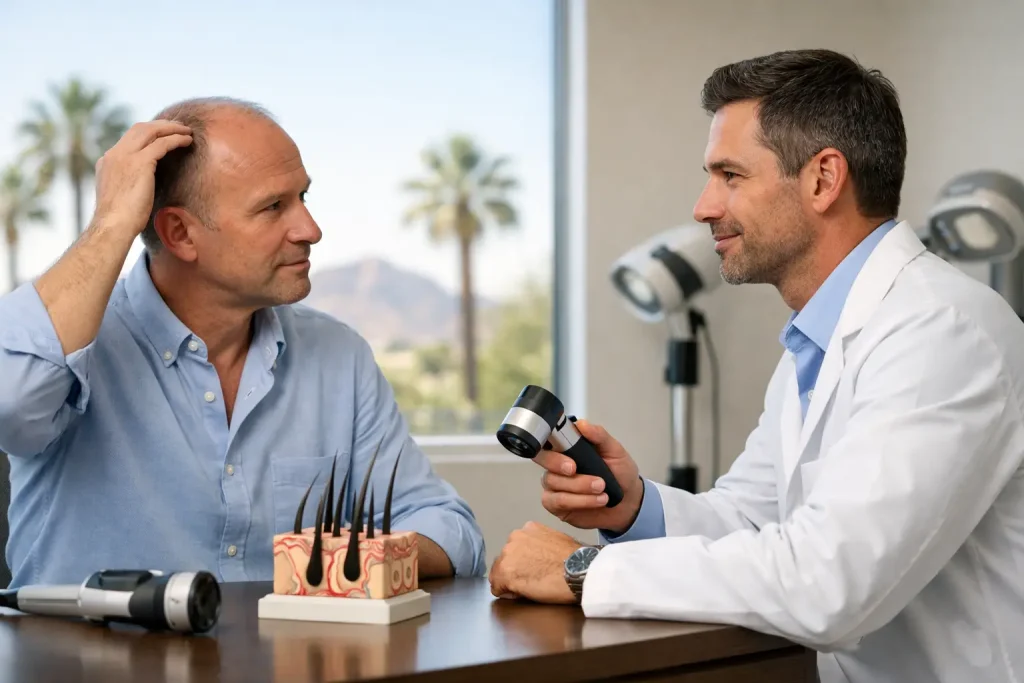
A good consultation should leave you clearer, not pressured. You should understand the likely cause of your hair loss, whether more than one factor may be involved, and what realistic improvement looks like over time.
In many cases, the physician will assess your scalp and donor area, review your health history, discuss progression patterns, and explain whether treatment should begin with stabilization, restoration, or both. If surgery is discussed, you should hear about graft estimates, scarring considerations, downtime, growth timelines, and how future loss may affect planning. If non-surgical therapy is recommended first, you should understand why waiting could improve your eventual result.
The best consultations also make room for lifestyle concerns. Some patients need a discreet option because of public-facing work. Some want eyebrow restoration after over-plucking or scarring. Some are focused on transgender facial framing and affirmation. Some simply want to look less tired on video calls. These goals are different, and the treatment plan should reflect that.
Red flags patients should not ignore
If a clinic promises a miracle, be careful. If every patient seems to need the same procedure, be careful. If the consultation feels rushed, or if no one asks about the cause and timeline of your loss, be careful.
Another common red flag is unrealistic density claims. Hair transplantation redistributes existing hair. It does not create new donor supply. Ethical planning means balancing cosmetic impact with long-term donor preservation. That is less flashy than overpromising, but it is how natural results are built.
You should also be cautious if post-procedure support is vague. Hair restoration does not end on procedure day. Recovery guidance, monitoring, and adjustment of medical therapy can all affect the outcome and your comfort during the growth cycle.
Choosing the right doctor means choosing the right plan
The real decision is not simply which clinic advertises the most. It is which doctor can look at your pattern of loss and tell you the truth about it. Sometimes that truth is that you are an excellent candidate for surgery. Sometimes it is that non-surgical treatment should come first. Sometimes it is that repair work will take stages, not one quick fix.
That level of honesty is what protects both your appearance and your confidence. Hair loss can feel personal, but the solution should still be grounded in careful medicine, technical skill, and respect for your choices. When you find a doctor who treats it that way, the process gets much clearer and much less intimidating.
A good next step is simple: choose a consultation where the goal is understanding your hair loss before trying to sell you a procedure. That is where better decisions begin.