Phoenix Hair Restoration Options That Fit You
Hair loss rarely presents as a simple choice between doing nothing and getting a transplant. The best Phoenix hair restoration options begin with understanding why hair is changing, whether loss is active, and what degree of improvement is realistically sustainable over time. A treatment that works well for a man with stable pattern loss may not be appropriate for a woman with diffuse thinning, a patient with hormonal changes, or someone repairing an unnatural prior transplant.
The goal is not to sell a single procedure. It is to create a plan that respects your existing hair supply, your medical history, your desired level of change, and the amount of downtime you can accept. For some people, that plan starts with medical treatment and scalp health. For others, surgery provides the most meaningful change. Many benefit from a thoughtful combination.
Start With the Cause, Not the Procedure
Hair restoration is most predictable when the diagnosis comes first. Pattern hair loss is common, but it is not the only reason density can decline. Hormonal shifts, thyroid concerns, nutritional deficiencies, autoimmune conditions, inflammation, medication changes, stress-related shedding, and traction can all affect the scalp and hair cycle.
A proper evaluation looks at the distribution and pace of loss, the quality of donor hair, family history, medical factors, and scalp condition. Scalp analysis, laboratory work, hormone evaluation, and genetic testing can be useful when the cause is unclear or when a patient wants a more complete picture before committing to treatment.
This matters because transplanting into actively thinning areas without a long-term strategy can leave a patient chasing future loss. Conversely, waiting for every strand to stabilize is not always necessary. The right timing depends on the diagnosis, age, loss pattern, and ability to preserve surrounding native hair.
Non-Surgical Phoenix Hair Restoration Options
Non-surgical care can slow progression, improve the caliber of miniaturized hairs, support scalp health, or create the appearance of greater density. These approaches are often the first step for early thinning, but they also have a role before and after surgery.
Prescription and topical medications may be appropriate for certain forms of pattern loss. They require an individualized discussion of expected benefits, possible side effects, pregnancy considerations where relevant, and the need for continued use. Medication can help maintain hair, but it does not create new follicles in an area that has been bare for years.
Regenerative therapies may be considered when follicles are still present but weakened. Options such as Regenera Activa AMT and TricoPat are designed to support the scalp environment and follicle activity. Injectables, laser therapy, PDO threads for hair loss, and hyperbaric oxygen therapy may also be incorporated for selected patients. These treatments have different evidence profiles and are not interchangeable, which is why a physician-guided recommendation matters more than a trend-driven package.
Hormone therapy can be relevant when an endocrine imbalance is contributing to shedding or density changes. For women experiencing perimenopausal or menopausal changes, and for others with clinically significant hormonal concerns, treating the underlying issue may be part of a broader restoration plan. Integrating conventional and naturopathic perspectives can be helpful when done with appropriate medical oversight.
Scalp micropigmentation, often called SMP, does not regrow hair. It can, however, reduce the contrast between the scalp and existing hair, make thinning look less noticeable, camouflage scars, or complement a transplant. It is a cosmetic density strategy, not a replacement for diagnostic care.
Surgical Options for Lasting Follicle Relocation
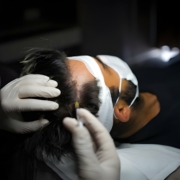
A hair transplant redistributes genetically resistant follicles from a donor area, usually the back and sides of the scalp, to areas with thinning or loss. Because donor supply is finite, surgical planning must be conservative and future-minded. A natural hairline, appropriate density, and preservation of donor reserves are more valuable than pursuing an aggressive result that cannot age well.
FUE, FUT, and Advanced FUE Techniques
Follicular unit extraction, or FUE, removes individual follicular units from the donor area. It can be a strong choice for patients who prefer short hairstyles, want to avoid a linear donor scar, or need flexibility in donor harvesting. Recovery is often straightforward, though donor shaving is commonly required with traditional FUE.
No-shave FUE and long-hair FUE offer more discretion for suitable candidates. These approaches can allow patients to maintain a more familiar appearance around the procedure, which may appeal to professionals or anyone who wants less obvious downtime. They are technically demanding and are not necessary for every patient, but they can be valuable when privacy is a priority.
ARTAS robotic FUE uses imaging and robotic assistance in portions of the harvesting process. It may be appropriate for some candidates, especially when donor characteristics and treatment goals align. The technology is a tool, not a substitute for medical judgment. Hairline design, graft handling, recipient-site creation, and the overall surgical plan remain critical to the result.
Follicular unit transplantation, or FUT strip surgery, involves removing a narrow strip of donor tissue and dissecting it into grafts. It leaves a linear scar but can provide a high number of quality grafts efficiently for the right patient. FUT may be especially worth discussing when greater coverage is needed, when existing donor hair makes FUE extraction less efficient, or when a patient needs to preserve donor resources for the future.
DHI, or direct hair implantation, refers to a graft placement technique that may allow precise control of angle and direction in selected areas. It can be useful for hairline refinement or density work, but it is not automatically superior to other placement methods. Technique should follow the needs of the recipient area rather than marketing language.
Beyond Scalp Transplants
Hair restoration can address more than scalp density. Beard transplantation and eyebrow transplantation can restore facial framing after thinning, scars, genetics, or prior trauma. These areas demand careful attention to direction, angle, and density because even a small number of poorly placed grafts can look noticeable.
Body hair transplant procedures may supplement scalp donor supply for selected patients, particularly in corrective or advanced-loss cases. Body hair behaves differently from scalp hair, so it must be used strategically. It is generally a supporting resource rather than a universal solution.
Transgender hair restoration can help create a more affirming hairline, improve temple density, or soften a pattern that feels inconsistent with a patient’s identity. The plan should be personal and medically informed, including consideration of hormone therapy, future loss risk, and the desired hairline design.
Corrective Surgery and Scar Revision Require Extra Judgment
Patients seeking repair after an unsuccessful procedure deserve a different kind of consultation. The question is not simply how many grafts can be added. It is whether the donor area has enough remaining capacity, whether existing grafts need camouflage or removal, and how to improve an unnatural hairline or visible scarring without creating another problem.
Corrective surgery may involve selective graft redistribution, carefully placed new grafts, scar revision, SMP, or a staged approach. A physician with extensive experience in both primary and corrective work can help set realistic priorities. Sometimes the most responsible recommendation is to preserve donor hair and make a measured improvement rather than promise complete reversal.
How to Choose the Right Plan
The most useful consultation should leave you clearer, not pressured. Ask what diagnosis is driving the recommendation, what alternatives exist, and what maintenance may be needed after treatment. If surgery is discussed, ask how donor supply is being calculated, how the plan accounts for future loss, who performs the key surgical steps, and what the recovery process will actually look like.
At Hair For Life Medical in Scottsdale, treatment planning is built around that full spectrum of options. Dr. Ramona Kelemen brings more than 24 years of hair restoration experience to a physician-centered evaluation designed to match the treatment to the person, not the other way around.
The right path may be a medication plan with regenerative support, a discreet no-shave FUE procedure, FUT for efficient coverage, or a staged combination that protects results over time. A careful diagnosis and an honest conversation are the first signs that you are being treated as a person with a long-term goal, not as a one-procedure sale.