
Introduction:
In the world of hair restoration, technological advancements have significantly improved the efficiency, precision, and results of treatments. Among the most popular methods for follicular unit extraction (FUE) are robotic systems like ARTAS and motorized handheld devices. These two options have distinct features and offer unique benefits, but many patients and professionals still wonder: which is superior? In this blog post, we’ll compare the ARTAS robotic system to motorized handheld devices, exploring their technology, benefits, limitations, costs, and more to help you make an informed decision.Understanding Hair Restoration:
Before diving into the specifics of ARTAS and handheld devices, it’s important to understand what FUE is and why it’s such a popular method for hair restoration.FUE Overview:
Follicular Unit Extraction (FUE) is a modern hair transplant technique where individual hair follicles are extracted from a donor area (typically the back of the scalp) and transplanted into areas of thinning or balding. Unlike traditional strip harvesting (FUT), FUE leaves minimal scarring and provides a natural-looking result. There are different tools and technologies available for performing FUE, with two of the most commonly used being ARTAS robotic systems and motorized handheld devices.ARTAS Robotic System:
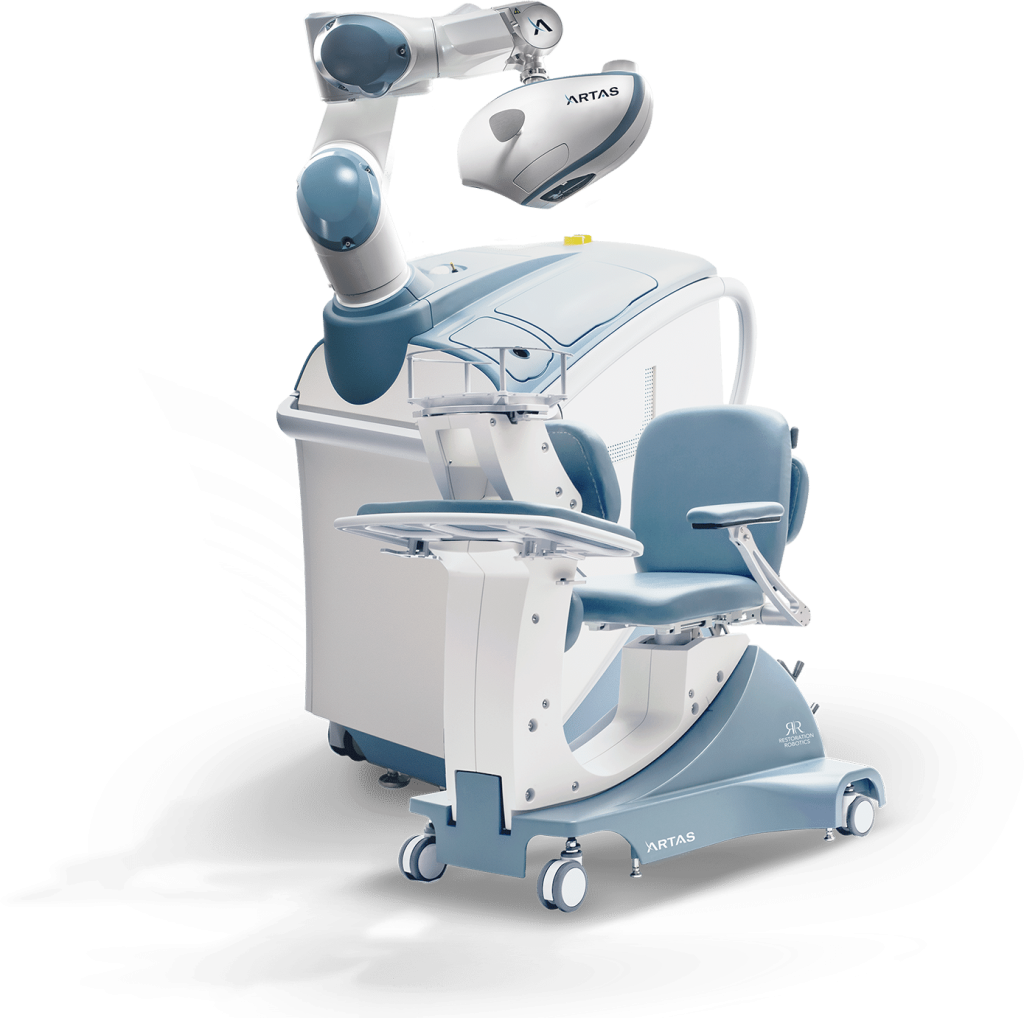
ARTAS is a state-of-the-art robotic system developed by Restoration Robotics (now part of the company Artas). It is designed to automate much of the FUE procedure, particularly the follicular extraction phase. How ARTAS Works:- Robotic Precision: ARTAS uses advanced algorithms and artificial intelligence (AI) to analyze the donor area and identify the healthiest and most viable hair follicles for extraction. In order to harvest correctly the doctor MUST be present and provide corrections to the robot operator.
- Minimally Invasive: The system uses a high-definition camera and precision instruments to carefully extract individual follicles without the need for incisions or sutures. Punch remains fairly large to today’s standard at 1mm vs 0.75mm of handheld devices.
- Real-Time Feedback: ARTAS provides real-time feedback to the surgeon, allowing them to make informed decisions during the procedure if they are present in the room, a thing lost in many practices.
- Efficient Harvesting: By automating parts of the process, ARTAS is capable of performing hair follicle extractions at a faster pace than manual techniques. Only if the patient is not moving.
- Precision and Accuracy: The AI-driven technology allows for incredibly precise follicle harvesting. This reduces the likelihood of damage to the follicles and minimizes the risk of scarring.
- Minimal Discomfort and Downtime: ARTAS is minimally invasive, which means there’s less trauma to the scalp during extraction and a faster recovery time.
- Consistency: The robotic system is highly consistent, performing extractions in the same way every time. This can be advantageous in achieving even, natural results again only if the doctor is present during the whole extraction process and can tell the operator to avoid certain areas that are less desirable.
- No Manual Labor: Since much of the extraction process is automated, ARTAS reduces the physical strain on the surgeon, allowing for longer procedures without compromising quality. due to their large nature, grafts still need to be trimmed.
- Cost: ARTAS comes with a hefty price tag, making it one of the more expensive options for FUE. The initial investment in the robotic system, combined with maintenance costs, can make the procedure pricier for patients.
- Dependence on Technology: While ARTAS is highly advanced, it’s still dependent on the system working flawlessly. Any technical malfunctions can disrupt the procedure.
- Learning Curve: Surgeons need to undergo specialized training to operate ARTAS effectively, which can take time and additional investment. (2-day course)
- New Notion: New practitioners think that the robot will replace experience and the doctor in the OR. Robot was intended as a tool for the doctor NOT a replacement.
- Limited Harvesting Area: ARTAS operates with a limited harvesting zone compared to manual techniques or motorized handheld devices. The robotic arm is designed to work within a specific area of the donor scalp, which means it might not be as versatile in extracting follicles from less accessible areas. In some cases, if a patient has a more diffused donor area or has areas of their scalp that are difficult to reach, the robotic system may not be able to harvest as many follicles as a skilled surgeon with handheld tools could. This limitation may require manual extraction for parts of the procedure, or in some cases, may make it a less ideal option for certain patients. If overharvested the patient will have the WINDOW effect.
- Larger Punch Size: One of the limitations of the ARTAS robotic system is the size of the punch used for follicular extraction (19G ~1mm). The robotic punch tends to be larger than what is typically used with manual motorized devices. While this larger punch is effective in extracting follicles, it can sometimes result in slightly larger incisions and more visible scarring compared to the smaller, finer punches used in manual FUE procedures. For patients who are particularly concerned with minimal scarring, this might be a factor to consider, as the larger punch size could lead to a less refined aesthetic outcome, especially in individuals with very fine or sparse donor hair.
- Sites and implantation: The robot cannot make close enough sites and implant, doctor must make sites in between the ones the robot made in order to achieve a natural look.
Motorized Handheld Devices:
Motorized handheld devices are an alternative to robotic systems for performing FUE. These devices are powered tools used by surgeons to manually extract individual hair follicles from the donor area. How Handheld Devices Work:- Mechanical Power: Motorized handheld devices operate through a motorized punch mechanism that rotates a small, cylindrical tool designed to remove hair follicles with minimal damage.
- Surgeon-Controlled: Unlike ARTAS, motorized handheld devices require the surgeon to have direct control over the angle, depth, and placement of each extraction. This allows for a more personalized approach.
- Versatility: There are many types of motorized handheld devices available on the market, offering a range of features and customization options.
- Tactile Feedback: One of the key advantages of handheld devices is the tactile feedback they provide to the surgeon. This hands-on approach gives the surgeon better control and allows them to feel how the tool is interacting with the scalp.
- Flexibility: Surgeons have greater flexibility with handheld devices, making adjustments in real-time as needed. They can assess the scalp and donor area during the procedure and make decisions based on their observations.
- Cost-Effective: Motorized handheld devices are generally less expensive than robotic systems like ARTAS. This can make FUE procedures more accessible to patients who are concerned about cost.
- Punch Size: handheld devices have a much smaller punch then ARTAS (regardless of the version), ~1mm vs 0.75-0.95mm.
- Healing time: Smaller punch means faster healing and less scaring vs ARTAS.
- Risk of Human Error: Since the surgeon is controlling the device, there is a greater potential for human error. Inaccurate placement or improper technique can lead to follicle damage or inconsistent results.
- Physical Strain on the Surgeon: The repetitive nature of follicle extraction can cause physical strain on the surgeon’s hands and wrists, especially during lengthy procedures.
- Longer Procedure Times: Depending on the surgeon’s skill and the device used, the extraction process with handheld devices can take longer compared to robotic systems, potentially leading to longer patient sessions.
- Potential for Uneven Results: While handheld devices allow for more customization, it can be harder to achieve the same level of consistency in results as a robotic system like ARTAS.
Comparing ARTAS and Motorized Handheld Devices: To help clarify the differences, here’s a side-by-side comparison of ARTAS and motorized handheld devices:
| Feature | ARTAS Robotic System | Motorized Handheld Devices |
|---|---|---|
| Precision | High – AI-driven, consistent results | Moderate – Dependent on surgeon’s skill |
| Speed of Procedure | Fast (due to automation) Slow if the patient moves | Slower (depends on surgeon’s pace) |
| Cost | High (robotic system investment) | Lower (cost-effective option) |
| Training Requirement | Requires certification 2 day course | Extensive FUE training |
| Surgeon Control | Limited – system-guided | High – full control by the surgeon |
| Patient Discomfort | Minimal (minimally invasive) | Minimal (may vary with technique) |
| Risk of Human Error | Low (due to automation) | Low (depends on surgeon’s experience) |
| Recovery Time | Fast (due to minimal scalp trauma) | Faster (due to smaller punch) |
| Customization | Limited – follows programmed patterns Punch 18 and 19g ~1mm | High – surgeon can adjust as needed (0.75mm-1mm) |
| Consistency of Results | High – same approach every time | Very High– vary based on technique |
Which Option is Superior? The choice between ARTAS and motorized handheld devices ultimately depends on a variety of factors, including patient preferences, the surgeon’s experience, and budget constraints.
- For Patients Who Prioritize Precision and Automation: ARTAS is likely the superior option. Its advanced robotic technology offers unparalleled precision and consistency, making it ideal for those seeking optimal results with minimal risk of human error.
- For Patients on a Budget: If cost is a major consideration, motorized handheld devices may be the better choice. They offer a more affordable alternative without sacrificing too much in terms of results, provided the surgeon is skilled.
- For Surgeons Who Prefer Hands-On Control: Those who enjoy the tactile feedback and direct control that comes with using motorized handheld devices may prefer this method. It allows them to tailor the procedure based on their observations, adjusting as needed.