The first surprise for many patients is that FUT strip surgery recovery is usually less about severe pain and more about patience, tightness, and knowing what is normal. The donor area at the back of the scalp needs time to heal, the grafts need protection, and the cosmetic result unfolds in stages rather than all at once.
That timeline matters. FUT can be an excellent option for patients who want a large number of grafts while preserving the donor area efficiently, but recovery is different from FUE. Because a strip of scalp is removed and the area is closed with sutures or staples, there is a linear incision to heal. For the right patient, that trade-off is worthwhile. Still, it helps to go in with realistic expectations so you are not alarmed by common postoperative changes.
What FUT strip surgery recovery usually feels like
Most patients describe the first few days as manageable. The donor area often feels sore, tight, numb, or tender rather than sharply painful. The recipient area can feel mildly irritated, and small crusts form around the newly placed grafts. Swelling may occur, especially around the forehead, and can shift downward over the first several days.
The sensation of tightness is one of the more distinctive parts of FUT healing. That happens because the scalp edges are brought together after the strip is removed. Some people notice it only when raising their eyebrows or turning their head. Others feel it more strongly for a few weeks, especially if they naturally have a tighter scalp.
Pain tolerance, graft count, scalp laxity, surgical technique, and your own healing pattern all affect the experience. A smaller session may heal faster and feel easier. A larger case can still heal well, but recovery may be more noticeable.
The FUT strip surgery recovery timeline
The first 72 hours
This is the period when protection matters most. The grafts are newly placed and the donor incision is fresh. You may be asked to sleep with your head elevated to reduce swelling and avoid any rubbing or pressure on the grafted area.
Mild oozing, redness, and crusting can be normal early on. The donor incision may feel tight or numb. If swelling develops, it often peaks around day two or three. Many patients are able to rest comfortably at home during this phase, but they should avoid strenuous activity, bending heavily, and anything that increases pressure or friction on the scalp.
Days 4 through 10
This is when the scalp starts to look better, even though healing is still underway. Crusting in the recipient area begins to loosen, swelling usually improves, and tenderness starts to decrease. The donor area may still feel tight, and numbness can continue.
If non-dissolvable sutures or staples were used, removal often happens around this time, depending on your surgeon’s protocol and how the incision is healing. Once the closure is removed, many patients feel more comfortable, although the line is still immature and should be treated gently.
Weeks 2 through 4
By this stage, most of the visible healing has settled enough for patients to feel more socially comfortable. Redness may still linger, especially in fair or reactive skin, but the scalp usually looks far less obvious than it did during the first week.
This is also the period when shock shedding can begin. The transplanted hairs often fall out before regrowth starts. That can be unsettling if you were hoping to see immediate density, but it is a standard part of the process. The follicles remain in place under the skin even though the shafts shed.
Months 1 through 3
This is often the least exciting part of the journey because there may not be much visible payoff yet. The donor scar continues to mature, and the transplanted follicles are transitioning into a resting and then growing phase. Some temporary numbness or altered sensation in the donor region can persist.
If you are judging the result at this point, you are judging far too early. Growth after FUT is gradual, and the real cosmetic change comes later.
Months 4 through 12
New hairs typically begin to emerge around the fourth month, though timing varies. Early growth may look fine, soft, or uneven at first. Density and caliber improve over time, and most patients see meaningful cosmetic progress between months six and twelve.
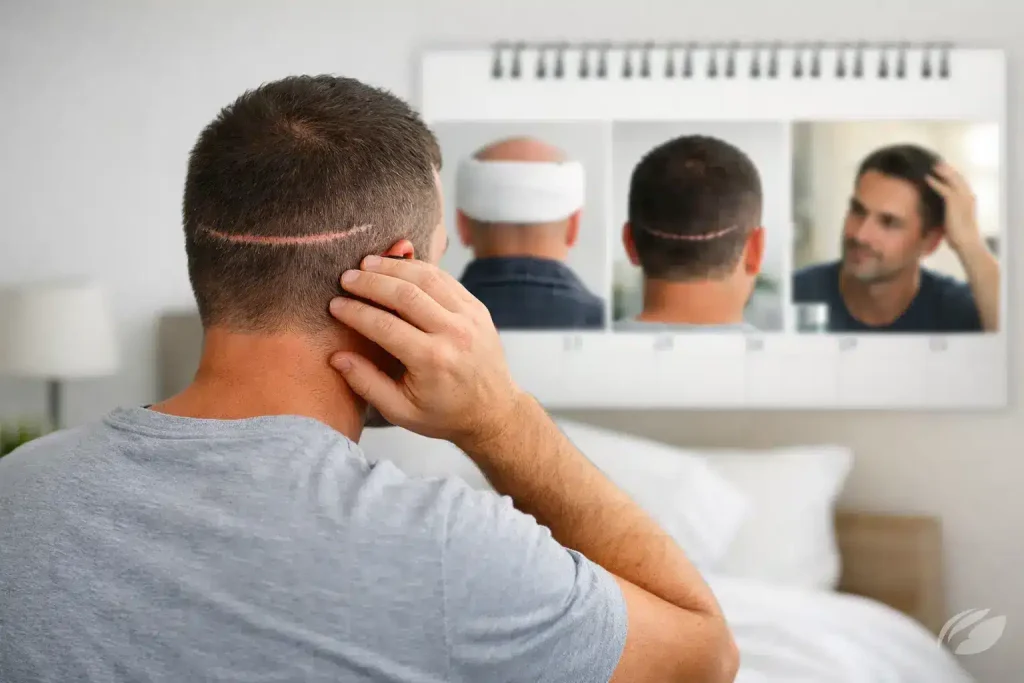
The donor scar also changes over these months. Early pinkness or firmness usually softens and fades. How discreet the line becomes depends on surgical closure technique, scalp characteristics, healing tendency, and how short you prefer to wear your hair.
Donor area healing after FUT
The donor area deserves special attention because it is the main difference between FUT and punch-based extraction methods. A well-performed FUT closure is designed to heal into a fine linear scar, but scar quality is never one-size-fits-all.
Some patients heal with a very subtle line that is easy to conceal with surrounding hair. Others may form a wider or more visible scar due to skin tension, genetics, inflammation, or returning to strenuous activity too soon. If you have a history of raised or thick scars elsewhere on the body, that is worth discussing before surgery.
Temporary numbness around the incision is also common. That does not usually mean something is wrong. Small sensory nerves can be affected during strip removal and closure, and sensation often improves gradually over time. In some cases, a patch of reduced feeling lasts longer.
Washing, exercise, and returning to normal life
After FUT, instructions must be followed closely because the grafts and donor closure have different needs. Washing generally starts with a very gentle approach. The goal is to keep the scalp clean without dislodging grafts or stressing the incision.
Exercise is where patients can accidentally slow their recovery. Light walking is often reasonable fairly early, but intense workouts, heavy lifting, contact sports, and anything that creates tension across the scalp usually need to wait. Pushing too soon can increase swelling, irritation, bleeding risk, and stress on the donor closure.
Work and social downtime depend on your job and comfort level. A person working remotely may resume normal tasks quickly. Someone in a highly public-facing role may prefer more time off until crusting and redness improve. This is one reason personalized planning matters. Recovery is not only medical. It is also practical.
What is normal and what deserves a call to your surgeon
A certain amount of soreness, tightness, swelling, crusting, itching, and shedding is expected. Mild asymmetry in swelling can also happen. These changes are common and usually improve with time.
What deserves prompt attention is worsening pain, spreading redness, significant drainage, fever, opening of the donor incision, or sudden trauma to the grafted area. Patients sometimes worry about every itch or scab, but the real concern is a pattern that is getting worse instead of better.
This is why experienced follow-up matters. Hair restoration is not just about placing grafts. It is about guiding healing, managing expectations, and recognizing when a recovery is on track versus when it needs intervention.
How to make FUT strip surgery recovery smoother
The biggest factors are not glamorous. Follow your washing instructions exactly. Sleep as directed. Avoid smoking if possible, because it can impair healing. Hold off on strenuous activity longer rather than shorter. Protect the scalp from sun exposure, and do not pick at crusts or scratch the incision.
It also helps to think beyond the first two weeks. Surgery redistributes hair, but it does not stop future hair loss. For many patients, the best long-term plan includes medical evaluation and supportive therapies to protect existing hair and improve overall density. That is especially true for men and women with ongoing thinning outside the transplanted zones.
A physician-led practice with deep experience in both surgical and non-surgical hair restoration can help match the procedure and the recovery plan to the individual, rather than treating every scalp the same. That kind of customization matters when scar management, prior surgery, hair characteristics, or underlying medical causes of loss are part of the picture.
The trade-off that matters most
FUT is not automatically better or worse than FUE. It is different. The main recovery trade-off is clear: FUT gives access to a strong graft yield through a linear donor excision, but in exchange, healing includes a donor incision, more tightness, and scar considerations. For the right patient, especially one who wants to maximize graft numbers and typically wears the surrounding hair long enough to conceal the donor line, that can be a very smart choice.
If you are considering FUT strip surgery recovery, the best question is not whether recovery exists. It does. The better question is whether the recovery profile matches your goals, hair characteristics, daily routine, and tolerance for the donor scar. When those factors are evaluated honestly, the process feels far more predictable and far less intimidating.
Good outcomes start before surgery. They start with choosing a physician who understands not only how to perform the procedure, but how to decide whether it truly fits you.