Understanding the Real Differences Before Choosing a Hair Transplant
Patients researching hair transplants in 2026 are often overwhelmed by marketing terms like FUE, Sapphire FUE, and DHI. Many clinics present these as completely different procedures, implying that one is clearly superior.
The truth is more straightforward: all three are variations of FUE, and the final result depends far more on who performs the surgery than the label used.
At Hair 4 Life Medical, Dr. Ramona Kelemen selects the most appropriate technique based on the patient—not marketing trends.
What Is FUE?
FUE (Follicular Unit Extraction) is the foundation of modern hair transplantation. Individual follicular units are extracted from the donor area and transplanted into thinning or balding areas.
Key characteristics:
- Individual graft extraction
- No linear scar
- Natural-looking results
- Flexible placement techniques
- Customizable density
FUE is not one specific method—it is a category of techniques.
This is important because Sapphire FUE and DHI are both variations built on the FUE concept.
What Is Sapphire FUE?
“Sapphire FUE” refers to using sapphire blades instead of steel blades when creating recipient sites.
Clinics often market this as:
- More precise
- Less trauma
- Higher density
- Faster healing
In reality, the blade material is only one small factor. The outcome still depends on:
- Angle of incision
- Depth control
- Spacing
- Surgeon experience
A sapphire blade does not automatically produce better results.
The technique is still standard FUE with a different tool.
What Is DHI (Direct Hair Implantation)?
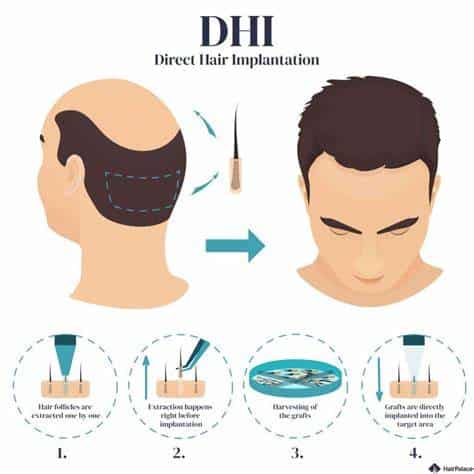
DHI uses an implanter pen to place grafts directly into the scalp. The graft is loaded into the pen and implanted in one step.
Clinics promote DHI as:
- No incisions
- Higher density
- Faster healing
- More advanced technology
However:
- Recipient sites are still created
- Density depends on spacing and blood supply
- Healing time is similar
- Extraction is still FUE
DHI is simply another way to place FUE grafts.
FUE vs Sapphire FUE vs DHI: The Real Comparison
Standard FUE
- Most flexible technique
- Full control over angles
- Customizable density
- Widely used by experienced surgeons
- Excellent natural results
Sapphire FUE
- Same as FUE with sapphire blade
- Marketing-driven distinction
- Results depend on surgeon skill
- No inherent density advantage
DHI
- Uses implanter pen for placement
- Often marketed as premium
- Slower for large sessions
- No proven superior growth
Which Technique Produces the Most Natural Results?
Natural results depend on:
- Hairline design
- Graft selection
- Angle and direction
- Density planning
- Donor preservation
These factors are independent of technique name.
An experienced surgeon using traditional FUE can achieve:
- Better density
- More natural hairlines
- Higher graft survival
than a technician-driven DHI procedure.
Why Technique Marketing Can Be Misleading
Many clinics promote:
- “Sapphire FUE only”
- “DHI exclusive”
- “Advanced robotic systems”
This limits flexibility.
Each patient is different:
- Hair caliber varies
- Donor density varies
- Hair loss pattern varies
A one-technique approach often prioritizes marketing over results.
The Hair 4 Life Medical Approach
At Hair 4 Life Medical, Dr. Ramona Kelemen focuses on customized FUE-based hair transplantation.
She personally performs:
- Hairline design
- Graft extraction
- Recipient site creation
- Graft placement
This surgeon-led approach ensures:
- Natural hair direction
- Balanced density
- Donor preservation
- Long-term planning
Technique selection is based on the patient—not a single advertised method.
What Matters More Than FUE, Sapphire, or DHI
Patients should focus on:
- Who performs the surgery
- Hairline design experience
- Donor management
- Natural results
- Long-term planning
These factors determine success—not the label.
Hair Transplant in 2026: What Patients Are Realizing
In 2026, patients are becoming more informed. The biggest shift:
They are moving away from asking:
- Which technique is best?
And instead asking:
- Who is performing my surgery?
This is the question that leads to better outcomes.
Which Technique Is Best?
The honest answer:
There is no universally “best” technique.
The best approach depends on:
- Patient goals
- Donor quality
- Hair characteristics
- Surgeon experience
FUE remains the foundation, while Sapphire FUE and DHI are simply variations of tools used within FUE.
The Bottom Line
FUE, Sapphire FUE, and DHI are not competing procedures. They are different ways of performing FUE hair transplantation.
The most important factor is the surgeon performing the procedure.
At Hair 4 Life Medical, Dr. Ramona Kelemen performs every step herself, ensuring precision, consistency, and natural results.
Choosing experience and surgeon involvement will always matter more than choosing a technique.
Schedule a Consultation
Meeting with Dr. Ramona Kelemen allows you to:
- Compare techniques honestly
- Understand your candidacy
- Receive a personalized plan
- Avoid marketing-driven decisions
The best hair transplant in 2026 isn’t defined by the tool—it’s defined by who performs the surgery.
The Bottom Line: Who Performs Your Hair Transplant Matters
If you’re looking for:
-
A physician-performed hair transplant in Phoenix or Scottsdale
-
Advanced FUE with refined tools like the WAW Slim, Zeus Ugraft, SAFE System
-
Natural, age-appropriate hairlines
-
A clinic that values craftsmanship over volume
Then Hair 4 Life Medical is not just an option — it’s the standard.
Because when it comes to permanent results, there is no substitute for a skilled doctor’s hands.
Interested in learning more? Contact Us or call Hair 4 Life at (480) 525-4547 to schedule an appointment.