How Long Until I See Real Growth After a Hair Transplant?

If you’re considering a hair transplant—or you’ve already had one—there’s one question that comes up more than any other:
“How long until I see real growth?”
Not marketing growth. Not baby fuzz. Not wishful thinking.
Real, visible, confidence-changing hair growth.
Let’s tell it like it is.
Hair transplants work. They are permanent when done correctly. But they do not deliver instant gratification. Hair grows on nature’s schedule, not on your calendar. Understanding the timeline is the difference between peace of mind and unnecessary anxiety.
This article breaks down exactly what happens month by month, what’s normal, what’s not, and when you can realistically expect results that matter.
Quick Answer: When Does Real Growth Start?
Most patients begin to see meaningful growth between 4 and 6 months after a hair transplant.
However:
-
Noticeable cosmetic improvement usually appears around 6–8 months
-
Final density and maturation occur at 12–15 months
-
Some patients continue improving up to 18 months
That’s the honest timeline. Anyone promising faster results is selling hope, not medicine.
Why Hair Transplants Take Time (And Always Have)
A hair transplant does not create new hair. It relocates genetically resistant follicles from the donor area to thinning or bald areas.
Once transplanted:
-
Follicles must re-establish blood supply
-
Enter a resting phase
-
Then resume their natural growth cycle
This is biology. It hasn’t changed in decades.
The technique may evolve. The tools may improve.
But hair growth speed is still governed by nature.
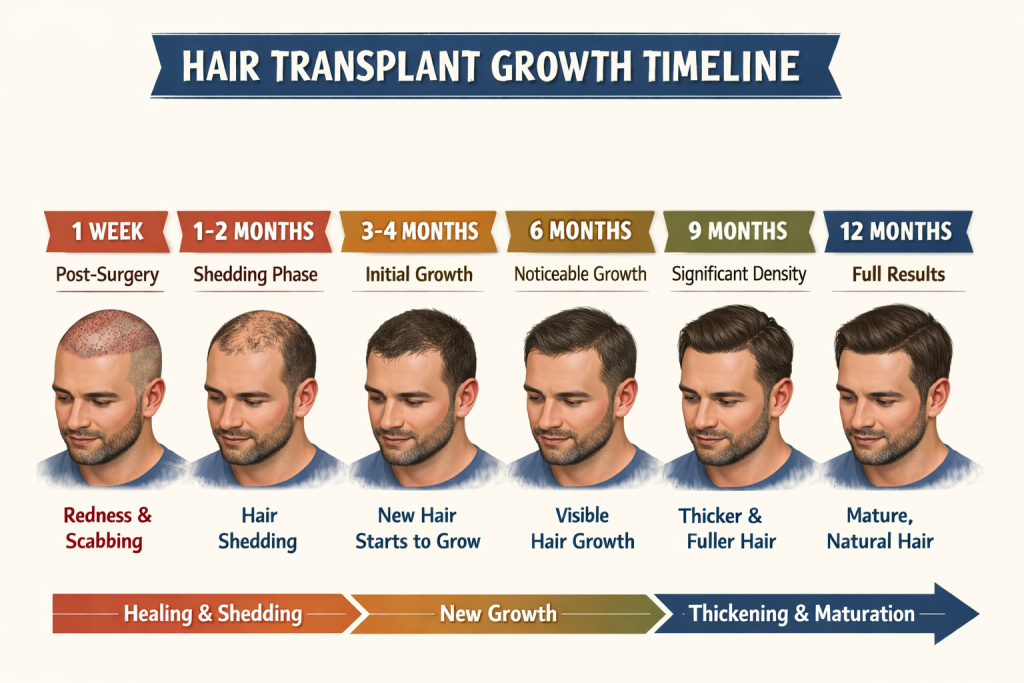
The Hair Transplant Growth Timeline (Month by Month)
Days 1–10: Healing, Not Growth
Immediately after surgery:
-
Grafts are secured
-
Scabs form and fall off
-
Redness is common
-
No growth occurs
At this stage, nothing you see reflects your final result.
Important:
If grafts look “thin” now, that’s normal. Density comes later.
Weeks 2–4: Shedding Phase (Shock Loss)
This is where many patients panic.
The transplanted hairs often fall out completely.
This is called:
-
Anagen effluvium
-
Or simply “shedding”
It is:
-
Expected
-
Temporary
-
Harmless
The follicle remains alive beneath the skin.
If your doctor didn’t warn you about this phase, that’s a red flag.
Months 1–3: The Quiet Phase
This is the hardest period psychologically.
What’s happening:
-
Little to no visible growth
-
Some areas may look thinner than before
-
Native hair may temporarily shed
What’s actually happening:
-
Follicles are resting
-
Blood supply is stabilizing
-
Growth cycles are resetting
This phase separates patients who understand the process from those who don’t.
Months 3–4: Early Growth Begins
Now we’re turning the corner.
You may notice:
-
Fine, thin hairs emerging
-
Uneven growth patterns
-
Patchiness
This is not your final density.
Hair grows in cycles and phases. Some follicles wake up earlier than others.
Patience here pays off.
Months 4–6: Real Growth Starts
This is where patients begin to relax.
What improves:
-
Coverage becomes noticeable
-
Hair thickens
-
Hairline definition improves
At this stage:
-
Friends may notice a change
-
You may start styling differently
-
Confidence begins to return
Still, density is not final.
Months 6–9: Cosmetic Results Are Obvious
For most patients, this is the turning point.
By month 6:
-
50–70% of growth is visible
-
Hair texture improves
-
Density increases steadily
By month 9:
-
Results are clearly apparent
-
Hair blends better with native hair
-
Styling options expand
This is often when patients say: “Now I finally get it.”
Months 9–12: Maturation Phase
Hair doesn’t just grow—it matures.
During this period:
-
Hair shafts thicken
-
Curl or wave may normalize
-
Density improves
-
Hairline softens naturally
At 12 months:
-
Most patients have reached 80–90% of their final result
Months 12–15 (Up to 18): Final Results
Some patients—especially those with:
-
Crown transplants
-
Large sessions
-
Body or beard hair grafts
May continue improving up to 15–18 months.
This is normal and expected.
Factors That Affect How Fast You See Growth
Not all hair transplants progress at the same pace.
1. Technique Used
-
Surgeon-performed FUE with minimal trauma tends to grow more predictably
-
Excessive graft handling or poor technique delays growth
2. Surgeon Involvement
Hair transplants are microsurgery, not assembly-line procedures.
Direct physician involvement matters:
-
During extraction
-
During graft placement
-
During hairline design
This affects survival and growth timing.
3. Donor Hair Quality
-
Thick donor hair grows faster and looks fuller sooner
-
Fine hair takes longer to show density
4. Area Transplanted
-
Hairlines often show results sooner
-
Crowns grow slower due to blood supply patterns
5. Patient Age & Health
-
Younger patients often heal faster
-
Smoking, poor nutrition, and unmanaged medical conditions slow progress
What Is NOT Normal After a Hair Transplant?
Let’s be direct.
 No growth at all by 6 months
Persistent redness beyond 4–5 months
Uneven or plug-like hairline design
Severe donor scarring or thinning
No growth at all by 6 months
Persistent redness beyond 4–5 months
Uneven or plug-like hairline design
Severe donor scarring or thinningThese warrant evaluation by an experienced hair restoration physician.
Can Anything Speed Up Hair Growth?
You cannot override biology—but you can support it.
Helpful Measures:
-
Proper post-op care
-
Gentle scalp handling
-
Good nutrition
-
Medical therapies when appropriate
-
Avoiding smoking
What Doesn’t Work:
-
Miracle shampoos
-
“Growth serums” with no evidence
-
Aggressive scalp massage early on
If it sounds too good to be true, it usually is.
The Most Common Patient Mistake
Comparing yourself to others online.
Every transplant is different:
-
Different donor density
-
Different scalp characteristics
-
Different techniques
-
Different surgeons
Your timeline should be judged by medical milestones, not social media photos.
The Honest Bottom Line
If you’re asking:
“How long until I see real growth?”
Here’s the truth:
-
4–6 months: Growth begins
-
6–9 months: Visible cosmetic improvement
-
12–15 months: Final result
Hair transplants reward patience. They always have.
When done properly, they deliver:
-
Permanent hair
-
Natural appearance
-
Long-term confidence
But they demand time.
That’s not a flaw—it’s the nature of real hair.
📍 Located in Scottsdale, Arizona, Hair 4 Life Medical is a boutique, physician-led clinic focused on custom hair restoration solutions.
📞 Call or visit hair4lifemedical.com to schedule your private 45–60 minute consultation with Dr. Kelemen.