FUE or DHI Transplant: Which Is Right for You?
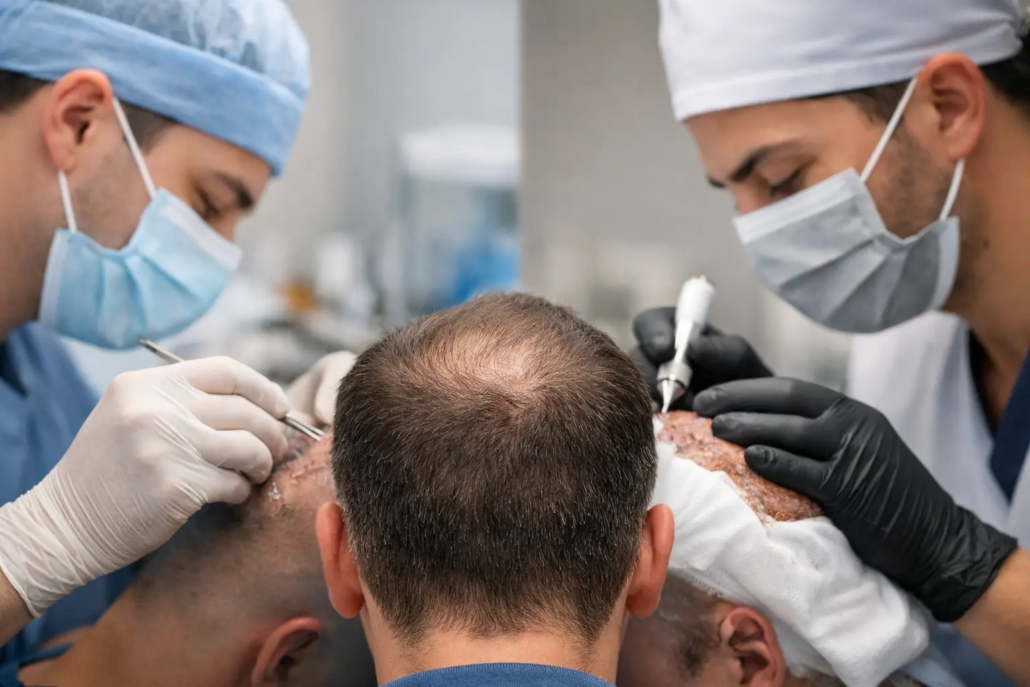
A transplant consultation should not begin with a sales pitch for one technique. When patients ask whether they need an FUE or DHI transplant, the more useful question is: what does your hair loss, donor supply, hair caliber, scalp characteristics, and long-term plan require?
Both options can produce natural-looking restoration when they are properly planned and performed. Neither is automatically “better.” The right choice depends on how grafts are harvested, how they are placed, the area being restored, and the experience of the physician directing every part of the procedure.
What FUE Means in Hair Restoration
FUE stands for follicular unit extraction. It is a method of harvesting individual naturally occurring follicular units from the donor area, usually the back and sides of the scalp. Each unit may contain one to several hairs. After harvesting, the grafts are prepared and placed into recipient sites designed to match the patient’s natural direction, angle, distribution, and hairline characteristics.
The main distinction is the donor-hair harvest. Unlike FUT strip surgery, FUE does not involve removing a linear strip of scalp. Instead, it leaves small dot-like scars that are typically difficult to see once healed, particularly when surrounding hair has reasonable coverage.
FUE is not one fixed experience. It may be performed manually, with motorized extraction tools, or with robotic assistance in appropriate candidates. It can also be adapted for people who prefer a discreet approach, including no-shave FUE and long-hair FUE. The procedure can be used for scalp restoration as well as selected beard, eyebrow, scar-revision, and corrective cases.
The quality of an FUE result is not determined by the letters “FUE” alone. Donor management, graft handling, recipient-site design, and careful placement matter as much as the extraction method.
What Is DHI?
DHI, commonly described as direct hair implantation, generally refers to the method used to place grafts rather than a completely separate method of harvesting them. In many DHI procedures, grafts are still obtained through FUE extraction. They are then loaded into a specialized implanter pen and inserted into the recipient area.
This is where marketing can make the decision sound simpler than it is. A clinic may present FUE and DHI as competing procedures, but they often overlap. FUE describes how grafts are removed from the donor area. DHI describes one possible way to implant them.
With conventional placement, the physician creates recipient sites first, then grafts are carefully placed into those sites. With an implanter pen, the instrument can create an opening and place a graft in a single motion. Either approach can be excellent in capable hands. Either can also produce poor results when the plan is rushed, grafts are mishandled, or the hairline does not respect the patient’s anatomy and future hair loss.
The Potential Advantages of DHI Placement
DHI placement may be useful when precise implantation is especially important, such as adding density between existing hairs, refining a hairline, or working in a smaller area. The implanter can give the surgeon controlled placement of delicate grafts, particularly single-hair grafts used at the frontal hairline.
Some patients are drawn to DHI because it is often promoted as less invasive or as requiring less shaving. Those claims need context. The amount of shaving, healing pattern, and recovery experience depend on the surgical plan, the number of grafts, the donor area, and the clinic’s technique. A no-shave option may be possible with either FUE-based approach in the right candidate, but it usually requires additional time, meticulous handling, and careful patient selection.
FUE or DHI Transplant: The Differences That Matter
For most patients, the decision is less about choosing a label and more about choosing a physician-led plan. The meaningful differences are practical.
An FUE procedure can be ideal for broader restoration when a patient needs a substantial number of grafts and has a stable, well-assessed donor supply. It can also work well for patients who prefer to avoid a linear donor scar or who may want to keep their hair relatively short.
DHI implantation can be valuable when the placement phase calls for exceptional control around existing native hair, a refined frontal zone, eyebrows, or selected areas of cosmetic detail. It is not, however, a guarantee of higher density, faster growth, or a more natural result. Density is limited by graft availability, scalp blood supply, hair characteristics, and the need to protect existing hair from unnecessary trauma.
A thoughtful surgeon may use more than one implantation method within a single restoration. For example, one approach may be selected for the hairline and another for a larger thinning area. That is not inconsistency. It is individualized surgical planning.
Natural Results Depend on Design, Not Branding
The hairline is where technical judgment becomes visible. A natural hairline is not simply low or dense. It should suit the patient’s age, facial proportions, ethnicity, family pattern of hair loss, and the possibility of future thinning. It also needs irregularity and softness. Using the finest single-hair grafts in the leading edge, then gradually building density behind it, helps avoid a harsh or plug-like appearance.
The same principle applies to crowns, part lines, temples, and areas of diffuse thinning. Hair grows at specific angles and directions. If grafts are placed too upright, too uniformly, or against the natural pattern, even healthy growth can look unnatural.
This is why surgical experience matters. Dr. Ramona Kelemen has focused exclusively on hair restoration for more than 24 years, including 19 years working for the founder of the American Board of Hair Restoration Surgery. That depth of specialization informs the details patients may not recognize during a consultation but will see in the mirror over time.
Your Donor Area Sets the Limits
Every transplant plan begins with the donor area. The back and sides of the scalp are often more resistant to pattern hair loss, but they are not unlimited. Taking too many grafts can create visible thinning in the donor zone and restrict options for the future.
A proper assessment considers donor density, hair thickness, curl or wave, color contrast between hair and scalp, scalp laxity when relevant, and the expected progression of hair loss. Fine hair, for example, may require a different density strategy than coarse hair. Patients with advanced loss may need to prioritize the frontal and midscalp regions rather than attempt full coverage everywhere.
For some people, a transplant should be delayed or paired with medical treatment. Active shedding, untreated hormonal concerns, nutritional issues, inflammatory scalp conditions, or rapidly progressing hair loss can affect the long-term outcome. A transplant moves existing follicles. It does not stop non-transplanted hair from continuing to thin.
Recovery and Growth Expectations
Both FUE and DHI-based procedures require patience. Small scabs in the recipient and donor areas are expected during the early healing period. The transplanted hairs often shed within the first several weeks, which can feel alarming but is a normal part of the process. The follicles remain beneath the skin and begin a new growth cycle over time.
Early growth may appear around three to four months, with more noticeable change often developing between six and nine months. Final maturation can take 12 months or longer, especially in the crown. Growth timing varies by patient, area treated, and individual biology.
Aftercare matters. Patients should follow the clinic’s washing instructions, avoid friction and pressure on grafts during the critical early period, and discuss when it is safe to resume exercise, sun exposure, and medications. Honest recovery guidance is more valuable than promises of an effortless procedure.
How to Choose With Confidence
The best consultation does not force an FUE-versus-DHI answer before examining the patient. It begins with diagnosis. Is the thinning genetic, hormonal, inflammatory, medication-related, stress-related, or connected to another health factor? Is the hair loss stable enough for surgery? Is there enough donor hair to accomplish the patient’s priorities responsibly?
At Hair For Life Medical in Scottsdale, the goal is to present the available options without pressure. For some patients, that may mean FUE with carefully planned recipient sites. For others, DHI-style implantation may offer an advantage in a specific area. For another patient, non-surgical therapy, medical treatment, scalp analysis, or a staged approach may be the wiser first step.
The most satisfying transplant is rarely the one with the catchiest name. It is the one that protects your donor supply, respects your future, and gives your hair a believable, age-appropriate chance to look like it has always belonged to you.