Best Options for Donor Depletion After FUE
A depleted donor area can change the entire strategy for restoring hair. For patients who have already had one or more transplants, the best options for donor depletion are rarely about simply finding more grafts. The priority is to protect what remains, understand why the donor area looks thin, and create a plan that improves appearance without causing additional visible damage.
Donor depletion is especially frustrating because it may appear in two places at once: the back and sides of the scalp can look overharvested, while the recipient area may still lack the density or hairline design a patient hoped to achieve. A careful physician-led evaluation can identify whether further surgery is appropriate, whether the focus should shift to repair, or whether non-surgical support will provide the better result.
What Donor Depletion Really Means
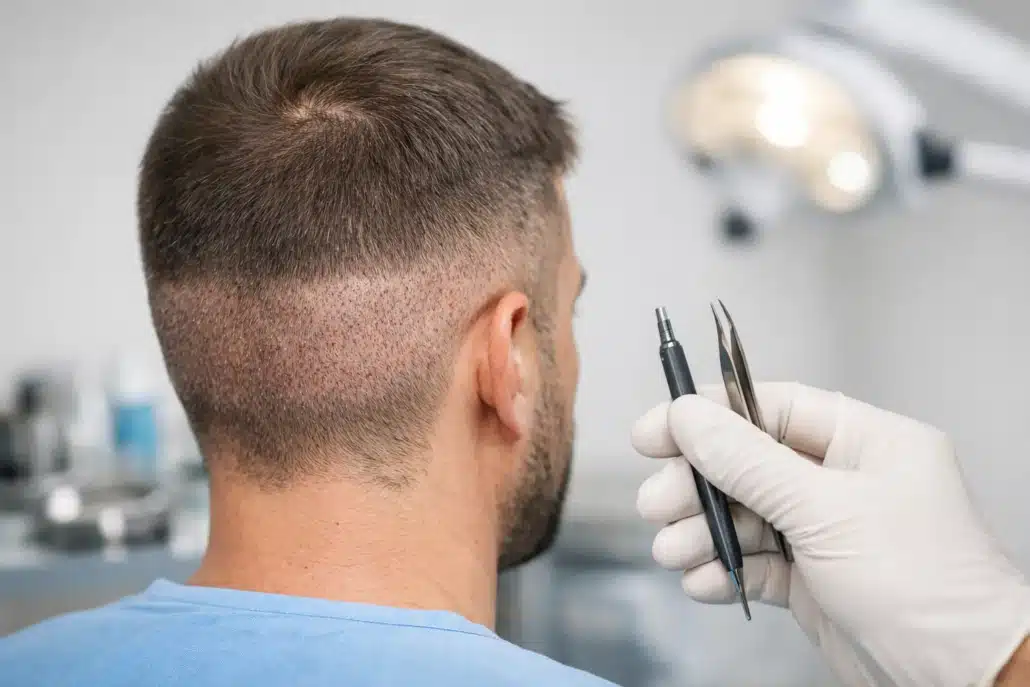
The donor area is not an unlimited supply of permanent hair. In a follicular unit excision (FUE) procedure, individual follicular units are removed from the back and sides of the scalp. When extraction is appropriately spaced and matched to a patient’s donor density, the remaining hair can usually disguise the removed grafts. When too many grafts are taken, punches are placed too closely together, or hair loss progresses after surgery, the donor zone may become visibly sparse.
Depletion can also follow strip surgery, particularly when a scar is wide, scalp laxity has been overestimated, or multiple procedures have reduced the available donor reserve. Some patients were not truly overharvested but have diffuse thinning in the donor region from an underlying hair-loss condition. That distinction matters. A donor area affected by active thinning requires a different plan than one that has been surgically depleted.
A proper assessment examines donor density, hair shaft caliber, scalp contrast, scar tissue, prior extraction pattern, scalp laxity, and the stability of hair loss. Trichoscopy and scalp analysis can make patterns visible that are easy to miss in a standard mirror examination.
Best Options for Donor Depletion Start With Preservation
The first decision is often whether to pause additional extraction. If the donor area is thin enough to show scalp through the hair, further FUE harvesting may worsen the appearance even if individual grafts can still technically be removed. A graft that survives in the recipient area is not necessarily a successful choice if its removal leaves a permanent cosmetic problem behind.
Medical stabilization is often the most valuable first step. Depending on the diagnosis and the patient’s health history, this may involve prescription medication, hormone evaluation and therapy when indicated, injectables, laser therapy, regenerative treatments, or a combination of approaches. The goal is not to promise that removed follicles will grow back. They will not. The goal is to support vulnerable native hair, reduce ongoing miniaturization, and preserve every remaining surgical option.
This is also the time to investigate the cause of ongoing thinning. Pattern hair loss, hormonal changes, nutritional factors, inflammatory scalp conditions, and diffuse forms of hair loss can all affect the donor region. Treating the visible transplant result without addressing the underlying process can lead to repeated cycles of surgery and disappointment.
Strategic recipient-area planning
When donor supply is limited, density must be placed where it creates the most visual value. In many cases, that means prioritizing the frontal hairline and frontal forelock rather than spreading a small number of grafts across a large crown area. The frontal zone frames the face and is seen in conversation, photographs, and professional settings. A conservative, age-appropriate hairline also protects limited grafts for the future.
Patients sometimes request maximum density everywhere because that was the original goal. With donor depletion, a skilled plan may require a more disciplined approach. It can be better to create a natural, believable frontal result than to pursue coverage that looks thin in every area.
Repairing an Overharvested Donor Area
Donor-area repair may include transplanting carefully selected grafts back into visibly depleted zones. This approach does not replace every lost follicle, and it requires an honest discussion about where those repair grafts will come from. If scalp donor hair is scarce, taking more scalp grafts simply to repair the scalp can be counterproductive.
In selected cases, beard or body hair can supplement the donor supply. Beard hair is generally the most useful non-scalp source because it often has a thicker caliber and can provide meaningful visual coverage. It may be used in the donor area, the midscalp, or crown, depending on hair characteristics and treatment goals. Body hair can also have a role, but its growth cycle, texture, curl pattern, and yield are more variable. It should be viewed as a strategic supplement, not a universal replacement for scalp donor hair.
Repair work demands particularly careful placement. Hair direction, angle, and graft distribution affect whether the donor region blends naturally. A dense cluster of coarse beard grafts placed without attention to surrounding scalp hair can look unnatural. The goal is camouflage and balance, not simply filling every visible space.
Scalp micropigmentation for visual density
Scalp micropigmentation, often called SMP, can be one of the most effective non-surgical tools for donor depletion. Tiny pigment impressions reduce the contrast between scalp and hair, helping an overharvested FUE area appear more uniform. It can also soften the appearance of a linear strip scar or make sparse areas less noticeable when hair is worn short.
SMP does not create hair and does not stop hair loss. Its value is visual: it can improve the look of coverage without consuming additional grafts. For some patients, SMP combined with medical stabilization is the wisest alternative to another surgical procedure. For others, it can complement a limited repair transplant by reducing the number of grafts needed for a convincing result.
When Another FUE Procedure May Still Be Possible
Donor depletion does not automatically rule out another FUE procedure. The answer depends on the remaining density, the distribution of previous extractions, the caliber of the donor hair, the patient’s future hair-loss risk, and the size of the recipient area still needing work.
A second procedure may be reasonable when prior harvesting was conservative, remaining donor zones are strong, and a patient has realistic goals. It should be planned with wider extraction spacing, conservative graft numbers, and a long-term view of donor management. In some cases, a no-shave or long-hair FUE approach may help patients maintain discretion during healing, but it does not change how many grafts can safely be harvested.
For patients with a previous strip scar, a carefully designed FUT procedure may occasionally be considered if scalp laxity and scar quality allow it. This is not a default solution, and it is not appropriate for everyone. Still, it illustrates why patients benefit from a clinic that can evaluate the full range of surgical and non-surgical options rather than treating every case as an FUE-only problem.
Red Flags to Avoid During Donor Depletion Repair
A depleted donor area creates understandable urgency, which can make aggressive promises especially appealing. Be cautious of any plan that guarantees a specific graft count before examining the donor scalp, dismisses the need for medical stabilization, or proposes harvesting extensively from beard and body areas without discussing variability.
It is also reasonable to ask how the procedure will be performed, who is responsible for critical surgical steps, and how the physician will protect the donor area during extraction. Repair cases are not routine volume procedures. They require judgment, restraint, and a willingness to say when more surgery is not in the patient’s best interest.
At Hair For Life Medical, donor depletion is approached as both a medical and aesthetic problem. Dr. Ramona Kelemen’s evaluation considers the remaining donor reserve, the history of prior procedures, the cause of current thinning, and the result the patient can realistically maintain over time.
A Plan That Respects the Donor Supply
The strongest donor-depletion plan is often a combination plan: stabilize active loss, use limited grafts only where they matter most, consider beard or body hair when appropriate, and use SMP or other supportive therapies to improve visual density. The right mix depends on the scalp, the patient’s priorities, and the amount of donor reserve that remains.
A depleted donor area is not a reason to abandon the goal of looking more like yourself. It is a reason to choose the next step carefully, with a plan built around preservation, natural appearance, and the future of every available graft.