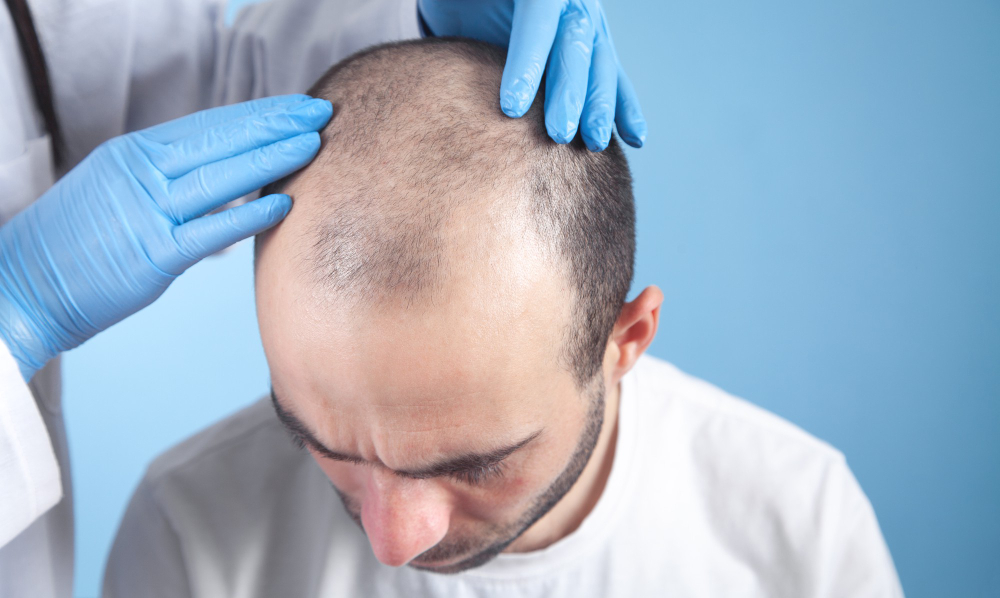
When a patient asks about PRP versus Regenera Activa, the real question is usually not which one sounds newer or stronger. It is which treatment makes sense for your pattern of hair loss, your scalp condition, your tolerance for repeat sessions, and your long-term plan. That distinction matters, because both treatments can play a role in hair restoration, but they are not interchangeable.
PRP and Regenera Activa are both non-surgical options used to support thinning hair. They are often discussed together because each aims to stimulate weaker follicles rather than replace them. But they do that in different ways, on different timelines, and with different expectations.
PRP versus Regenera Activa: the core difference
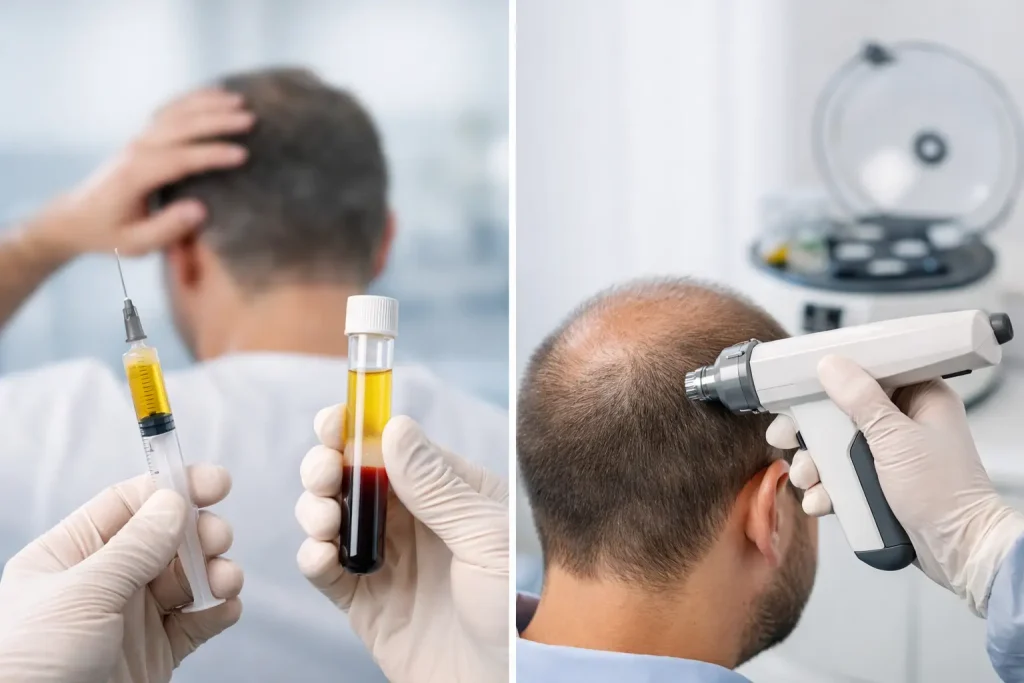
PRP stands for platelet-rich plasma. It uses your own blood, processed to concentrate platelets and growth factors, then injected into areas of thinning. The goal is to improve the environment around miniaturizing follicles and encourage stronger, healthier growth.
Regenera Activa is an autologous micrografting treatment. Instead of drawing blood, the physician takes a small sample of your own scalp tissue from a stronger donor area, usually in the back of the scalp. That tissue is mechanically processed into a suspension rich in progenitor cells, growth factors, and supportive tissue elements, then injected into areas affected by hair thinning.
So the simplest way to think about PRP versus Regenera Activa is this: PRP is blood-derived stimulation, while Regenera Activa is scalp tissue-derived stimulation. Both use your own biologic material. The source is what changes.
How PRP works in real patients
PRP is commonly used for early to moderate thinning, especially when follicles are still alive but underperforming. This can include androgenetic alopecia in men and women, diffuse thinning, and cases where shedding is part of a broader inflammatory or hormonal picture.
After a blood draw, the sample is spun down so the platelet-rich portion can be isolated. That concentrate is then injected throughout the scalp in targeted areas. Platelets release signaling molecules that may improve blood supply, reduce inflammatory stress, and support the follicle cycle.
PRP is rarely a one-and-done treatment. Most patients need an initial series followed by maintenance. That can be a drawback for someone who wants fewer appointments, but it can also be an advantage because treatment can be adjusted over time. If your hair loss changes, your physician can adapt the protocol, combine PRP with medications or hormone support, and monitor response more closely.
How Regenera Activa works
Regenera Activa is designed around the idea that healthy scalp tissue contains regenerative elements that may help compromised follicles function better. A small punch biopsy is taken from a donor zone where hair is genetically stronger. The sample is processed into injectable micrografts, then placed into thinning areas.
For the right patient, the appeal is obvious. It is typically performed as a single session rather than a short series, and many people like the idea of using scalp-derived regenerative material rather than blood-derived plasma.
That said, Regenera Activa is still not a cure for progressive hair loss. It may improve hair quality, slow miniaturization, and support density in selected patients, but it does not stop the biology of pattern loss on its own. In many cases, it works best as part of a broader strategy rather than as a standalone answer.
Who is a better candidate for PRP?
PRP tends to fit patients who are in the earlier stages of thinning and still have a meaningful number of miniaturized follicles to rescue. It can also be useful for patients who want a lower-barrier treatment without scalp tissue harvesting. If someone is uneasy about a biopsy-based procedure, PRP may feel more approachable.
It is also commonly used after hair transplant surgery to support healing and graft maturation, or alongside medical treatment for patients who need a layered plan. In a physician-led practice, PRP can be particularly valuable because the protocol can be customized based on scalp health, shedding pattern, and response over time.
Patients with inflammatory scalp issues, hormonal hair loss, or telogen shedding may still be considered, but this is where diagnosis matters. If the underlying cause is not identified, even a well-performed PRP treatment may disappoint.
Who may benefit more from Regenera Activa?
Regenera Activa may be more attractive to patients with early androgenetic hair loss who want a biologic treatment with fewer repeat visits upfront. It is often considered for men and women who still have thinning rather than fully bare areas, and who have a suitable donor zone from which the tissue sample can be taken.
It may also appeal to patients looking for an option between basic non-surgical treatments and more definitive surgical restoration. Some prefer it because it feels more concentrated and tissue-specific. Others choose it because they want to avoid the cadence of frequent PRP sessions.
But candidacy is narrower than marketing language sometimes suggests. If an area has been bald for a long time, if there is extensive follicle loss, or if scarring and underlying disease are present, the benefit may be limited. In those situations, transplant surgery, medical therapy, or a combined plan may be more realistic.
PRP versus Regenera Activa for results and timing
Both treatments ask for patience. Hair grows slowly, and biologic stimulation works on the hair cycle, not overnight. With PRP, patients often undergo an initial series and may notice gradual improvement in shedding, texture, and early density over several months. Maintenance is usually needed to preserve gains.
With Regenera Activa, the timeline is also gradual. Early changes may involve reduced shedding or improved hair caliber before visible density changes appear. Because it is often presented as a single-session treatment, some patients assume the response will be dramatic. Usually, the improvement is more modest and depends heavily on baseline follicle health.
Neither treatment can create density where follicles are no longer present. That is one of the most important realities in any honest discussion of PRP versus Regenera Activa. These therapies support living follicles. They do not replace absent ones.
Cost, maintenance, and practicality
PRP and Regenera Activa differ not only biologically, but also practically. PRP often starts with a lower entry cost per visit, but repeated sessions and maintenance can add up over time. Regenera Activa may involve a higher upfront investment, though usually with fewer treatments initially.
This does not make one better than the other. It depends on how you think about treatment. Some patients prefer spreading cost across multiple visits and adjusting as they go. Others would rather have a more concentrated initial treatment and reassess later.
Downtime is generally limited for both, though Regenera Activa includes tissue harvesting, so there is a small donor area to heal. PRP avoids that step, but it does require blood draw and multiple scalp injections.
Why diagnosis matters more than brand names
The biggest mistake patients make is comparing treatments before confirming the type of hair loss they actually have. Pattern hair loss, diffuse shedding, scarring alopecia, traction-related loss, hormonal shifts, nutritional issues, and post-surgical thinning do not all respond the same way.
That is why treatment planning should never begin with a package. It should begin with scalp analysis, medical history, family history, and a close look at whether the follicles are miniaturizing, inflamed, dormant, or gone. In a practice focused exclusively on hair restoration, that diagnostic step usually changes the recommendation.
Sometimes the right answer is PRP. Sometimes it is Regenera Activa. Sometimes it is medication, hormone balancing, laser therapy, or transplant surgery. And often, the best result comes from combining treatments in the right sequence rather than expecting one procedure to do everything.
A physician’s view on choosing between them
If your hair is thinning but you still have active follicles, either option may be worth discussing. PRP is flexible, familiar, and often easier to integrate into an ongoing medical plan. Regenera Activa may suit patients who want a tissue-based regenerative approach with fewer initial sessions.
What matters most is not choosing the trendier term. It is choosing the treatment that fits your stage of loss, your diagnosis, and your willingness to maintain results. A careful evaluation can save months of frustration and steer you toward a plan that is both realistic and effective.
Hair loss is personal, and so is the right solution. The best next step is not guessing which treatment wins on paper, but finding out what your scalp is actually asking for.