
Regenera Activa Review and Expected Results
A Regenera Activa review should begin with a question more useful than “Does it work?”: Is this treatment appropriate for the type, stage, and cause of your hair loss? For some patients with early thinning, it can be a practical physician-delivered addition to a broader plan. For others, especially those with advanced pattern loss or inactive follicles, expectations need to be much more measured.
Regenera Activa is often marketed as a regenerative solution, but no responsible hair restoration practice should present it as a replacement for a careful diagnosis, medical therapy, or surgical restoration when those options are indicated. The best results come from matching the treatment to the patient, not from treating every thinning scalp the same way.
What Is Regenera Activa?
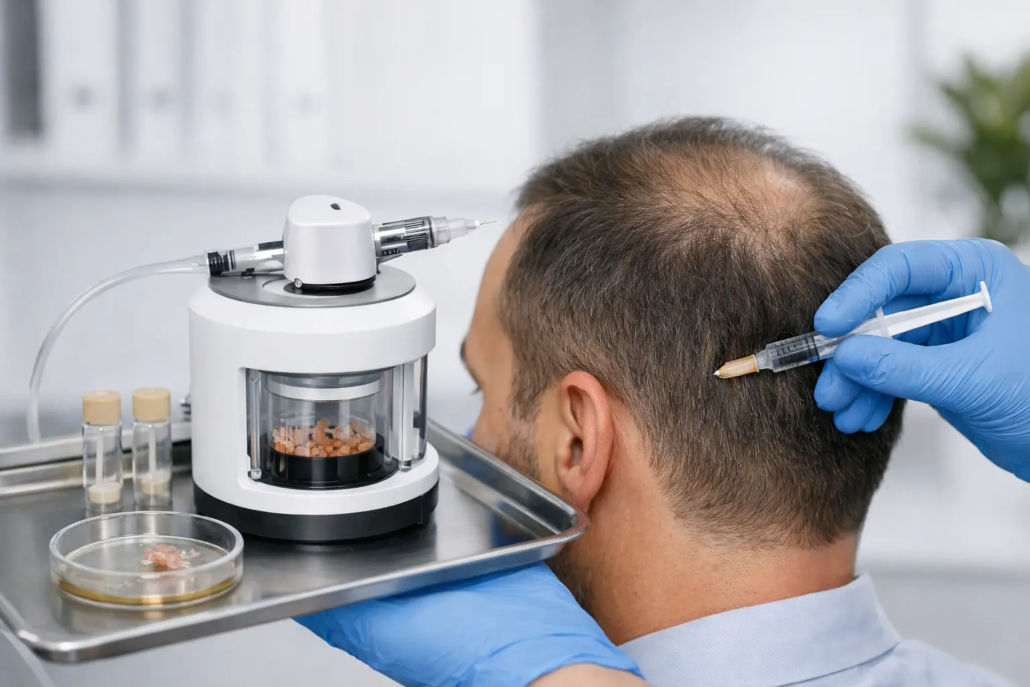
Regenera Activa is an autologous micrografting treatment, meaning it uses a small sample of your own tissue. During the procedure, a physician typically removes several small tissue samples from the scalp, commonly from an area where hair is more resistant to genetic thinning. The tissue is processed in a specialized device to create a suspension of micrografts, then placed into areas of concern through a series of scalp injections.
The goal is to introduce tissue components associated with the follicular environment into thinning areas. Depending on how it is described, you may hear references to progenitor cells, growth factors, extracellular matrix components, or signaling cells. These terms can sound definitive, but the practical point is simpler: the treatment aims to support compromised, still-living follicles rather than create entirely new follicles where none remain.
That distinction matters. Regenera Activa may help improve the quality, caliber, or retention of existing hair in selected candidates. It does not reliably restore a completely bare scalp, rebuild a severely recessed hairline on its own, or replace the density achievable with a well-planned hair transplant.
Regenera Activa Review: Where It May Fit
The most favorable candidates generally have early to moderate thinning and enough miniaturized hairs in the treatment zone to potentially respond. This may include men with diffuse thinning at the crown or midscalp, women experiencing reduced density through the part line, and patients who want to address progression before considering surgery.
It can also be considered for people who prefer an office-based treatment with minimal visible downtime. Because the tissue comes from the patient, there is no donor product from another person involved. Some patients view this as an appealing option when they want a biologically based adjunct to a medical hair-loss plan.
However, candidacy depends on more than the appearance of thinning. A clinician should assess the pattern of loss, scalp health, family history, medications, hormonal factors, nutritional concerns, and whether the hair loss is stable, active, or inflammatory. Sudden shedding, patchy loss, scalp pain, scaling, or significant itching may require medical evaluation before any cosmetic restoration treatment is considered.
Patients with advanced baldness should be especially cautious about marketing promises. If follicles have been absent for years, an injectable micrografting procedure is unlikely to generate the coverage needed for a meaningful cosmetic change. In that setting, medications to protect remaining hair, scalp micropigmentation for the appearance of density, or surgical restoration may be more realistic options, depending on the individual.
What Does the Procedure Feel Like?
Regenera Activa is typically performed in a medical office. Local anesthetic is used for the tissue collection area and may also be used in the areas receiving injections. The procedure itself is relatively short compared with a transplant procedure, although total appointment time varies based on the treatment plan and the physician’s protocol.
Patients can expect temporary tenderness in the donor area, mild swelling, pinpoint bleeding, or scalp sensitivity. Injection sites may be sore for a short period. Most people return to regular non-strenuous activities quickly, though they should follow their physician’s aftercare instructions regarding exercise, scalp washing, sun exposure, and medications that may increase bruising or bleeding.
A treatment with limited downtime is not the same as a treatment with no recovery considerations. Your physician should explain what is normal after treatment, what symptoms warrant a call to the office, and how the procedure fits around your work, travel, or social schedule.
Results: What Is Realistic?
Hair grows slowly, so evaluating Regenera Activa too early can be misleading. Any potential improvement is generally assessed over months, not days or weeks. Patients may notice reduced shedding first, followed by gradual changes in hair quality, thickness, or density if they respond.
Results vary considerably. The biological behavior of hair loss is influenced by genetics, hormones, age, the duration of thinning, overall health, and whether the patient continues with other recommended therapies. A patient with early androgenetic hair loss who combines treatment with a carefully selected maintenance plan may have a very different experience from someone treating extensive long-standing loss without addressing the factors driving it.
Clinical evidence for regenerative hair treatments continues to develop, but it is not a guarantee of regrowth. Studies vary in design, patient selection, processing methods, treatment intervals, and outcome measurements. This is why before-and-after photographs should be interpreted thoughtfully. Consistent lighting, hair length, styling, baseline severity, and the use of additional therapies all affect what a result looks like.
A credible consultation should include baseline photography and, when appropriate, scalp analysis so progress can be assessed objectively. “I think it looks better” is encouraging, but it is not the same as having a documented comparison over time.
Is One Treatment Enough?
Some protocols use a single Regenera Activa session, while maintenance recommendations differ by provider and by a patient’s response. There is no universal schedule that fits every person. The need for follow-up depends on the underlying diagnosis, the rate of ongoing loss, and whether the treatment is being used alone or alongside medications, laser therapy, platelet-based injectables, hormone optimization, or other approaches.
This is also where a comprehensive clinic has an advantage. A patient should not be pushed into repeated sessions simply because that is the only service offered. If the hair loss is progressing despite treatment, the plan should be reassessed. The right next step may be a different non-surgical therapy, a change in medical management, or a discussion about future transplant candidacy.
Risks and Questions to Ask
Because Regenera Activa uses your own tissue, concerns related to foreign donor material are reduced. Still, it is a medical procedure and has potential risks. These can include discomfort, swelling, bruising, bleeding, infection, temporary numbness, and an unsatisfactory response. Individual medical history, blood-thinning medications, scalp conditions, and healing tendencies should be reviewed beforehand.
Ask who will perform the tissue harvest, processing, and injections. In hair restoration, physician involvement and technical consistency matter. You should also ask what diagnosis is being treated, what outcome is realistic for your current level of loss, how results will be measured, and what the alternative options are if you are not an ideal candidate.
Be cautious if a provider promises guaranteed density, describes the treatment as a cure for baldness, or avoids a discussion of medications and surgery when those options may be relevant. A treatment plan should make room for your goals, budget, tolerance for maintenance, and desire for discretion without overstating what any one procedure can deliver.
A More Useful Way to Decide
At Hair For Life Medical, the question is not whether Regenera Activa is “better” than every other hair-loss treatment. It is whether it has a rational place in your individualized plan. A detailed evaluation can identify whether you are trying to preserve weakening hair, improve the appearance of diffuse thinning, stabilize loss before transplantation, or address a medical contributor that has not yet been recognized.
For the right patient, Regenera Activa can be a worthwhile supportive treatment with a relatively straightforward recovery. For the wrong patient, it can become an expensive detour from a more effective solution. The most valuable consultation is one that gives you permission to choose carefully, with a clear understanding of both the possibilities and the limits.