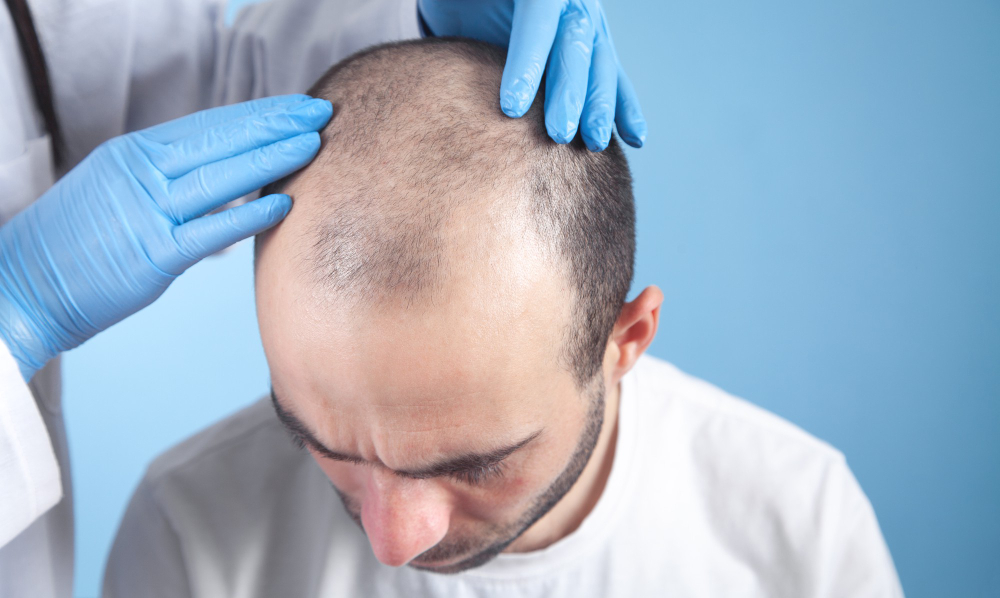

Temple recession can change the entire balance of a face, even when the rest of the hairline still appears relatively full. For patients researching the best ways to restore temples, the right answer is rarely a single treatment. A natural result depends on why the temples have receded, whether loss is still progressing, the quality of the donor area, and how the restored hairline will look not only now, but years from now.
The temples are among the most technically demanding areas of hair restoration. They frame the forehead, connect the frontal hairline to the sides of the scalp, and often contain finer, softer hairs than the central hairline. Restoring them requires careful diagnosis, conservative planning, and a physician who understands how to create density without making the hairline look artificial.
Why Temple Hair Loss Requires a Different Plan
Some degree of temporal recession is normal, particularly in men as the hairline matures. A mature hairline usually sits slightly higher and has gentle recession at the corners. It is not automatically a sign that someone needs a transplant.
However, more pronounced recession can be part of androgenetic hair loss, also called pattern hair loss. In women, temple thinning may also be associated with hormonal shifts, traction, inflammatory scalp conditions, nutritional deficiencies, autoimmune causes, or diffuse thinning. The treatment plan should address the diagnosis rather than simply placing grafts where hair is missing.
This is why a hairline that looks good in a photo is not necessarily the right hairline for every patient. Lowering an already receding hairline too aggressively may use valuable donor hair and create a result that becomes difficult to maintain if future hair loss continues. The most successful temple restoration respects age, facial proportions, current density, and the patient’s likely long-term pattern of loss.
Best Ways to Restore Temples Based on Your Hair Loss Pattern
Stabilize Active Hair Loss Before Surgery When Possible
If temple recession is actively progressing, medical treatment may be the first step. Medications and hormone-focused therapies can help appropriate patients slow miniaturization and preserve the native hairs surrounding the temples. This matters because transplanted hair may remain while unprotected native hair behind it continues to thin, leaving an unnatural gap over time.
A physician-guided evaluation can determine whether prescription medication, topical treatment, hormone assessment, or another approach is appropriate. Not every patient is a candidate for every medication, and side effects, medical history, pregnancy considerations, and personal preferences should guide the decision.
For some patients, stabilizing loss improves temple coverage enough that surgery can be delayed or avoided. For others, it creates a stronger foundation for a future transplant.
Consider Regenerative and Non-Surgical Support for Early Thinning
When temple hairs are finer but still present, regenerative treatments may be useful as part of a broader plan. Options such as Regenera Activa AMT, TricoPat, laser therapy, injectables, and carefully selected scalp therapies may support weakened follicles in appropriate candidates.
These treatments do not create new follicles in a completely bare temple. Their role is different: they may help preserve, strengthen, or improve the appearance of existing miniaturized hairs. Results vary based on the cause and stage of hair loss, so honest expectations are essential.
Scalp analysis and diagnostic testing can be particularly valuable when the pattern is unclear. A patient with rapid shedding, scalp inflammation, diffuse thinning, or hormonal symptoms may need a different plan than someone with stable, long-standing recession at the corners.
Use FUE or FUT for Permanent Temple Hair Restoration
For established temple loss with an adequate donor supply, a hair transplant can provide the most visible and lasting improvement. Follicular unit extraction, or FUE, removes individual follicular units from the donor area. Follicular unit transplantation, or FUT strip surgery, removes a narrow strip of donor-bearing scalp and then separates it into grafts.
Neither method is universally better. FUE may appeal to patients who prefer individual extraction, need a smaller procedure, or want discreet options such as no-shave FUE or long-hair FUE. FUT can be an excellent option for patients who need a larger number of grafts or want to preserve donor resources in certain situations. The right technique depends on scalp characteristics, hair caliber, donor density, hairstyle preferences, previous procedures, and long-term goals.
Temple restoration often requires fewer grafts than a large frontal reconstruction, but it demands precision. The work is not simply about filling an empty triangle. It involves choosing the right graft types, angles, direction, and density transition.
Use Fine Grafts at the Leading Edge
A natural temple should not begin with rows of thick, multi-hair grafts. The leading edge typically needs carefully selected single-hair follicular units, placed with irregularity and softness. Slight variation is what makes a hairline look human rather than engineered.
Behind that soft transition, strategically placed grafts can add density and connect the temple to the frontal hairline. Hair direction is especially important. Temple hairs generally grow flatter against the scalp and at different angles than central frontal hairs. If the angle is too upright or the direction is too uniform, even a dense transplant can look noticeable.
This is one reason temple work should be treated as artistic surgical planning, not a standard graft-count procedure.
Temple Points, Temporal Peaks, and Side Profile Balance
Patients often use the word “temples” to describe several different areas. The temporal recessions are the corners between the frontal hairline and the sides of the scalp. The temple points are the small, pointed areas lower on the sides of the forehead that help frame the face. Restoring one does not always mean restoring the other.
Rebuilding temple points can create a stronger frame for the face, especially when frontal recession has made the forehead appear wider. But this must be approached conservatively. A very low or sharply defined temple point may look appropriate on a teenager yet appear out of place as a patient ages.
Your side profile matters as much as your front-facing appearance. A physician should evaluate the relationship among the forehead, brow, sideburn region, facial shape, and existing hairline. The goal is not to recreate someone else’s hairline. It is to create a version that looks believable on you.
When a Hair Transplant May Not Be the First Choice
A transplant may need to wait if hair loss is rapidly changing, the donor area is limited, or the cause of loss has not been identified. Patients with diffuse unpatterned thinning, certain scarring conditions, or untreated inflammatory scalp disease need careful medical evaluation before surgical planning.
Corrective cases also require special attention. A previous transplant with pluggy grafts, poor angles, visible scarring, or an overly low hairline may be improved through graft redistribution, scar revision, removal of select grafts, or strategic camouflage. These cases are often more complex than a first procedure because donor resources must be managed carefully.
Scalp micropigmentation can sometimes reduce the contrast between hair and scalp, particularly when paired with medical treatment or transplantation. It does not grow hair, but it can be a useful visual-density option for selected patients who want a non-surgical component in their plan.
Questions to Ask During a Temple Restoration Consultation
A meaningful consultation should be more than a discussion of price and graft numbers. Ask whether your hair loss appears stable, what may be causing it, and whether medical treatment should be part of the plan. You should also ask how the proposed hairline accounts for future loss and whether the donor area can support future needs.
It is reasonable to ask who will perform each step of the procedure, how grafts will be selected for the temple edge, and what the expected growth timeline looks like. Transplanted hair typically sheds after surgery before new growth begins. Early growth may appear around several months, while maturation and density development continue over the following year.
At Hair For Life Medical, treatment planning is built around physician-led diagnosis and options rather than pressure to choose one procedure. Some patients benefit from surgery, some from non-surgical treatment, and many from a combination designed to protect both present and future results.
A well-restored temple should not announce itself. It should quietly restore proportion, soften the transition between the forehead and scalp, and give you the confidence of a hairline that looks like it has always belonged to you.