A bad hair transplant usually does not stay private. It can show up in bright light, in wet hair, across a sharp hairline, or in the frustration of styling around visible scarring. Corrective hair transplant surgery is designed for exactly this situation – when prior work looks unnatural, healed poorly, or simply did not deliver the density or design you were promised.
This is one of the most demanding areas in hair restoration. Unlike a first procedure, correction starts with limitations. The donor area may already be depleted. Scar tissue may affect blood supply. Old grafts may sit at the wrong angle, in the wrong zone, or in numbers that make a natural result harder to achieve. Good corrective work is not about adding more hair wherever there is space. It is about diagnosis, restraint, and a plan that respects what is still possible.
When corrective hair transplant surgery makes sense
Not every patient with transplant regret needs another surgery. In some cases, the issue is shock loss that has not fully recovered, a hairline that feels too aggressive for age, or progressive thinning behind previously transplanted grafts. Those situations may call for medical treatment, scalp micropigmentation, or simply a better long-term plan.
Corrective hair transplant surgery becomes more relevant when there is a clear structural problem. That may include pluggy grafts from older techniques, a hairline that looks too straight or too low, poor angulation that makes hair stick out unnaturally, patchy growth, obvious donor scars, or visible overharvesting from FUE. Some patients also seek correction after receiving grafts that were placed without enough attention to facial proportions, ethnic hair characteristics, curl pattern, or crown anatomy.
The key question is not just what looks wrong. It is what can be improved safely. An experienced surgeon will evaluate donor reserves, scalp laxity if FUT is being considered, scar quality, hair caliber, contrast between hair and skin, and the pattern of ongoing loss. That full picture matters more than any single complaint.
Why repair is harder than a first transplant
A corrective case often requires the surgeon to solve several problems at once. One area may need graft removal or redistribution. Another may need scar revision or softening. The surrounding native hair may still be thinning, which means the design has to work both now and years from now.
Scar tissue changes the equation. It can reduce circulation, make recipient site creation less predictable, and limit how densely grafts should be placed in one session. Donor management is also more complex because many repair patients have already used part of their safest donor supply. If prior harvesting was aggressive, preserving what remains becomes just as important as rebuilding the front.
This is why corrective surgery should never be rushed. The best result is often staged. You may need one procedure to remove or reposition poorly placed grafts and a later session to refine density and softness. For some patients, combining surgery with non-surgical support gives a more realistic and more stable outcome.
Common problems corrective surgery can address
An unnatural hairline is one of the most common reasons patients seek repair. The problem may be a hard edge, oversized grafts at the front, incorrect irregularity, or a design that does not fit the patient’s age, facial structure, or gender goals. In these cases, correction may involve softening the leading edge with finer single-hair grafts, reducing density in the wrong places, or revising the shape entirely.
Poor growth is another concern, but it requires honest evaluation. Sometimes the original grafts never survived well because of poor handling, poor site creation, dehydration, or inadequate post-op support. Sometimes the transplanted grafts grew, but native hair around them continued to miniaturize, creating a thin result that looks like failure. Those are different problems and they should not be treated as if they are the same.
Donor scarring can also be improved, although not erased. A widened FUT scar may be revised surgically if scalp conditions allow. FUE white-dot scarring or overharvested zones may benefit from strategic redistribution, body hair transplant in selected cases, or scalp micropigmentation. Real improvement is possible, but the plan has to be honest about limits.
What the evaluation should include
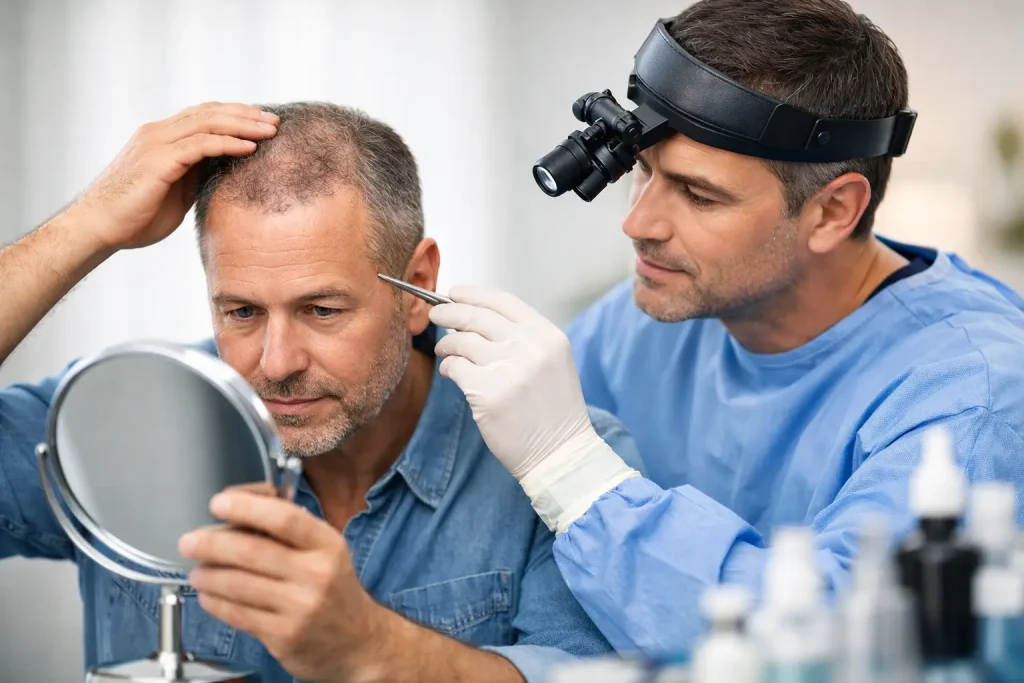
A proper corrective consultation is more than looking at before-and-after photos. It should begin with a detailed review of your surgical history, including the method used, the number of grafts claimed, any complications, and the timeline of your hair loss since surgery. If you do not know exactly what was done, that uncertainty itself matters.
Your surgeon should examine both recipient and donor zones closely. The direction, angle, and caliber of existing grafts are important. So are scar texture, scalp mobility, donor density, and the presence of miniaturizing native hair. In some patients, medical causes of ongoing loss also need attention, especially if hormonal shifts, inflammation, or diffuse thinning are part of the picture.
At Hair For Life Medical, this kind of diagnostic approach matters because corrective surgery should not be sold as a one-size-fits-all fix. Some patients need revision surgery. Some need treatment first to stabilize loss. Some need a staged plan that combines both.
Corrective hair transplant surgery options
The right technique depends on what went wrong and what resources remain. FUE is often useful in corrective cases because it allows selective harvesting and detailed placement. It can also be used to extract poorly positioned grafts for relocation in certain situations. FUT may still have value, especially when additional grafts are needed and the scalp is a good candidate, but prior scarring and laxity have to be assessed carefully.
If the front hairline is harsh, the surgeon may place finer single-hair grafts ahead of older work to create a softer transition. If older plug grafts are too obvious, some may be partially or fully removed, then the area can be rebuilt in a more natural pattern. If the crown was designed poorly, correction may involve restraint rather than chasing density in a high-demand area that could consume too many grafts.
For patients with depleted scalp donor supply, body hair may be considered in select cases. It is not a universal replacement for scalp hair, and matching characteristics matter. Used thoughtfully, it can sometimes support scar camouflage or add coverage where traditional donor options are limited.
Setting realistic expectations
Corrective surgery can be life-changing, but it is still surgery, not magic. The goal is improvement, often substantial improvement, not a reset button that restores unlimited donor hair or completely erases evidence of prior work.
Patients usually do best when they understand three things early. First, naturalness matters more than raw graft counts. Second, donor preservation is a long-term priority. Third, the final plan may involve more than one method. A combination of surgical refinement, medical therapy, and camouflage techniques often produces the most convincing result.
This is also where physician judgment matters. A responsible surgeon will tell you when a lower hairline is a bad idea, when density should be built conservatively, or when scar tissue changes what is advisable in a single session. Saying no to the wrong plan is part of good corrective care.
Choosing the right surgeon for repair work
Corrective cases require technical skill, but also maturity and patience. You want a surgeon who understands hairline design, graft angulation, donor conservation, scar management, and the behavior of hair loss over time. You also want someone comfortable giving a nuanced answer instead of promising a dramatic turnaround after a quick look.
Ask how the surgeon approaches old graft removal, scar revision, overharvested donors, and limited donor supply. Ask who performs the critical parts of the surgery. Ask what trade-offs exist in your case. A serious corrective consultation should leave you better informed, not pressured.
Many patients seeking repair have already had one disappointing experience. That history deserves respect. The right clinic will meet that concern with transparency, careful planning, and a treatment path shaped around your anatomy, not a sales script.
If your previous transplant left you self-conscious, you are not stuck with it forever. Corrective hair transplant surgery can often restore a more natural appearance and, just as importantly, restore trust in the process when the plan is thoughtful, honest, and built around what your hair can still do.