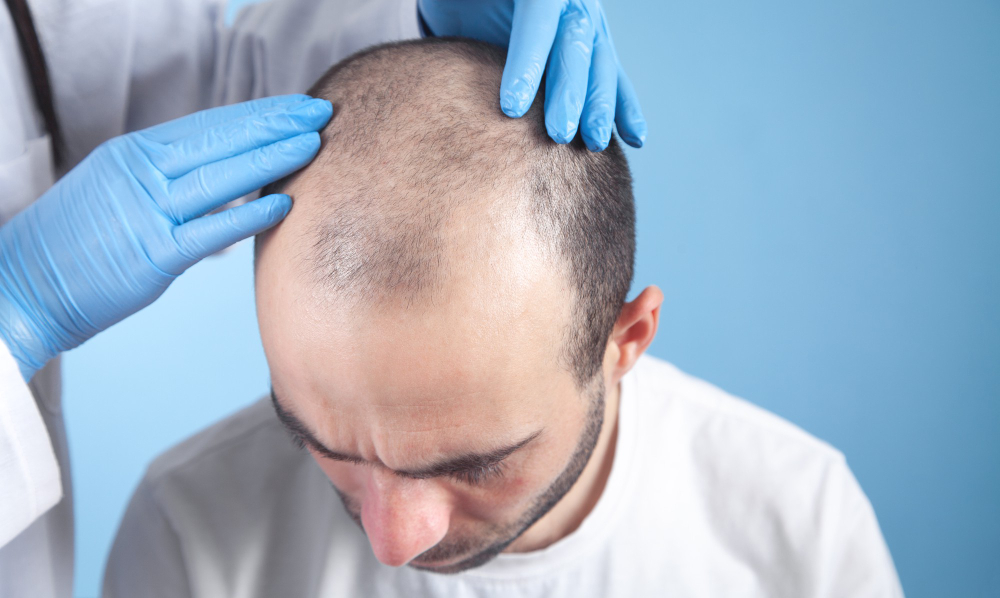
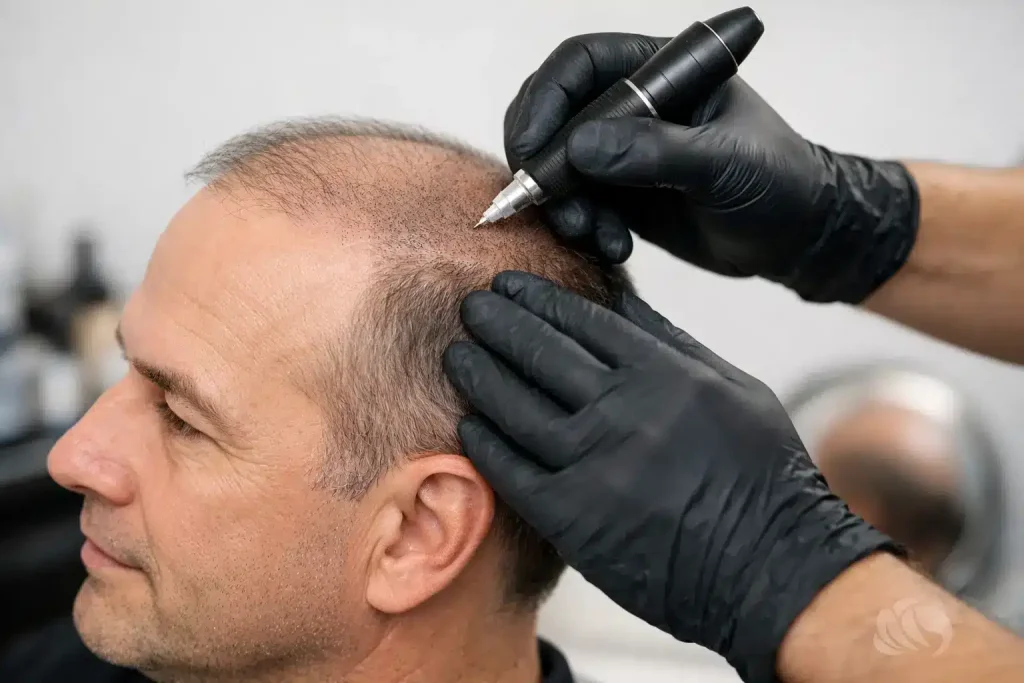
When thinning becomes visible under bright office lighting, camera flashes, or a part line that seems to widen overnight, most people are not looking for hype. They want honest answers. Scalp micropigmentation for thinning hair is one of the most effective cosmetic options for reducing contrast between the scalp and existing hair, which can make hair look fuller without surgery. The key is understanding what it can do well, where it has limits, and why proper planning matters.
What scalp micropigmentation for thinning hair actually does
Scalp micropigmentation, often called SMP, is a medical cosmetic procedure that places tiny pigment impressions into the scalp to replicate the appearance of hair stubble or to reduce show-through in thinning areas. For patients with diffuse thinning, the goal is usually not to create the look of a shaved head. It is to soften the visibility of the scalp so the remaining hair appears denser.
That distinction matters. SMP does not grow hair. It does not stop hormonal hair loss. It does not replace a transplant when a patient needs actual hair coverage and has enough donor supply to support surgical restoration. What it can do, very effectively in the right patient, is improve the visual impression of fullness.
This is why evaluation comes first. Thinning can result from androgenetic alopecia, hormonal shifts, inflammatory scalp conditions, stress-related shedding, prior surgery, or medical issues that need diagnosis. If the cause is still active and untreated, adding pigment without addressing the process may solve only part of the problem.
Who is a good candidate for SMP
The best candidates are usually men and women who still have hair but are bothered by visible scalp in specific zones, often along the frontal scalp, midscalp, crown, or part line. It can also be helpful for people who are not ready for surgery, are not ideal transplant candidates, want to improve the appearance of density after a transplant, or need camouflage in scarred areas.
SMP can be especially appealing to professionals who want a low-maintenance improvement that looks subtle in everyday settings. If you style your hair a certain way to hide thinning, avoid overhead lighting, or feel uncomfortable during video calls, SMP may offer a meaningful cosmetic change with less downtime than surgery.
Still, candidacy is not automatic. Hair color, skin tone, degree of thinning, scalp health, and long-term hair loss pattern all affect planning. Patients with unstable hair loss need a more careful strategy because the pattern visible today may not be the pattern visible two years from now.
Where SMP works best and where it needs caution
For thinning hair, SMP is strongest as a density treatment. It works by lowering the contrast between light scalp and darker hair. The result is often most convincing when there is still enough native hair to blend with the pigment.
It tends to work well in diffuse thinning across the top, thinning at the crown, widened parts in women, and as an adjunct after hair transplantation. It can also improve the appearance of donor or linear scars when designed thoughtfully.
Where caution is needed is in patients with very long hair expectations, rapidly progressive loss, or unrealistic goals. If someone has advanced thinning and expects SMP alone to look like a full head of hair at close range, that is not a fair expectation. Likewise, if the remaining hair is miniaturizing quickly, pigment placement must account for what the scalp may look like if more hair is lost later.
This is one reason physician-led hair restoration practices tend to approach SMP differently. The procedure is not just about placing dots. It is about forecasting the pattern of hair loss, evaluating the scalp medically, and deciding whether SMP should stand alone or be combined with treatments that address the cause.
How the procedure is planned
Good SMP starts with design, not pigment. The practitioner needs to study the thinning pattern, native hair density, existing hairline, scalp undertones, and how the patient wears their hair. In thinning cases, the objective is usually a soft, layered effect that sits behind and between existing follicles rather than a bold, uniform pattern.
Sessions are typically spaced out because the treatment is built gradually. This allows the provider to assess healing, pigment retention, and overall balance before adding more density. That gradual approach is often what keeps the result natural. Too much pigment too quickly can look flat or obvious, especially in patients with finer hair.
Pigment selection also matters. The wrong tone can heal too cool, too dark, or too artificial against the patient’s complexion and hair characteristics. Technique matters just as much. Impression size, depth, spacing, and distribution all influence whether SMP reads as believable density or as pigment sitting on the scalp.
SMP versus hair transplant for thinning hair
This is where many patients need the most clarity. SMP and transplantation are not competing versions of the same treatment. They solve different problems.
A hair transplant moves living follicles to areas of loss. Its advantage is real hair growth. That means texture, length, and actual coverage. Its limitations are donor supply, surgical candidacy, cost, recovery, and the reality that some patients need medical treatment to protect ongoing native hair.
SMP creates the illusion of greater fullness. Its advantage is that it is nonsurgical, fast to appreciate visually, and often useful even when donor hair is limited. Its limitation is that it cannot create true volume or replace hair strands.
For some patients, the best answer is not one or the other. It is both. A transplant can rebuild a hairline or add coverage, while SMP can reduce scalp show-through between grafts or in areas where transplant density alone may not deliver the desired cosmetic effect. When planned together, the result can look more complete than either treatment alone.
Can SMP be combined with medical treatment?
Often, yes, and this is where a comprehensive hair clinic adds real value. If thinning hair is ongoing, the smartest plan may include therapies designed to stabilize or slow progression while SMP improves appearance. Depending on the diagnosis, that might involve medications, hormone evaluation, regenerative treatments, or other physician-guided options.
This matters because a cosmetic improvement tends to hold up better when the underlying condition is being managed. A patient with active androgenetic loss may love their early SMP result, but if they continue to thin significantly without treatment, the pattern around the pigment can change. That does not mean SMP was a mistake. It means hair loss is dynamic, and treatment should account for that.
What results look like in real life
The best SMP results rarely announce themselves. People may simply think you look healthier, younger, more rested, or as though your hair appears thicker. That subtlety is often exactly what patients want.
Expect improvement, not perfection. Under normal conversational distance and everyday lighting, a well-executed treatment can make a meaningful difference. Under harsh lighting or very close inspection, the scalp is still skin, not growing hair. Setting expectations correctly is part of good care.
You should also expect maintenance over time. Pigment can fade gradually, and touch-ups may be needed depending on skin type, sun exposure, and the original treatment approach. This is normal and should be discussed before starting.
Questions worth asking before you move forward
If you are considering SMP, ask who performs the procedure, how your hair loss diagnosis is determined, whether the provider also evaluates transplant candidacy and medical options, and how long-term changes in hair loss are factored into the design. Those questions tell you whether the discussion is truly centered on your outcome or just on selling a procedure.
For many patients, the most reassuring setting is one where SMP is offered as part of a full hair restoration plan rather than as the only answer for every concern. Hair For Life Medical takes that broader approach because the visible symptom and the cause of hair loss are not always the same problem.
Is scalp micropigmentation for thinning hair worth it?
If your main frustration is visible scalp and your goal is to look fuller, more balanced, and less self-conscious without surgery, it may be one of the highest-value treatments available. If your goal is actual new hair growth, then SMP alone is probably not enough.
That is the real answer with thinning hair. It depends on what bothers you most, what your scalp is doing medically, and what kind of result fits your life. The right plan should respect all three.
A good consultation should leave you feeling informed, not pressured. When the treatment matches the pattern, the person, and the long-term strategy, confidence tends to follow naturally.
Reference
What Is Scalp Micropigmentation? What to Know